

Florida Car Accident Lawyer
A crash takes a normal week apart: the pain, the car you no longer have, the paychecks you are about to miss, and no idea who pays for any of it. We can take it from here. Call 954-522-5800 for a free consultation. You pay us nothing unless we win. We have won these claims for Floridians from the Keys to the Panhandle, and we work them from five offices between Fort Lauderdale and Fort Myers.
Whatever else you do, see a doctor within 14 days of the crash. Florida ties your own accident coverage to that one deadline under Fla. Stat. § 627.736, and it runs from the accident, not from when the pain started or from when you decided it was serious. Miss it and no part of it comes back.
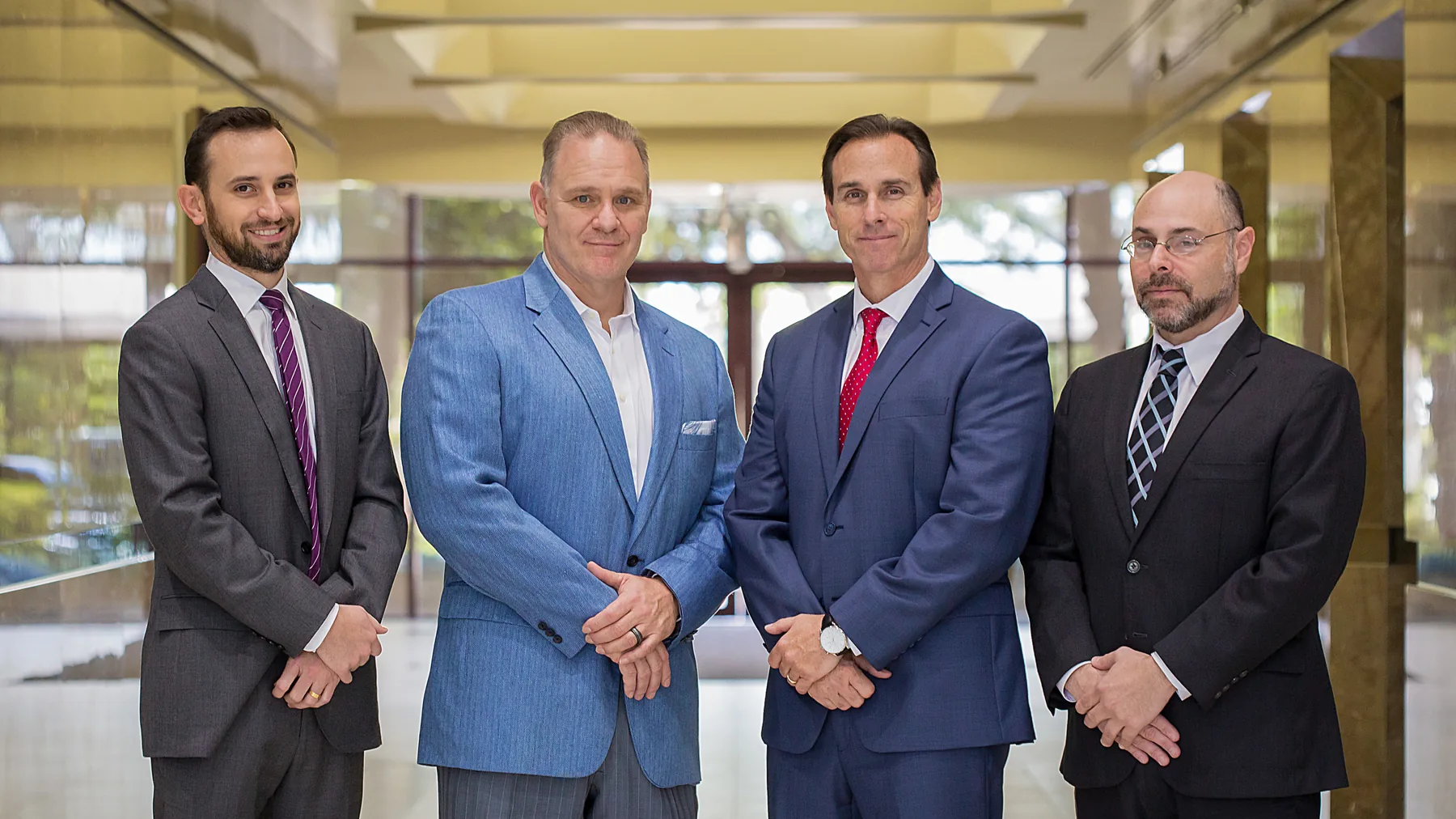
Winning car accident claims for Floridians for more than thirty years
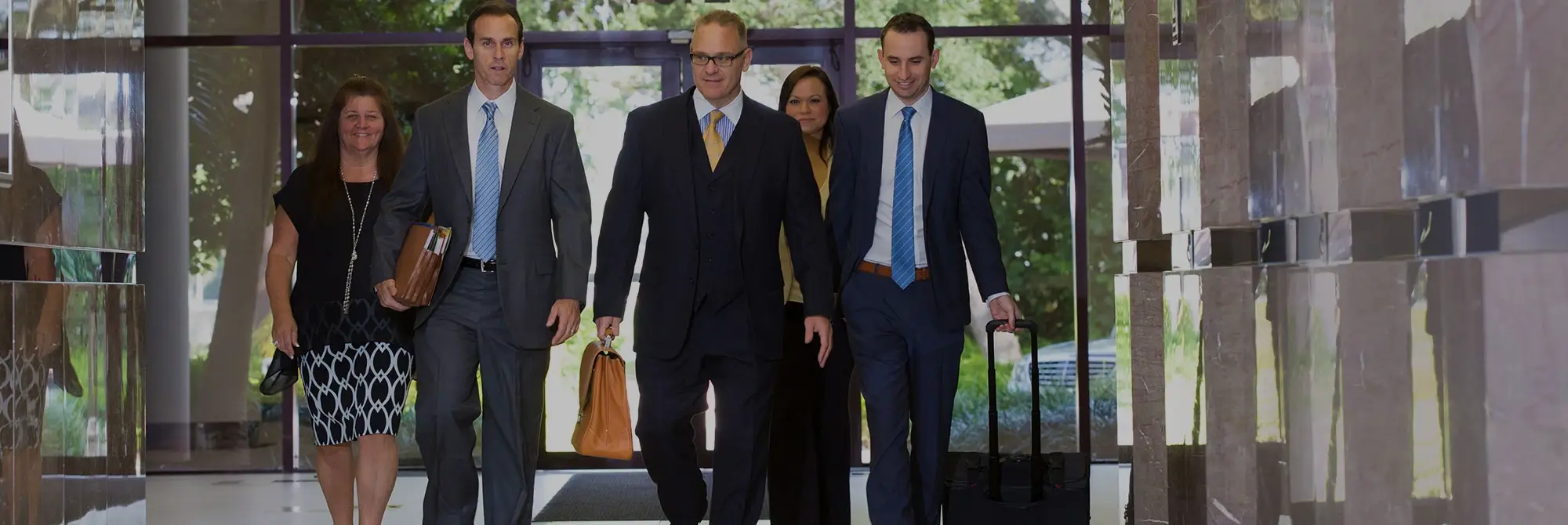
A car accident claim arrives at a hard time, usually while the bills are still coming in and nobody has told you what happens next. You do not have to work it out on your own. The attorneys in this photograph have won these cases across Florida since 1993, from the Keys to the Panhandle, and one of them will handle yours from the first call to the last check.
Call 954-522-5800 for a free consult and a trial lawyer will tell you today whether you have a case. You pay us nothing unless we win, and we work from five offices between Fort Lauderdale and Fort Myers.
Meet the attorneys →What Florida law does with a car accident claim
The other driver caused it, and their insurer is already asking you for a recorded statement. Meanwhile you are working out how to pay the first medical bill, how to replace the paycheck you just missed, and how to get to work tomorrow without a car. Answering all of that is our job, and it starts the day you call.
Below is the law a Florida car accident claim actually runs on: the deadline, who can be made to answer for it, the order a case moves in, how the number at the end gets built, and which policies pay. Our city pages cover what happens on the ground in each market. This is the part that is the same wherever in Florida you were hit.
Florida gives you two years to file most car accident claims from a crash on or after March 24, 2023. The claim runs against the driver who caused it, the owner of the car they were driving, and their employer if they were working at the time. Whatever share of the fault is yours comes off what you recover.
The deadline that ends a Florida car accident claim
One date ends the claim, and nothing brings it back. It is worth knowing which date yours is before anything else on this page matters.
Two years, from the day of the crash
Most claims from an accident on or after March 24, 2023 have to be filed within two years. An older accident keeps the four years that applied when it happened. The period sits in Fla. Stat. § 95.11, and it runs from the accident rather than from the day the pain got bad, the day the insurer stopped returning calls, or the day a doctor first said the word surgery. People lose good cases to this, and they lose them by weeks.
A claim filed one day late is over, whatever the medical records show. There is no discretion in it and no application to be made. If you are reading this and you are not sure when your crash was, that is the one fact worth establishing today.
Two years for a death, running from a different day
Where somebody died, the case is a wrongful death action and the two years under Fla. Stat. § 95.11 run from the date of death rather than from the date of the crash. Those are the same day often enough that people assume they always are. Where somebody survived a crash for months, the difference decides whether there is a case.
A government vehicle changes the whole timetable
A crash with a city truck, a county vehicle, a school bus or a state car is governed by Fla. Stat. § 768.28, and the ordinary rules stop applying. Written notice has to be presented to the agency itself and, in most cases, also to the Department of Financial Services, within three years of the claim accruing and within two where somebody died. Suit cannot be filed until the agency has had its time to respond, which is six months in an ordinary case.
The same section caps what a public body pays at $200,000 to any one person and $300,000 for any one incident, whatever the injury is worth. Anything above that requires an act of the Legislature. It is the reason a claim against a government defendant is a different case from the day it starts, and the reason the notice goes out early rather than when the file is ready.
When the clock stops, which is rarer than people hope
Fla. Stat. § 95.051 lists what pauses a limitations period, and a driver leaving the state, hiding, or using a name nobody can serve are on it. A child's own claim is treated separately, but the pause is narrower than most people assume: it applies where there is no parent or guardian able to bring the case, and even then the section sets an outer limit of seven years from the event.
None of it is something to rely on. Every one of these is an argument to be made later, in front of a judge, against a defendant with every reason to say it does not apply. The deadline is the deadline, and the exceptions are a rescue rather than a plan.
The evidence runs out long before the deadline does
Two years is the legal clock. The practical one is shorter and nobody announces it. Camera footage from the gas station on the corner is overwritten in days. The car is repaired or sold for salvage, and the module inside it that recorded speed, braking and belt use goes with it. Witnesses who gave a name at the scene move.
That gap is why the first weeks matter more than the last eighteen months. A preservation letter has to reach the right company before its own schedule deletes the thing you needed, and a letter sent after the fact reaches an empty drive.
Who can be held answerable
Most people assume a car accident claim is against one driver. It frequently is not, and the difference between one defendant and three is usually the difference between a claim worth the policy limit and a claim worth what the injury actually cost.
- The driver who caused it. The starting point, and on a small case the end of it. What limits this claim is almost never whether the driver was at fault. It is how much coverage they bought, which is why the parties below matter so much.
- The owner of the car, even if they were at home. Florida treats a motor vehicle as a dangerous instrumentality, which means the owner is answerable for the way somebody they lent it to drove it. A parent who let a son take the car, a friend, a small company whose van an employee had for the weekend: each is a separate party with, frequently, a separate policy.
- The employer, where the driver was working. A driver on the clock puts their employer in the claim, and a company policy is normally far larger than a personal one. It is worth establishing early what the driver was doing, because a delivery, a service call or a trip between job sites is work, and the driver rarely volunteers it.
- A business that served the alcohol, in two narrow situations. Florida does not hold a bar answerable for serving an adult who then drove. Fla. Stat. § 768.125 allows a claim in two cases only: where the drink was sold or furnished to somebody under 21, and where a business knowingly served a person habitually addicted to alcohol. Both are provable, both need the receipts and the staff, and both need somebody asking within days.
- The public body that built or maintained the road. A missing sign, a dead signal, a blind turn nobody trimmed back, a design that puts turning traffic in the path of through traffic. These are claims under Fla. Stat. § 768.28, with the notice requirements and the caps described above, and they need the maintenance and complaint records before those records age out.
- The maker of the car, or of one part of it. Where a belt let go, an airbag fired late or not at all, a seat collapsed or a roof crushed, the injury may be worse than the crash should have caused. That is a separate claim against a manufacturer, it is proved from the vehicle itself, and it dies the day the vehicle is scrapped.
- A rideshare or delivery company. A driver logged into an app carries commercial coverage that changes with what they were doing at that moment. The rules are their own subject, and they are on our Florida rideshare accident page.
How a Florida car accident case actually runs
A case has an order to it, and knowing the order is most of what stops the wait feeling like nothing is happening. Very little of this is visible from the outside, which is why it is written out here.
- Preservation goes out before anything else. Letters to the businesses with cameras, to whoever holds the vehicle, to the employer if a company truck was involved. Each one puts a company on notice that it may not destroy something, and each has to arrive before that company’s own deletion schedule does.
- Treatment runs its course, and the file waits for it. A claim cannot be valued until the doctors can say what is permanent and what is not. Settling before that point means guessing, and the guess is always low, because the surgery that follows a course of injections is the expensive part and it has not happened yet.
- Every policy gets found. Under Fla. Stat. § 627.4137 an insurer has to disclose the limits of each known liability policy within 30 days of a written request, in a sworn statement, along with a copy of the policy itself. It is a short letter and it decides the size of the case, so it goes early rather than at the end.
- The demand goes in, with the whole case attached. Records, bills, the wage loss, the physicians’ opinions on what is still ahead, and the argument on fault. A demand with a number and no proof gets an answer with a number and no proof. Most claims resolve at this stage, and how well they resolve is decided by how completely this is done.
- Suit is filed in the right county. Fla. Stat. § 47.011 allows the case in the county where the defendant lives or where the accident happened, and the choice matters. Filing starts a clock that a claims file does not have, which is frequently the point: an insurer with no deadline can take a year to say no.
- Discovery, which is the long part. Written questions, documents, depositions of the drivers and the witnesses, and physicians on both sides. The defense will ask for a medical examination by a doctor it chooses and paid for. This stage runs months, and it is where a case is actually won.
- Mediation, which most Florida courts require. A day in a conference room with a neutral mediator, both sides and the adjuster with authority to pay. A high share of cases settle here, in front of somebody who has just heard, for the first time, exactly what the trial would look like.
- A formal offer, which changes what a refusal costs. Fla. Stat. § 768.79 lets either side serve a formal offer. Where a defendant refuses one and the judgment ends up at least 25 percent more than the amount offered, the defendant can be made to pay attorney fees from the date of the offer. It is one of the few things that puts real pressure on a carrier that has decided to wait you out.
- Trial. Few cases reach it, and the ones that settle well settle because the other side believed this one would. A firm that does not try cases is a firm every adjuster in the state has already priced.
What the claim is worth, and how that number is built
Nobody can put a number on a case at the first phone call, and any lawyer who does is selling. What can be explained on day one is how the number gets built, and what comes off it before anybody is paid.
The medical care, both halves of it
Everything already billed, and separately what the treating physicians say is still ahead. The second half is usually the larger one and it is the half an early offer leaves out, because a spinal injury treated with injections for a year is cheap until the year it is not.
The income, and then the capacity to earn it
Wages already missed are an arithmetic problem. What somebody can no longer earn is a different claim and a much bigger one, and it is proved with an economist and the treating physicians rather than asserted. A roofer with a fused ankle and a bookkeeper with the same ankle have very different cases.
Pain, suffering, and what you no longer do
The head of loss with no invoice attached, which is exactly why an early offer prices it lowest. It is proved from the ordinary detail of a life: what somebody did before, what they cannot do now, and who has had to take it on instead.
Your share of the fault comes off the top
Florida divides fault rather than treating it as all or nothing. Under Fla. Stat. § 768.81 an award is reduced by whatever percentage of the blame is yours, so a case worth $100,000 with 20 percent on you pays $80,000.
The same section carries a hard edge that arrived in March 2023: a person found more than 50 percent at fault for their own harm recovers nothing at all. That single rule is why the fight over fault is frequently the whole case, and why a recorded statement given early, on painkillers, to the other side’s adjuster, is worth so much to them.
What gets repaid out of the recovery
Health insurance, Medicare and Medicaid pay medical bills and then get repaid from the settlement. Fla. Stat. § 768.76 keeps those payments from being deducted from the award, because the right to be repaid already exists, which means the money is advanced rather than given.
Those repayment claims are negotiable and they are routinely reduced. How hard somebody works at that is invisible in the headline number and is a real part of what a client actually takes home.
Punitive damages, which are separate and rare
Fla. Stat. § 768.72 does not allow punitive damages to be pleaded at all until a court has seen evidence supporting them, and they require intentional misconduct or gross negligence shown by clear and convincing evidence. A drunk driver case can reach it. An ordinary rear-end collision does not, and a lawyer promising otherwise at a first meeting is describing a different case from the one you have.
What changes from one part of Florida to another
The statutes are the same in Pensacola and in Key West. Almost nothing else is, and on a car accident claim the differences show up in three specific places.
Where the case gets filed, when you were hit far from home
Florida moves an enormous number of people around itself. Somebody from Fort Lauderdale gets hit on I-4 outside Orlando; a family from Naples is rear-ended on the Turnpike. Fla. Stat. § 47.011 puts the case in the county where the crash happened or where the defendant lives, and neither of those is necessarily home.
That decides which court, which judge, which jury and how far anybody has to travel to a deposition. It is a real strategic choice where there is more than one option, and it is made at filing rather than revisited later.
Juries are not the same from one county to the next
The same facts, the same injury and the same medical bills produce meaningfully different verdicts in different parts of the state, and every experienced defense adjuster in Florida already knows the number for the county your case is in. Pretending otherwise costs clients money.
Out-of-state drivers, rental cars and visitors
A large share of Florida crashes involve somebody who does not live here: a rental car, a visitor on a policy written in another state, a snowbird insured somewhere else for half the year. Those cases turn on which state’s policy language applies and on finding a company that has no local office, and they take longer for reasons that have nothing to do with the injury.
A proven record, anywhere in Florida
Our five offices run from Fort Lauderdale to Fort Myers, and they are where we work from rather than the limit of where we act. We have litigated in courts across Florida, and a crash on the other side of the state is still our case: where it is filed is a decision made on the merits rather than on our convenience.
The insurance behind a Florida car accident claim
Which policies exist decides what a claim can actually collect, and the answer surprises most people. Florida requires less of drivers than almost any other state.
Your own policy pays the first bills, whoever caused the crash
Every car registered in Florida has to carry personal injury protection under Fla. Stat. § 627.733, and Fla. Stat. § 627.736 sets what it does: $10,000 in benefits, paying 80 percent of reasonable medical expenses and 60 percent of lost wages, regardless of who was at fault.
Two conditions cut it down. You have to be seen by a qualifying provider within 14 days of the crash or none of it is payable, and the full $10,000 is only available where a provider determines you had an emergency medical condition. Without that finding the benefit falls to $2,500, which does not cover an ambulance ride and a scan.
Florida does not require the other driver to insure your injuries
This is the part that catches people. A Florida driver has to carry the coverage above and $10,000 in property damage liability under Fla. Stat. § 324.022. Coverage for injuring somebody else is not required of an ordinary private car at all.
So a driver can be entirely at fault, badly hurt you, and be fully legal with nothing that pays you a dollar for the injury. Whether there is a claim worth bringing frequently comes down to what that driver happened to buy, or to the coverage below.
The coverage that answers all of that is your own
Uninsured and underinsured motorist coverage pays where the driver who hit you had nothing, or had far too little. Under Fla. Stat. § 627.727 an insurer has to offer it with every liability policy and can only leave it off if the customer signed a written rejection, and its limits have to match the bodily injury liability limits bought unless lower ones were chosen in writing.
It is the single most valuable coverage on a Florida policy and the one people decline to save a few dollars a month. Where more than one vehicle is insured, whether those limits stack is decided by a separate signed form, and it can double or triple what is available.
Finding every policy, rather than the obvious one
Fla. Stat. § 627.4137 forces disclosure of each known policy including excess and umbrella coverage, and the answer comes as a sworn statement rather than a phone call. An at-fault driver on a company errand, a vehicle owned by somebody else, a household policy covering a relative: each is a separate layer, and each is found by asking rather than by being told.
Medical payments coverage, which people forget they bought
An optional coverage on many Florida policies that pays medical bills outside the limits above, frequently the 20 percent share left over. It is worth reading the declarations page rather than assuming, because it is money already paid for and it is routinely left unclaimed.
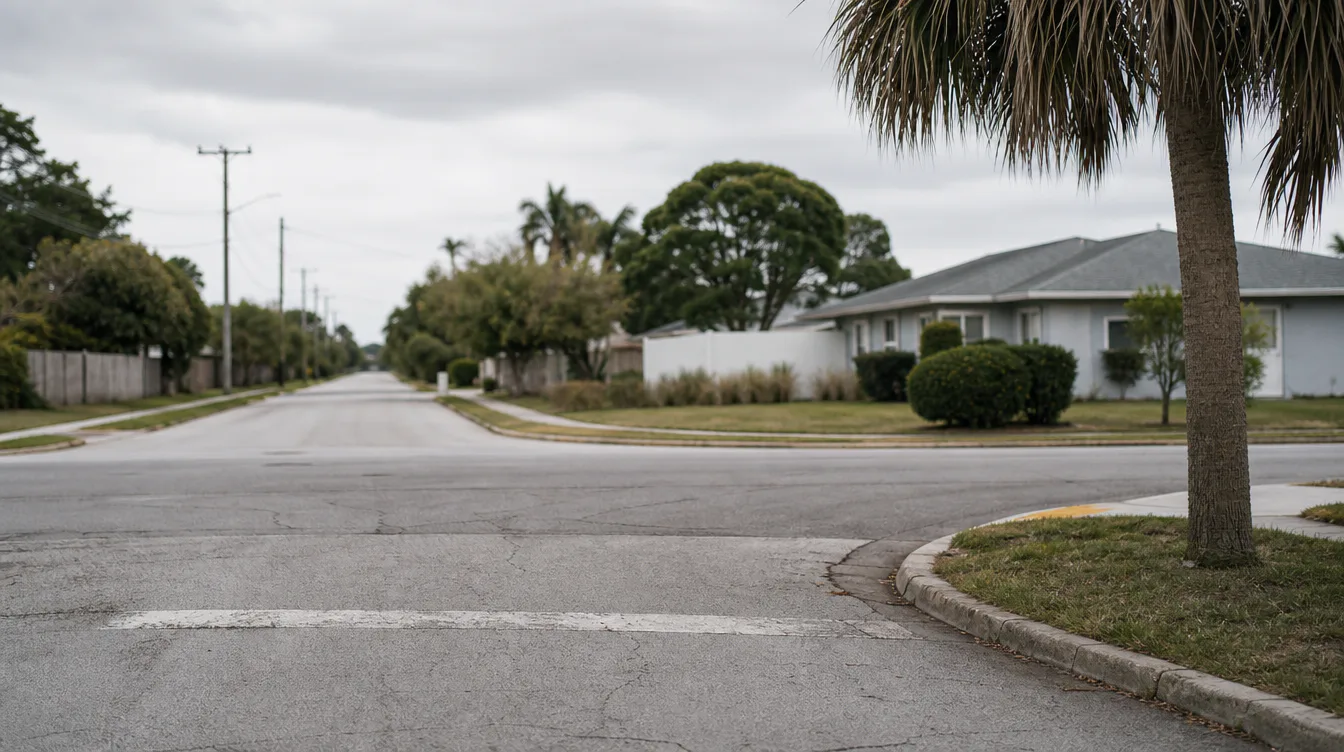
How we run a Florida car accident claim
What happens in the first two weeks
The insurer for the driver who hit you will make contact quickly and will sound helpful. What it wants is a recorded statement, taken while you are medicated and before anyone knows how bad the injury is, and it is the cheapest evidence that insurer will ever get. You are required to cooperate with your own insurer. You are not required to give theirs anything, and we take that conversation off you from the day you call.
At the same time we go after the things that disappear. Camera footage from the business on the corner, the vehicle itself before it is repaired, the event data recorder inside it that logged speed and braking in the seconds before impact. Those go on a schedule that has nothing to do with your case, and a preservation letter has to reach the right party before the schedule runs out.
When you can sue the driver who hit you
Nobody is off the hook because of how your first medical bills happen to be paid. Florida lets you bring a claim directly against the at-fault driver once your injury meets the statutory threshold: permanent injury within a reasonable degree of medical probability, significant and permanent scarring or disfigurement, significant and permanent loss of an important bodily function, or death.
That is where the real compensation is, because it is the only route to pain and suffering. Getting there depends on medical documentation built from the first week, not assembled a year later.
Being partly at fault no longer works the way it used to
Florida changed to modified comparative negligence on March 24, 2023. Under Fla. Stat. § 768.81, a person found more than 50 percent at fault recovers nothing at all. At 50 percent or less, recovery is reduced by your share.
This is why insurers now push so hard on fault in the first few weeks. Every percentage point they can move onto you is money off your claim, and past the halfway mark it wipes the claim out entirely. What you say in a recorded statement is the cheapest way for them to get those points.
What we go after
- The at-fault driver’s bodily injury liability coverage, which Florida does not require them to carry
- Your own uninsured and underinsured motorist coverage, which is often the largest policy in the case
- Intersection, business and doorbell camera footage, most of which is overwritten within weeks
- The other driver’s employer, where the crash happened during work
How your own coverage works, and why it runs out
Every Florida driver carries Personal Injury Protection. It pays 80 percent of reasonable medical expenses and 60 percent of lost wages, capped at $10,000 in total, and it pays no matter who caused the crash. One ambulance ride, one emergency room visit and one MRI can exhaust it before you have seen a specialist.
There is a second trap inside the statute. Unless a doctor determines you have an emergency medical condition, that benefit drops from $10,000 to $2,500. The determination has to be made and documented by a qualifying provider, and a walk-in clinic visit does not automatically produce one. We check whether it was done, because by the time it starts to matter the fourteen days are long gone.
If you were working when it happened
A crash on the clock puts two claims in play at once, and people routinely pursue one of them. Workers compensation covers a crash that happened in the course of your job, and it pays whether or not anybody was at fault. It also pays nothing at all for what the crash did to you beyond bills and part of your wages.
The driver who hit you is outside that system entirely. The ordinary claim against them still exists and still covers pain, suffering and the earnings comp does not replace. The comp carrier gets a share of that recovery back, and how big a share is argued rather than assumed. The mechanics are on our workers compensation page.
What we have recovered on these claims
Matters this firm handled in this area of law. Figures are gross recoveries, before attorney fees, costs and medical liens come out of them.
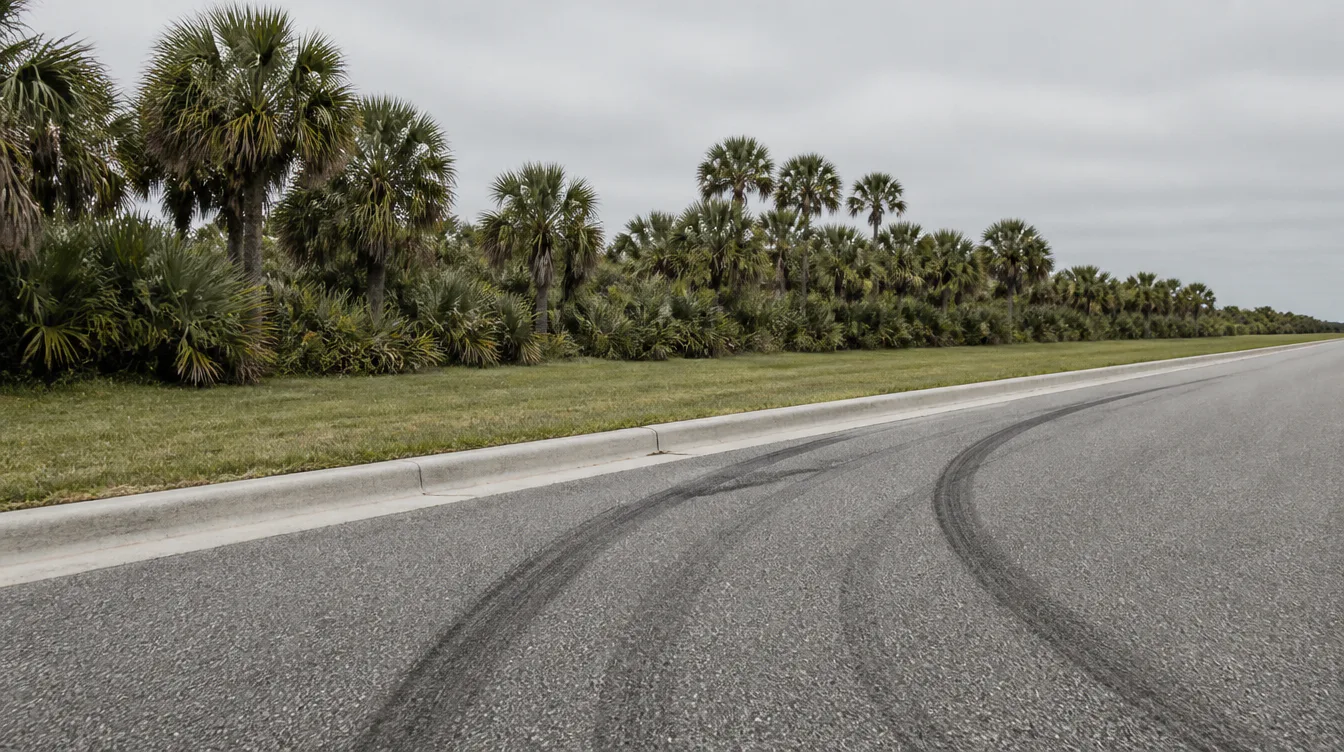
A client was seriously hurt making a U-turn in Fort Lauderdale, and the responding officers assigned fault for a right-of-way violation.
Broward County policy limits settlementEvery verdict and settlement we publish, with the press coverage for the ones that were reported. No result predicts another case: every claim turns on its own facts, its own evidence and the insurance actually available.
Who would handle your case
Your case is handled by one of the trial lawyers below, and you will know which of them has it from the first conversation. They do car accident work week in and week out, they will tell you what your case is worth and why, and they will be straight with you about the parts that are hard.
-
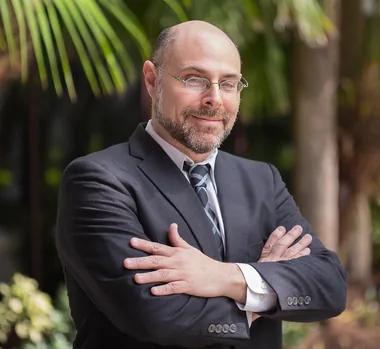 Brian H. Malamud Senior Trial Attorney More than twenty years on the Wolf & Pravato trial team. Brian Malamud has handled your kind of case many times over, and he knows early which parts of it are going to decide it. Full profile →
 -
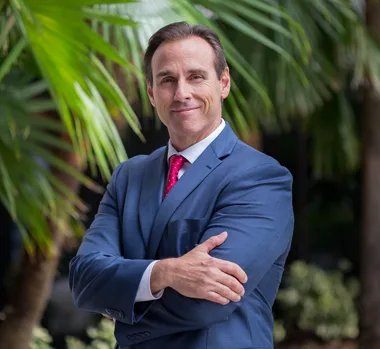 Richard P. Pravato Founding & Managing Attorney Board Certified in Civil Trial Law by The Florida Bar since 2004, and by the National Board of Trial Advocacy. Injury cases exclusively since 1996. Full profile →
 -
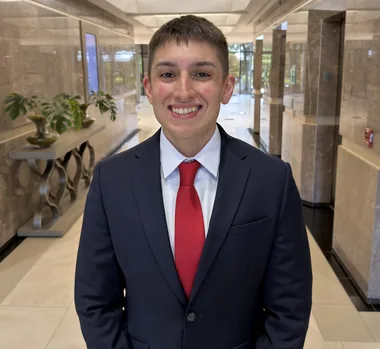 Alazay Ventura-Coffey Trial Attorney On his first day as a sworn attorney, Alazay Ventura-Coffey co-chaired a Broward County jury trial that returned $1,387,060.58. He has built every case that way since. Full profile →
Car Accident questions we are asked
Do I still have a case if Florida is a no-fault state?
Yes. No-fault decides who pays your first medical bills, not who is responsible for the crash. Once your injury meets the statutory threshold, which includes permanent injury, significant permanent scarring, significant and permanent loss of an important bodily function, or death, you can bring a claim directly against the at-fault driver for the full extent of your losses, including pain and suffering.
What if the driver who hit me had no insurance?
Florida does not require drivers to carry bodily injury liability coverage, so this happens constantly. The claim usually runs through your own uninsured or underinsured motorist coverage instead. Many people carry UM without knowing it. Send us your declarations page and we will read it for you at no charge.
The insurance adjuster wants a recorded statement. Should I give one?
Not before you speak to a lawyer. Adjusters are trained, you are injured and probably medicated, and the recording exists forever. Since March 2023 anyone more than 50 percent at fault recovers nothing in Florida, so a few sentences that sound cooperative can be worth more to them than anything else in the file.
How much is my Florida car accident case worth?
It depends on the injuries, the treatment, lost earnings, whether the injury is permanent, and how much coverage exists to pay it. Available coverage is often the real ceiling, not the severity of what happened to you. Any lawyer who quotes a number before reading your medical records and the policy limits is guessing.
How long do I have to file a car accident lawsuit in Florida?
For crashes on or after March 24, 2023, two years from the date of the accident under Fla. Stat. § 95.11. Earlier crashes generally keep the older four-year deadline, and claims involving a government vehicle carry their own shorter notice requirements. Evidence deadlines are far shorter than any of these.
Questions that apply to any Florida injury claim, fees, deadlines, recorded statements and shared fault, are answered on our injury claim FAQ. What we have recovered is on recent case results.
Five Florida offices
We take car accident claims statewide. Each market below has its own page on this claim, with that office's address, its direct number and the court a case there is filed in.
Fort Lauderdale car accident claims
2101 W Commercial Blvd, Fort Lauderdale. Serving Broward County.
View →Miami car accident claims
1111 Brickell Avenue, Miami. Serving Miami-Dade County.
View →West Palm Beach car accident claims
2101 Vista Parkway, West Palm Beach. Serving Palm Beach County.
View →Boynton Beach car accident claims
1375 E Gateway Blvd, Boynton Beach. Serving Palm Beach County.
View →Fort Myers car accident claims
1825 Colonial Blvd, Fort Myers. Serving Lee County.
View →Other claims we handle
Three of the closest to this one. The full list is on our Florida practice areas page.
Tell us what happened
A lawyer will listen, tell you what Florida law does with those facts, and be straight with you about whether it is worth bringing. If it is not, we will say so.
We take cases anywhere in Florida.