















Why Skid Mark Patterns Tell a Different Story Than Police Reports in Florida Crash Reconstruction
Why skid marks tell a story, police reports often don’t
A Florida crash report describes what the responding officer saw and what the parties said. A skid mark pattern shows what actually happened in the seconds before impact. The two stories don’t always match. The responding officer arrives after the crash, talks to drivers who may be in shock or motivated to shade their accounts, and produces a report based on the available information. The skid marks on the road are physical evidence that doesn’t shade anything. They show speed, braking time, steering input, vehicle direction, and sometimes which vehicle had which path through the collision. A car crash skid mark patterns resource introduces the basic patterns; this article explores why skid mark evidence often produces a different account of the crash than the police report and what that difference means in Florida personal injury cases.
This article explains the categories of skid marks investigators look for, what each one demonstrates, why modern braking systems changed the evidence picture, and how skid mark analysis fits within Florida crash reconstruction.
Featured snippet — 5 things skid marks can prove
- Speed at the start of braking — calculated from skid length and surface friction.
- Direction of travel — straight skids vs. yaw marks indicating loss of control.
- Driver reaction time — the gap between perception and braking.
- Whether ABS was engaged, modern vehicles produce scrub patterns instead of full skids.
- Which vehicle was where at impact — multiple skid trails establish positions.
What Florida police reports include — and what they don’t
Under Florida’s crash reporting statute (§ 316.066), Florida crash reports must include specific information about the parties, vehicles, location, and circumstances. The standard FLHSMV crash report portal provides reports completed on the standardized FLHSMV crash form. What the form includes:
- Driver and vehicle identification, insurance, and license information.
- Crash location, road conditions, and weather.
- Apparent contributing factors and possible violations.
- Driver and witness statements (often summarized).
- Diagram of vehicle positions at and after impact.
- Officer narrative.
What it doesn’t include in most cases: precise measurement of skid marks, calculated speed at braking, frame-by-frame reconstruction, or analysis of vehicle dynamics. Officers complete reports under time pressure and don’t typically conduct a full reconstruction. The crash report is a starting point, not a complete factual record.
Yaw marks, gap skids, and ABS scrub patterns
Investigators distinguish multiple categories of marks left by tires:
- Straight skids — produced when wheels lock during braking. Length correlates with speed at the start of braking, given known surface friction.
- Yaw marks — produced when a vehicle is rotating while sliding. They indicate loss of control, often because of speed, evasive maneuver, or surface conditions.
- Gap skids — broken pattern showing the driver pumped the brakes (older vehicles) or engaged and disengaged braking. Total stopping evidence requires analysis of all gaps.
- ABS scrub patterns — modern vehicles with anti-lock braking systems don’t produce traditional locked-wheel skids. They produce shorter, less defined “scrub” marks that still provide reconstruction information but require different analytical approaches.
- Acceleration marks — produced by a wheel spinning under acceleration, distinct from braking marks.
- Critical speed yaw marks — produced when a vehicle exceeds the friction limit on a curve.
Each category supports different conclusions. A misidentified skid mark — calling a yaw mark a straight skid, for example — produces wrong reconstruction conclusions. Trained reconstruction experts know how to distinguish them.
How skid mark analysis fits within crash reconstruction
Skid mark analysis is one component of broader crash reconstruction. NHTSA crash investigation research includes published methodology on reconstruction techniques. A complete reconstruction usually combines:
- Scene measurements — skid marks, debris fields, final rest positions.
- Vehicle damage analysis — what hit what, at what angle.
- Event Data Recorder (EDR) downloads — modern vehicles store crash data, including pre-impact speed, braking, and steering.
- Photographic documentation — both scene and vehicle.
- Witness testimony — for context, the physical evidence doesn’t reveal.
- Dashcam, surveillance, and traffic camera footage were available.
Skid marks alone don’t reconstruct a crash. Skid marks combined with vehicle damage, EDR data, and witness testimony often produce a coherent picture that the police report alone doesn’t capture.
How modern ABS systems changed skid mark evidence
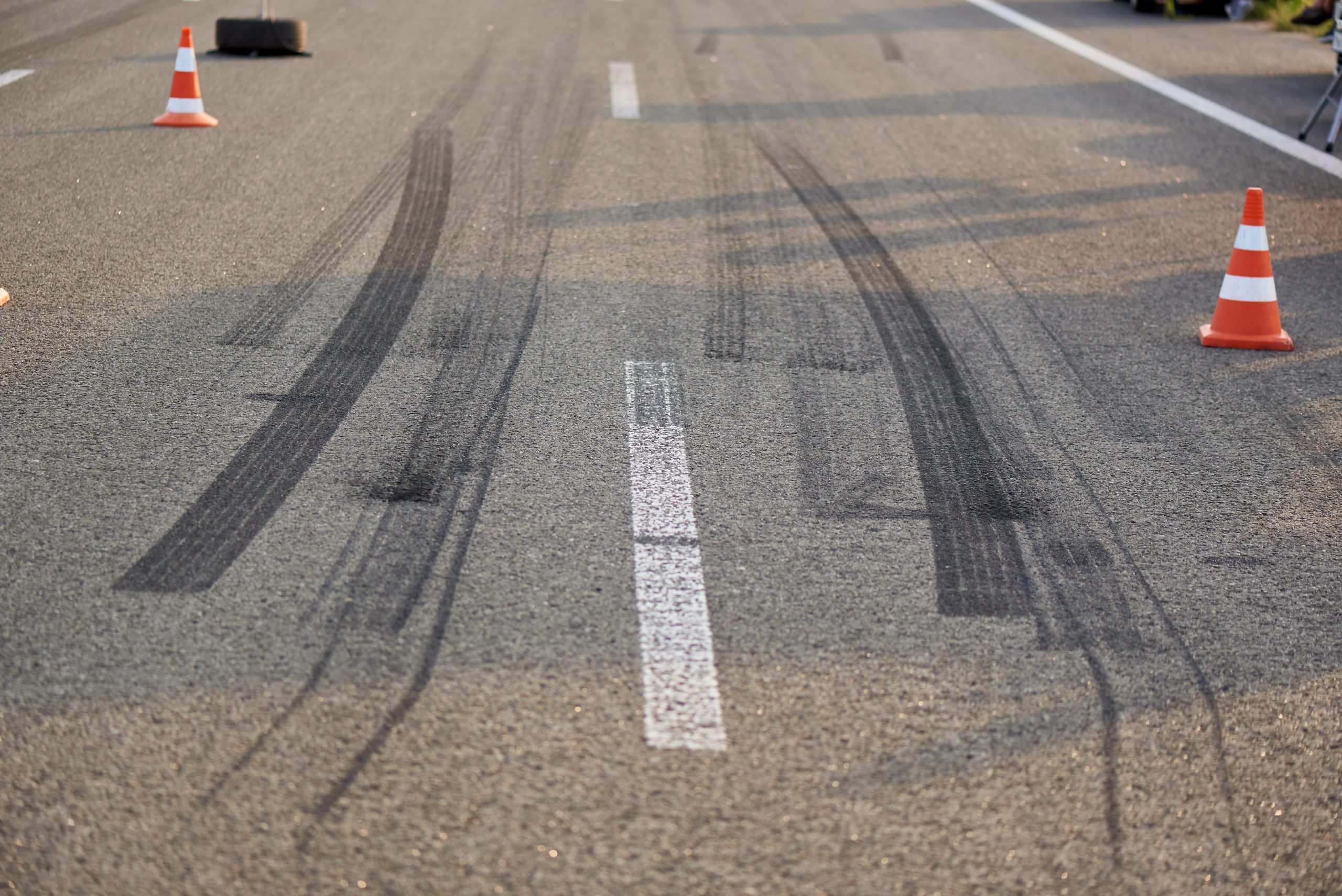 Anti-lock braking systems became near-universal in U.S. vehicles by the early 2000s. ABS-equipped vehicles don’t produce traditional locked-wheel skids during emergency braking. Instead, they produce shorter, less obvious scrub marks. This changed crash reconstruction in important ways:
- Older speed-from-skid-length formulas don’t apply directly to ABS-equipped vehicles.
- Apparent “no skid marks” doesn’t mean the driver failed to brake — it may mean ABS engaged and produced scrub marks rather than full skids.
- Reconstruction increasingly relies on EDR data combined with physical evidence rather than skid lengths alone.
- Insurance carriers sometimes argue “no skid marks = no braking” in ABS-equipped vehicles; this argument is often technically wrong.
Florida cases involving newer vehicles benefit from EDR analysis as much as or more than skid mark analysis. Counsel familiar with reconstruction methodology knows when to engage which evidence type.
Why police reports don’t tell the whole story
Florida police reports serve their statutory function — documenting that a crash occurred, identifying parties, and capturing immediate circumstances. They don’t typically include the depth of analysis a personal injury case may need. Reasons reports often diverge from full reconstruction:
- Officers complete dozens of reports per shift; full reconstruction takes hours per crash.
- Driver statements at the scene are often shaped by shock, motivation, or incomplete recollection.
- Apparent contributing factors are officer judgments based on available information, not formal findings.
- Diagrams are approximations, not precise measurements.
- Some evidence — like skid marks — degrades within days as traffic wears them down.
See our resource on how to get an accident report for the procedural side of obtaining the report itself. Once obtained, the report is a starting point — not a final factual conclusion.
How Florida law treats skid mark evidence
Florida courts admit skid mark evidence and reconstruction expert testimony under standard evidentiary rules. Skid mark evidence becomes most useful when offered through qualified expert testimony — typically accident reconstruction engineers — who can explain methodology and conclusions to a jury. See our Florida car accident lawyer resource for the broader Florida personal injury framework. Counsel evaluates whether reconstruction expert engagement is warranted based on case value, disputed liability, and the strength of competing evidence.
How skid mark evidence supports comparative fault rebuttal
Under Florida’s comparative fault statute (§ 768.81), a claimant more than 50% at fault for their own harm generally cannot recover damages in a negligence action to which the statute applies. Below that bar, damages are reduced in proportion to fault. Skid mark evidence often rebuts comparative fault arguments — proving that the plaintiff was not speeding, that they did brake in time, that the at-fault driver had time to react and didn’t. The objective physical evidence frequently overcomes self-serving statements at the scene.
How long does Florida skid mark evidence remain useful?
Florida personal injury cases run against Florida’s two-year filing deadline for most negligence actions under § 95.11, as amended by HB 837 effective March 24, 2023. Practical skid mark deadlines are far shorter — skid marks degrade within days as traffic wears them down. Photographic preservation at the scene, ideally within hours, captures the most useful evidence. Counsel engaged early can dispatch investigators or photographers to document marks before they’re gone.
When to retain counsel
Cases where liability is disputed, where the police report doesn’t fully capture what happened, or where injuries are severe enough to justify reconstruction investment typically benefit from early counsel. Reconstruction experts are most useful when engaged before evidence is lost — vehicle preservation, scene photographs, and witness identification all benefit from prompt action.
Wolf & Pravato has recovered over $200 million for injury clients across Florida, with more than 75 years of combined experience. We work on a contingency basis — you pay nothing unless we win. To discuss a Florida car accident where the police report doesn’t match what you remember, call 844-643-7200 or request a free case evaluation.
Frequently Asked Questions:
- What do skid marks prove in a car accident?
Skid marks can establish speed at the start of braking, direction of travel, driver reaction time, whether ABS engaged, and the relative positions of vehicles approaching impact. Combined with vehicle damage and EDR data, they often produce a more complete picture than the police report alone. - Why don’t police reports always match what really happened?
Officers complete reports based on driver statements, scene observation, and time-pressured judgment. They typically don’t conduct full reconstruction. Driver statements at the scene can be shaped by shock or motivation. The report is a starting point, not a complete factual finding. - What’s the difference between skid marks and yaw marks?
Skid marks are produced when wheels lock during straight-line braking. Yaw marks are produced when a vehicle is rotating while sliding, indicating loss of control. They look different and support different reconstruction conclusions. - Why don’t modern cars leave skid marks?
Anti-lock braking systems prevent wheel lock-up, so they don’t produce traditional locked-wheel skids. ABS-equipped vehicles produce shorter “scrub” marks instead. The absence of obvious skids doesn’t mean the driver failed to brake. - Can skid mark evidence rebut comparative fault arguments?
Often yes. Skid marks and reconstruction analysis can show that the injured party wasn’t speeding, did brake in time, or wasn’t at fault for the impact angle. Objective physical evidence frequently overcomes the at-fault driver’s self-serving scene statements. - How long do skid marks remain visible after a crash?
Variable but usually short — often days, sometimes only hours, depending on traffic volume, weather, and surface conditions. Photographic preservation as soon as possible after the crash captures the most useful evidence. - When does my Florida case need a reconstruction expert?
Cases with disputed liability, severe injuries justifying reconstruction investment, or police reports that don’t match the available physical evidence often benefit from reconstruction expert engagement. Counsel evaluates whether expert engagement is warranted on a case-by-case basis.
Recent Posts
- Fort Myers Crash Medical Bills: PIP, MedPay, and Health Insurance Coordination
- Police Cruiser Accidents in Florida: Sovereign Immunity, FL Statute 768.28, and the 3-Year Notice Trap
- Why Skid Mark Patterns Tell a Different Story Than Police Reports in Florida Crash Reconstruction
- Bicycle Accident Hotspots and Right-of-Way Rules in Boynton Beach

- Fort Myers Truck Accident Liability: Driver, Carrier, or Cargo Loader?
- Pedestrian Accidents in Lakeland School Zones: Crosswalk Rights, Evidence, and Next Steps

FLORIDA’S PERSONAL INJURY ATTORNEYS FOR + 20 YEARS