















What Evidence You Need to Prove a Fort Lauderdale Slip and Fall Claim
A wet floor near a checkout aisle. A cracked parking lot outside a Broward County retail strip. A poorly lit stairwell at a hotel along A1A. Slip and fall accidents happen in a wide range of settings — but proving that the property owner is legally responsible requires more than showing you were injured on their premises.
Florida’s premises liability law sets a specific evidentiary bar, and gathering the right documentation quickly can determine whether your claim succeeds or stalls. The Fort Lauderdale slip and fall lawyers at Wolf & Pravato work with injury victims to build the evidence record these claims require. Call 844-643-7200 — pay nothing unless we win.
Why Slip and Fall Claims Are Harder to Win Than People Expect
Many people assume that falling on someone else’s property automatically entitles them to compensation. It does not. Florida law requires the injured person to affirmatively prove that the property owner knew—or reasonably should have known—of the hazardous condition and failed to correct it.
That is a meaningful legal burden. Without evidence that the dangerous condition existed for long enough that a reasonable business should have discovered it, or that the owner had direct notice of it, a claim may not succeed regardless of how serious the injury was.
What the Law Requires You to Prove
For a slip and fall on a transitory foreign substance (spilled liquid, dropped food, tracked-in water), Florida’s slip and fall statute (§ 768.0755) places the burden of proof on the injured person. You must show that:
- A dangerous condition existed — A substance or hazard was present on the floor or walking surface.
- The business had actual or constructive notice — Either the business knew about the hazard, or the hazard existed long enough that a reasonable inspection would have discovered it.
- The condition caused your injuries — Your fall was a direct result of the hazard, not an unrelated event.
- You suffered documented damages — Medical expenses, lost income, pain and suffering, or other quantifiable losses.
Each of these elements requires evidence. Missing any one of them can leave a valid injury without a viable claim.
For broader premises liability claims — including unsafe structures, broken handrails, or inadequate lighting — the notice standard may apply differently. An attorney can evaluate what framework applies to your situation.
The Evidence That Can Make or Break Your Claim
Incident Reports
If you fall at a store, hotel, restaurant, or other commercial property, request that staff complete an incident report before you leave. Ask for a copy. This document creates an official record of the date, time, location, and circumstances of your fall — and may note which employees were present and whether the hazard was acknowledged.
If management refuses to provide a copy or denies that an incident report was filed, document that refusal.
Surveillance Footage
Surveillance cameras are among the most valuable sources of evidence in slip-and-fall cases. Footage can show how long the hazard was present before your fall, whether employees walked past it without addressing it, and the exact sequence of events.
The critical problem: most businesses overwrite surveillance footage within 24 to 72 hours. A formal legal hold or preservation demand — typically sent by an attorney — may be required to prevent the footage from being deleted. Waiting even a few days may mean the footage is gone.
Witness Statements
Anyone who saw you fall, observed the hazard before the fall, or witnessed the business’s response afterward may provide important testimony. Gather names and contact information at the scene if possible. Witnesses who saw an employee acknowledge the spill and walk away without addressing it, for example, can directly support a notice argument.
Photos and Video From the Scene
If you are physically able, photograph the hazard immediately — the wet surface, broken floor, missing warning sign, or whatever caused your fall. Capture multiple angles. Photograph any visible footprints or track marks in the substance to help establish how long it was present. If your footwear or clothing shows staining consistent with the substance, photograph that as well.
Medical Records
Medical documentation serves two purposes: it establishes that your injuries are real and causally connected to the fall. Seek treatment as soon as possible after the incident. Gaps in care or delayed treatment are routinely used by insurers to argue that injuries were not as serious as claimed or were caused by something other than the alleged negligence.
Keep records of every provider visit, prescription, diagnostic test, therapy session, and related expense.
Maintenance Logs and Inspection Records
Businesses are typically required to maintain cleaning and inspection schedules. If a store claims its staff inspected the area shortly before your fall, maintenance logs can confirm or contradict that claim. These records are usually obtained through formal discovery in litigation — another reason having legal representation early in the process matters.
How Your Own Actions May Affect Your Claim
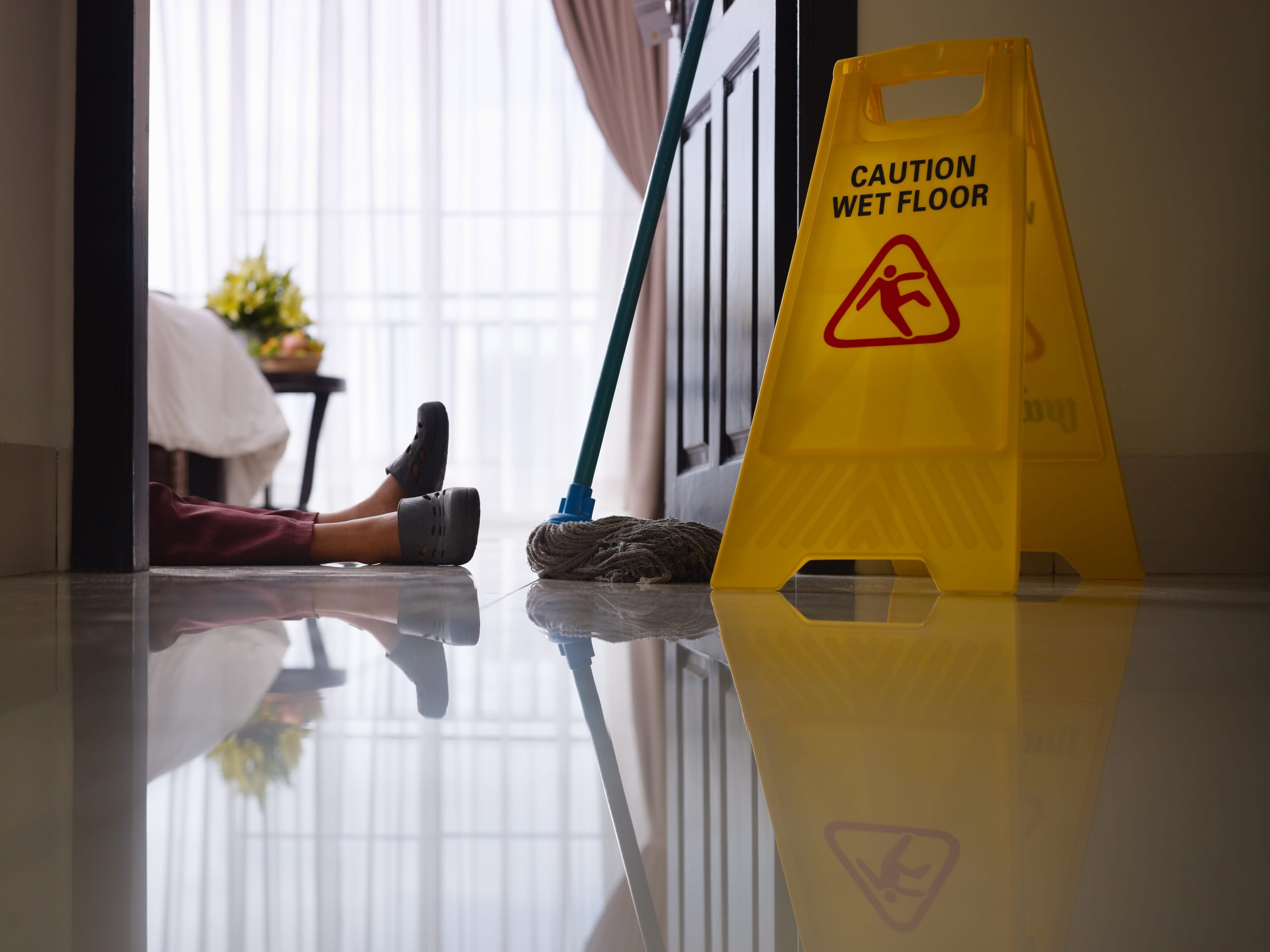
Florida applies Florida’s comparative fault statute (§ 768.81) to slip and fall cases. If you are found partly responsible — for example, because you were looking at your phone, ignored a warning sign, or entered an area marked as restricted — your damages may be reduced in proportion to your share of fault. If your fault exceeds 50%, you may be barred from recovery entirely.
Insurers often look for anything that suggests the visitor contributed to the fall. Avoid making statements that could be interpreted as an admission of inattentiveness.
Evidence That Disappears Fast — Why Timing Matters
Several categories of evidence are time-sensitive:
- Surveillance footage — Often overwritten within 24–72 hours
- The physical hazard — Cleaned up or repaired before it is documented
- Witnesses — Harder to locate days or weeks later
- The incident report — May be amended or details may shift after the fact
Acting quickly — and having an attorney send a formal evidence preservation letter to the property owner — can help prevent evidence from being lost or destroyed.
How an Attorney Builds a Fort Lauderdale Premises Liability Claim
An experienced Fort Lauderdale premises liability attorney can:
- Send an immediate evidence preservation demand to the property owner
- Subpoena surveillance footage before it is overwritten
- Identify and contact witnesses while recollections are fresh
- Request maintenance logs and inspection records through the discovery process
- Retain liability experts when the notice element is contested
- Document and quantify all categories of damages — past and projected
Many of these steps require legal authority or procedural knowledge that is difficult to access without representation.
FAQs: Slip and Fall Evidence in Fort Lauderdale
What is the most important piece of evidence in a slip and fall case?
There is no single most important piece — the strength of a claim usually comes from multiple sources working together. That said, surveillance footage showing how long the hazard existed before your fall is often among the most powerful evidence available.
What if there were no witnesses to my fall?
Eyewitnesses are helpful but not required. Physical evidence — photos, the incident report, your medical records, and surveillance footage — can support a claim without witness testimony.
Can I still file a claim if I did not report the fall at the time?
Failing to file an incident report at the time complicates a claim, but does not automatically eliminate it. Other evidence may establish that the fall and the hazard were real. Speak with an attorney as soon as possible.
How long do I have to file a slip and fall claim in Florida?
Under Florida Statutes § 95.11, most negligence claims carry a two-year statute of limitations. Waiting too long can bar your right to pursue compensation entirely.
What if the store says the floor was dry and I just tripped?
The business’s characterization of events is not the final word. Surveillance footage, your photos, witness testimony, and the staining on your clothing can all contradict a business’s account.
Does it matter where I fell — store vs. private property vs. a government building?
Yes. The legal standard and notice requirements may differ depending on the property type and owner. Claims against government entities, for example, often have shorter notice deadlines. An attorney can advise on which framework applies.
Speak With a Fort Lauderdale Slip and Fall Attorney
Slip and fall claims are won or lost on evidence — and evidence disappears fast. If you were injured on someone else’s property in the Fort Lauderdale area, the sooner you act to document what happened and preserve the record, the stronger your position may be.
Law Offices of Wolf & Pravato has recovered over $200 million for injury victims across Florida. Schedule a case evaluation today — there are no upfront fees, and you pay nothing unless we win.
Call 844-643-7200.
Recent Posts
- Fort Myers Injury Claims and Lost Wages: Pay Stubs, PTO, Self-Employed Proof, and Future Earning Impact
- What Evidence You Need to Prove a Fort Lauderdale Slip and Fall Claim
- Fort Myers Personal Injury Intake Prep: What to Bring to Your First Call
- Fort Myers Property Damage: Total Loss Valuation, GAP Insurance, and Rental Reimbursement
- Multi-Vehicle Collisions in Fort Lauderdale: How Fault Gets Assigned in Florida (Practical Scenarios)
- Uninsured / Underinsured Driver Crashes in Fort Lauderdale: UM Coverage + Proof Strategy


FLORIDA’S PERSONAL INJURY ATTORNEYS FOR + 20 YEARS