














Miami Brickell, Wynwood & South Beach Pedestrian Crash Hotspots: FDOT Data Breakdown
Why Brickell, Wynwood, and South Beach pedestrian patterns differ
Three of Miami’s most pedestrian-active districts — Brickell, Wynwood, and South Beach — have completely different crash profiles. The pedestrians are different, the drivers are different, the road geometry is different, and the time-of-day patterns are different. A Brickell pedestrian crash at 8:30 AM on a Tuesday looks nothing like a South Beach Ocean Drive crash at 1:00 AM on a Saturday. Same Florida law, same Miami-Dade County, vastly different corridor-specific liability questions. A Miami pedestrian accident lawyer working a case in any of these districts starts by understanding what the corridor’s typical crash patterns look like — because that context shapes evidence priorities, witness identification, and the practical realities of what happened.
This article walks through the three corridors’ distinct pedestrian crash patterns based on publicly available transportation data, what makes each one’s liability questions different, and how the Florida legal framework applies.
Featured snippet — 5 ways the corridors differ
- Brickell: high-density commuter mix with tourist overlay; mid-day weekday crashes common.
- Wynwood: entertainment-district pedestrian volume peaks evenings and weekends.
- South Beach: tourist-heavy with significant late-night and alcohol-involved patterns.
- Different time-of-day patterns mean different witness pools, surveillance availability, and driver populations.
- Different road geometries — multilane Brickell Avenue, narrow Wynwood streets, beach-adjacent Collins Avenue — change crash mechanics.
What FDOT data tells us about Miami pedestrian crashes
The FDOT pedestrian safety data published reports identify Miami-Dade as one of Florida’s highest pedestrian crash counties year over year. The data identifies multiple Miami corridors as recurring concentration zones for pedestrian crashes. FDOT data is descriptive — it tells investigators what patterns recur, not what happened in any specific case — but it provides context that shapes case evaluation. Counsel reviewing a Miami pedestrian crash typically pulls FDOT corridor data for the location to understand whether the crash fits a known pattern.
FDOT-published reports also identify factors that frequently appear in Miami-Dade pedestrian crashes: visibility issues at night, mid-block crossings outside marked crosswalks, distracted driving, alcohol-involved driving, and high-speed corridors with limited pedestrian infrastructure. These factors don’t determine fault in any specific case but inform what investigation focuses on.
Brickell — high-density commuter and tourist mix
Brickell has its own pedestrian crash profile reflecting the district’s identity:
- High-rise residential and office concentration produces heavy weekday pedestrian volume during morning and evening commutes.
- Brickell Avenue’s wide, multilane configuration mixes high-speed driving with pedestrian crossings.
- Tourist activity overlays the commuter pattern, particularly near Brickell City Centre and waterfront areas.
- Rideshare drop-off and pickup activity creates frequent door-zone and curb-zone interactions.
- Surveillance density is high — most blocks have multiple business and residential cameras.
Crash investigation in Brickell typically benefits from extensive surveillance availability. Building security cameras, business surveillance, and traffic cameras together usually capture some portion of the events leading to a crash. Counsel sending preservation letters within days of a Brickell crash often secures multiple footage angles before retention cycles eliminate them.
Wynwood — pedestrian-heavy entertainment district
Wynwood’s crash profile differs sharply from Brickell’s:
- Pedestrian volume peaks evenings and weekends rather than weekday commutes.
- Many streets are narrow with on-street parking, limiting visibility and creating door-zone risk.
- Alcohol-involved driving is more frequent than in commuter-dominated districts.
- Tourist pedestrians unfamiliar with local traffic patterns increase risk.
- Rideshare activity is intense, with frequent rapid pickup and drop-off zones.
Wynwood pedestrian cases often involve evening or late-night events. Witness identification is harder because the pedestrian volume itself makes any single witness one of many. Surveillance availability varies — some Wynwood blocks have heavy camera coverage from galleries and businesses, others have less. Bar and nightclub surveillance can be particularly valuable but requires fast preservation requests.
South Beach — Ocean Drive and Collins Avenue patterns
South Beach pedestrian crashes have their own characteristic patterns:
- Ocean Drive’s pedestrian density and slow vehicular traffic produce different crash mechanics than Brickell’s high-speed corridors.
- Collins Avenue mixes hotel curbside activity with through-traffic in ways that create frequent pedestrian-driver conflicts.
- Late-night patterns are more pronounced — including alcohol-involved drivers and pedestrians.
- Tourist pedestrians, often unfamiliar with Florida traffic patterns, frequently appear in crashes.
- Rental scooters and rental bikes add another layer of pedestrian-zone activity.
South Beach cases often involve hotel surveillance, restaurant cameras, and Miami Beach Police Department response patterns. Miami Beach is a separate municipality from Miami; Miami Beach Police handle most South Beach crashes, with their own evidence and investigation protocols. Counsel familiar with both Miami Beach and Miami Police processes navigates both efficiently.
How Florida’s pedestrian rules apply across Miami corridors
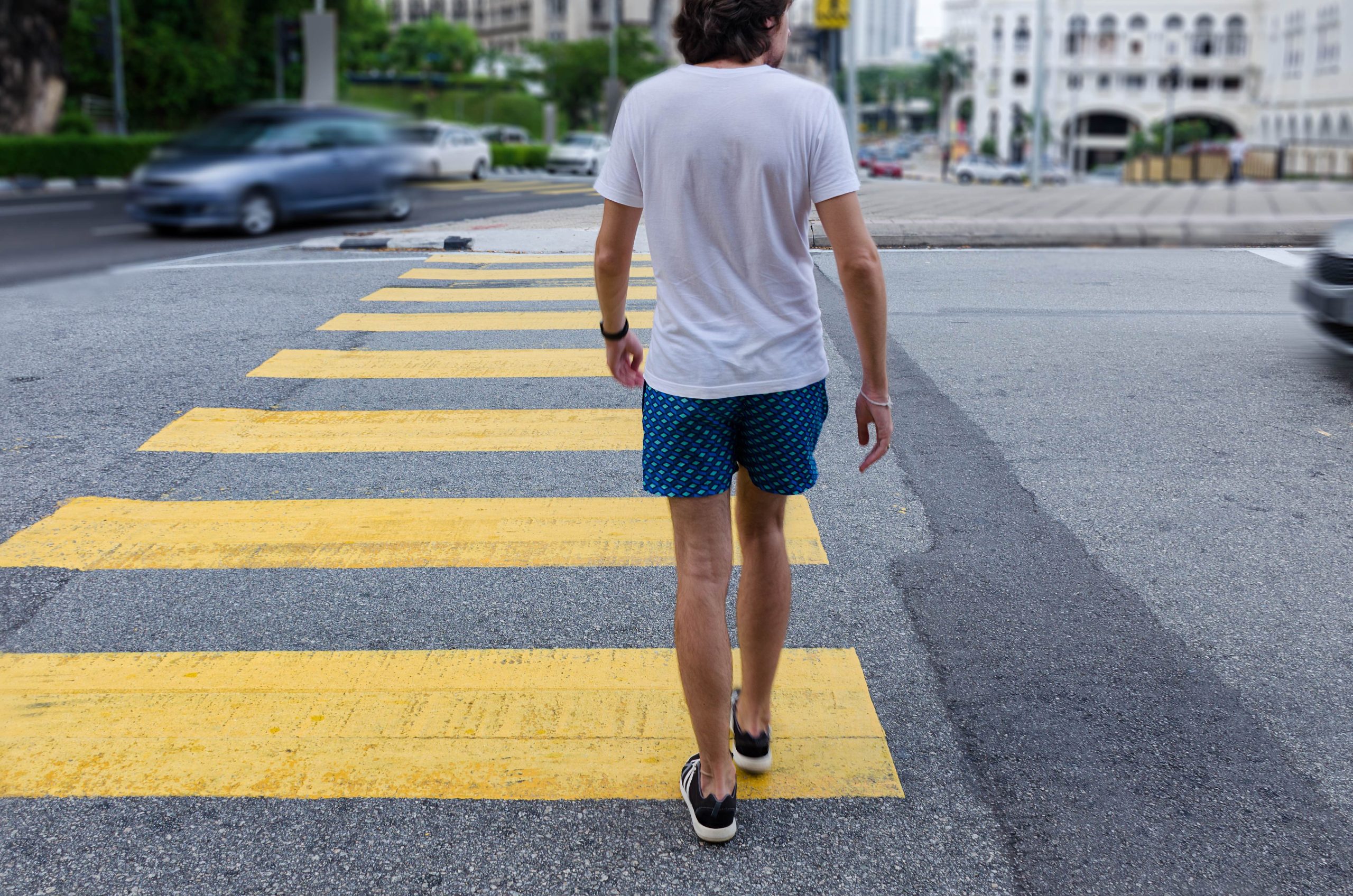
Under Florida’s pedestrian statute (§ 316.130), Florida law sets specific pedestrian duties and driver duties at and outside crosswalks. Pedestrians at marked crosswalks generally have right-of-way; pedestrians outside crosswalks have a duty to yield to vehicles. Drivers have a duty of due care toward pedestrians regardless of crosswalk status. The same statute applies the same way in Brickell, Wynwood, and South Beach. What changes is the practical context — visibility, lighting, traffic patterns, and witness availability — that affects how the rules play out in specific cases.
Mid-block crossings outside marked crosswalks frequently arise in pedestrian crash cases. The pedestrian duty to yield doesn’t eliminate driver liability — drivers still have a duty of due care — but it can support comparative fault arguments by insurance carriers.
FLHSMV data on Miami-Dade pedestrian crashes
The FLHSMV crash dashboard provides Florida crash statistics by county. Miami-Dade has historically been one of Florida’s highest pedestrian crash counties. The data is publicly accessible and provides corridor-level context. Combined with FDOT data, it gives a reasonably complete picture of where Miami-Dade pedestrian crashes concentrate. None of this data determines liability in any specific case — that turns on case-specific facts — but it establishes the corridor-level context investigators work within.
How comparative fault works for Miami pedestrian victims
Florida’s § 768.81 modified comparative fault applies to pedestrian cases. A pedestrian more than 50% at fault for their own injury generally cannot recover. Below that bar, damages are reduced in proportion to fault. Common comparative fault arguments in Miami pedestrian cases:
- Mid-block crossing outside a marked crosswalk.
- Crossing against a “Don’t Walk” signal.
- Visibility — dark clothing, low light conditions.
- Distraction — phone use, headphones.
- Intoxication.
Strong evidence — surveillance footage, witness testimony, accident reconstruction — often rebuts most comparative fault arguments insurers raise. Even where some pedestrian fault exists, partial recovery is usually available below the 50% bar.
When pedestrian cases extend beyond traffic
Some Miami pedestrian crashes connect to broader cases — premises liability for inadequate sidewalk maintenance, dram shop claims against bars that overserved drivers, rideshare-driver-on-the-clock claims, and commercial-vehicle cases. See our Miami personal injury lawyer resource for the broader injury practice framework. Identifying multiple defendants and theories early matters because each adds an evidence layer and a potential coverage source.
How Florida law applies to Miami pedestrian cases
Florida’s pedestrian framework — § 316.130 pedestrian rules, § 768.81 comparative fault, § 627.736 PIP, the two-year statute of limitations — applies the same way across Miami-Dade as elsewhere in Florida. See our Florida car accident lawyer resource for the broader statewide framework. What distinguishes Miami cases is local context — multiple municipalities (Miami, Miami Beach, Coral Gables, others), each with its own police response patterns; high tourist driver concentration; and corridor-specific traffic patterns.
How long do Miami pedestrian victims have to act
Miami pedestrian crash cases run against Florida’s two-year filing deadline for most negligence actions under § 95.11, as amended by HB 837 effective March 24, 2023. Claims that arose before the effective date may be governed by the prior four-year rule. Practical investigation deadlines are usually much shorter — surveillance retention cycles in Brickell, Wynwood, and South Beach businesses are typically measured in weeks. The 14-day PIP rule under § 627.736 also applies for Florida-resident pedestrians.
When to retain counsel
Miami pedestrian crashes typically benefit from very early counsel because surveillance preservation is time-critical. A preservation-of-evidence letter sent within days of the crash to nearby businesses, hotels, and traffic camera operators preserves footage that would otherwise cycle out. A counsel familiar with Brickell, Wynwood, and South Beach surveillance ecosystems knows what to request.
Wolf & Pravato has recovered over $200 million for injury clients across Florida, with more than 75 years of combined experience. We work on a contingency basis — you pay nothing unless we win. To discuss a Miami pedestrian crash case, call 844-643-7200 or request a free case evaluation.
Frequently Asked Questions:
- Where in Miami do most pedestrian crashes happen?
Miami-Dade has historically been one of Florida’s highest pedestrian crash counties per FDOT and FLHSMV data. Concentration zones include Brickell, Wynwood, South Beach (Ocean Drive and Collins Avenue), and several major arterial corridors throughout the county. - What does Florida law say about pedestrian right-of-way?
Under § 316.130, pedestrians at marked crosswalks generally have right-of-way. Pedestrians crossing outside marked crosswalks have a duty to yield to vehicles. Drivers have a duty of due care toward pedestrians regardless of where they’re crossing. - Can I recover damages if I was crossing outside a crosswalk?
Often yes, with possible damage reduction for comparative fault. Florida’s § 768.81 modified comparative fault applies — a pedestrian more than 50% at fault generally cannot recover, but partial recovery below that bar is available. Strong evidence often supports the pedestrian’s position even outside crosswalks. - Does PIP cover pedestrian injuries in Miami?
Under specific conditions yes. Florida-resident pedestrians may be covered by their own PIP for medical expenses up to PIP limits, even if not in a vehicle at the time. The 14-day rule under § 627.736 applies. Tourist pedestrians without Florida PIP have different coverage paths. - What evidence matters most in Miami pedestrian cases?
Surveillance footage from nearby businesses, hotels, and traffic cameras; witness identification; the crash report; vehicle damage and pedestrian injury photos; cell phone records (when distraction is at issue); and FDOT corridor data establishing context. - How long do I have to file a Miami pedestrian crash case?
Florida’s statute of limitations for most negligence actions is two years under § 95.11, as amended by HB 837 effective March 24, 2023. Practical investigation deadlines are much shorter, especially for surveillance preservation. - Should I talk to insurance before talking to a Miami pedestrian lawyer?
Generally, no, beyond reporting the incident. Recorded statements before counsel is engaged can complicate cases. Initial consultations with reputable firms are typically free.
Recent Posts
- Wrong Burial Plot and Grave-Site Errors in Fort Lauderdale

- Rainwater Falls at Fort Lauderdale Store Entrances

- Parking-Lot Backing Crashes in Fort Lauderdale: Who Has the Right of Way?
- Elevator and Escalator Injuries at Fort Lauderdale Shopping Centers
- Delivery Driver Car Accidents in Lakeland: Who Pays?

- Injured as a Passenger in Fort Lauderdale: Whose Insurance Pays?





FLORIDA’S PERSONAL INJURY ATTORNEYS FOR + 20 YEARS