













Multi-Vehicle Crashes on I-95 and US-1 in Fort Lauderdale: How to Protect Your Claim When Five Cars Collide
Why multi-vehicle crashes are a different animal
A two-car rear-end has a simple liability structure — whoever hits the car in front usually bears primary fault. A five-car chain on I-95 near Sunrise Boulevard, or a pile-up on US-1 through downtown Fort Lauderdale, is a different problem entirely. Multiple drivers, multiple points of impact, competing accounts of who hit whom first, and layered insurance policies that all point fingers at each other. Each driver has incentives to shift fault elsewhere. Each carrier wants to minimize its own exposure. And the injured person has to navigate it without losing the evidence that would actually show what happened. A Fort Lauderdale car accident lawyer working a multi-vehicle case treats the first week as critical — because scene evidence, surveillance, and early witness accounts often decide how fault ultimately gets allocated.
This article walks through how these cases work under Florida law, what to do in the first hours, and where claims most often come apart.
Featured snippet — What to do after a multi-vehicle Fort Lauderdale crash
- Call 911 and get medical care — same-day if possible, within the 14-day PIP window.
- Do not move vehicles unless required for safety; the final-rest position matters.
- Photograph everything: all vehicles, all license plates, impact points, skid marks, road conditions, signage.
- Collect contact info from every other driver — not just the one who hit you directly.
- Get witness names and phone numbers before they leave.
- Request the Florida Traffic Crash Report once available (usually within about 10 days).
- Notify your own auto insurer to open PIP, and loop in UM/UIM coverage if applicable.
- Avoid giving recorded statements to other drivers’ insurers until you’ve spoken with counsel.
Where these crashes happen on I-95 and US-1
Broward County’s I-95 corridor and US-1 (Federal Highway) see a steady volume of multi-vehicle crashes because of where cars converge and what conditions prevail:
- I-95 through downtown Fort Lauderdale — dense traffic, frequent lane changes, merging pressure at Broward Boulevard, Sunrise Boulevard, and Oakland Park Boulevard.
- I-95 near the I-595 interchange — one of the busiest interchanges in the region.
- US-1 through Fort Lauderdale Beach and central areas — stop-and-go traffic, frequent signals, high pedestrian activity.
- Exit ramps, where deceleration and merging create chain-reaction risk.
- Weather events — sudden South Florida downpours dramatically reduce visibility and traction.
Location matters because it shapes the evidence available (highway cameras vs. local surveillance), the speeds involved, and the types of injuries that result.
The crash report is central — but not always simple
Under Florida’s crash reporting statute, drivers involved in certain crashes must stop and report; law enforcement generates a Florida Traffic Crash Report. The statute also provides that certain reports are restricted from public access for 60 days post-crash during investigation of specified offenses. That 60-day window matters when criminal charges (DUI, leaving the scene) may be involved.
In multi-vehicle crashes, the officer’s narrative, diagram, and citations often shape insurer positioning from day one. But the report isn’t necessarily correct — it reflects what the officer could piece together at the scene, often from conflicting driver accounts. Supplementing it with independent evidence (photos, witnesses, surveillance) is routinely necessary to correct or confirm the officer’s initial take.
How is fault split across five cars?
Under Florida’s comparative fault statute, a jury allocates a percentage of fault to each party, including the plaintiff. A plaintiff found more than 50% at fault generally cannot recover damages in a negligence action to which the statute applies; below that bar, damages are reduced in proportion to fault. With multiple defendants, each is generally liable for its own allocated share.
Multi-vehicle allocation often turns on the sequence of impacts: who struck first, who had time to stop, who was following too closely, and who contributed additional impacts by failing to slow. A “10-car pile-up” narrative can obscure the fact that liability percentages may differ dramatically between the lead rear-end strike and downstream impacts. Early evidence preservation is how those percentages get established on the plaintiff’s side rather than dictated by defense accounts.
When a truck is in the chain
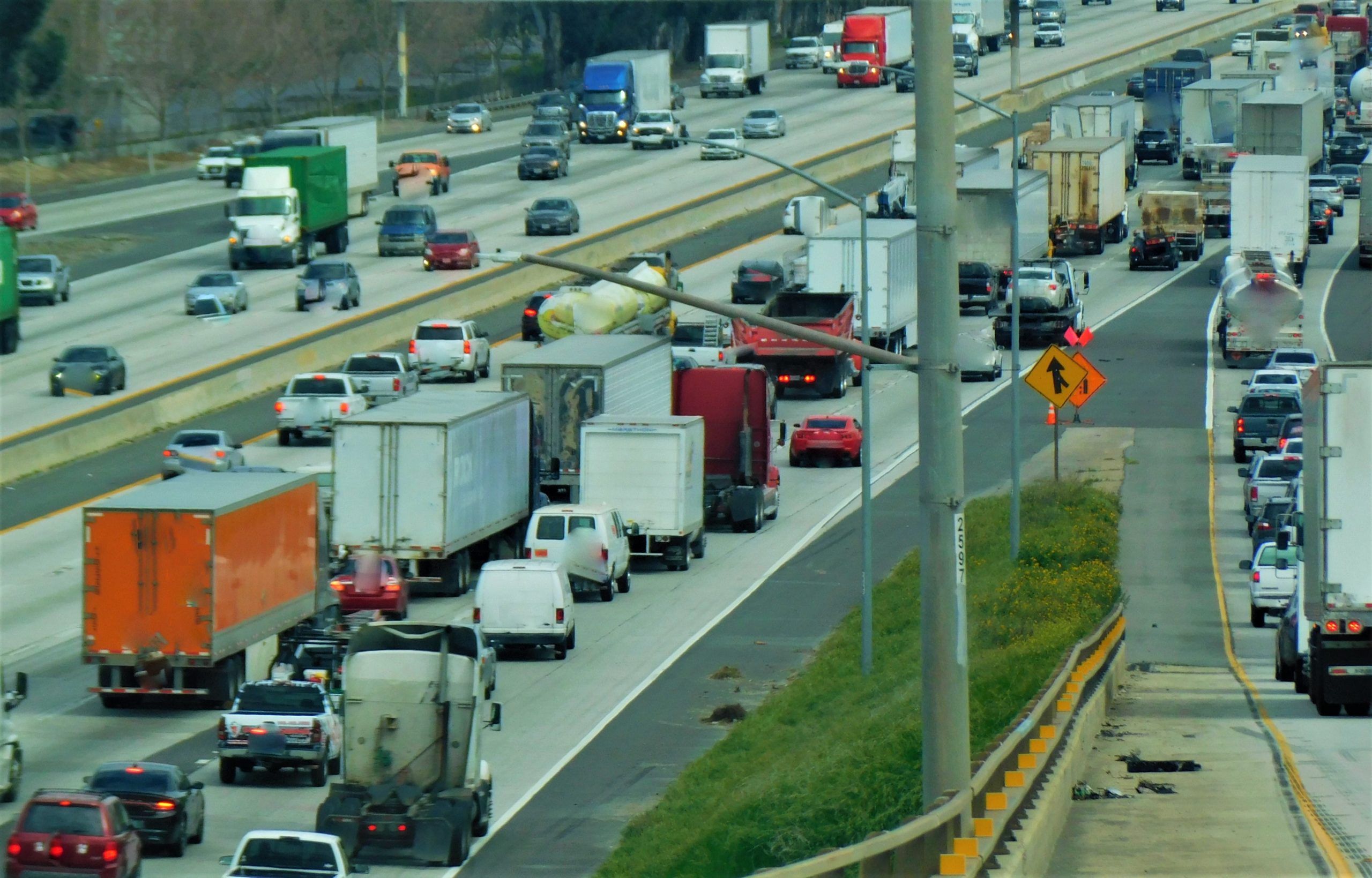
If a commercial truck is involved in a multi-vehicle I-95 crash, the analysis shifts. FMCSA regulations, ELD data, ECM downloads, and carrier liability theories all come into play. Multi-vehicle pile-ups that include a semi-truck often produce the most severe injuries and the deepest available coverage. For a walk-through of how commercial carrier liability layers work, our Fort Lauderdale truck accident team handles these cases specifically.
PIP runs independent of who’s at fault
Regardless of how fault among the drivers shakes out, Florida’s PIP statute provides no-fault medical coverage. PIP medical benefits are conditioned on receiving initial services and care within 14 days after the motor vehicle accident, with reimbursement generally at 80% of reasonable and necessary medical expenses up to $10,000 (EMC) or $2,500 (no EMC). The 14-day clock runs from the crash, not from when the fault is resolved. Waiting for insurers to sort out fault before seeking care can forfeit PIP benefits entirely.
Evidence that actually decides multi-vehicle cases
- Scene photos: capture every vehicle from multiple angles, license plates, final-rest positions, road conditions, and debris patterns. The physical geometry of the scene tells a story that narratives alone can’t.
- Surveillance and highway cameras: I-95 has extensive DOT camera coverage; US-1 has surveillance from adjacent businesses. Preservation requests must go out quickly — business footage can be overwritten in weeks.
- Witness statements: independent witnesses (not other drivers) are especially valuable for establishing the impact sequence.
- Vehicle damage patterns: photographs and professional inspection can reveal the direction and severity of each impact.
- ECM/EDR data: modern cars have event data recorders that capture pre-crash speed and braking. Download requires cooperation or legal process but can be decisive.
- Medical records: consistent, well-documented treatment ties specific injuries to specific impacts in ways that matter during allocation disputes.
Why preservation matters more in multi-vehicle cases
The more drivers and insurers involved, the more actively each side pushes fault elsewhere — and the more quickly inconvenient evidence can disappear. Highway surveillance is often overwritten on short cycles. Business surveillance cycles through 14–30 days. Vehicles go to salvage. Witnesses become unreachable. Florida’s two-year filing deadline for most negligence actions under § 95.11, as amended by HB 837 effective March 24, 2023, is the outside limit. Claims that arose before the effective date may be governed by prior rules. The real preservation window is days or weeks. For broader rules, see Florida car accident claim guidance.
When to call a lawyer
Multi-vehicle cases with multiple insurers and competing fault narratives are exactly where early legal involvement meaningfully changes outcomes. Preservation letters, coordinated evidence-gathering, and structured communications with each carrier can prevent fault from being inappropriately loaded onto the plaintiff. Our Fort Lauderdale personal injury team handles complex multi-vehicle litigation across Broward County.
Wolf & Pravato has recovered over $200 million for injury clients across Florida, with more than 75 years of combined experience. We work on a contingency basis — you pay nothing unless we win. To discuss your Fort Lauderdale multi-vehicle crash, call 844-643-7200 or request a free case evaluation.
Frequently Asked Questions:
- Who’s at fault in a multi-vehicle I-95 crash?
Fault is rarely one driver in these cases. Under § 768.81, a jury allocates percentages among all responsible parties. The allocation often depends on the sequence of impacts — who struck first, who had time to stop, and who contributed to downstream impacts. Evidence preservation is what supports your side of the allocation. - How is fault allocated in a pile-up?
Each driver is evaluated on their own conduct — speed, following distance, reaction time, visibility, and whether they contributed additional impacts beyond the initial collision. Percentages are assigned to each. A plaintiff more than 50% at fault generally cannot recover in a negligence action to which § 768.81 applies. - Does PIP cover a multi-vehicle crash?
Yes. PIP runs on the same structure regardless of how many vehicles were involved or how fault is eventually allocated. The 14-day medical rule and $10,000 (EMC) / $2,500 (no EMC) limits apply exactly as in any motor vehicle crash. - What if more than one driver hit my vehicle?
Multiple defendants may be named, each with their own policy. Each is generally liable for its own allocated share under § 768.81. Compiling damage evidence that ties specific impacts to specific defendants supports the allocation argument. - What if I don’t know which driver caused the crash?
Often, nobody does immediately, which is exactly why investigation matters. Surveillance, DOT cameras, witness accounts, vehicle damage analysis, and ECM/EDR downloads help reconstruct the sequence. Professional accident reconstruction is common in these cases. - Can I still recover if I’m partly at fault?
Generally, yes, as long as you’re not more than 50% at fault under Florida’s modified comparative negligence rule. Below that bar, damages are reduced in proportion to your fault percentage. Claims that arose before March 24, 2023, may be governed by the prior pure comparative rule. - How long do I have to file a Fort Lauderdale multi-vehicle crash claim?
Florida’s statute of limitations for most negligence actions is two years under § 95.11, as amended by HB 837, effective March 24, 2023. Claims that arose before the effective date may be governed by prior rules. The practical evidence-preservation deadline is much shorter.
Recent Posts
- Wrong Burial Plot and Grave-Site Errors in Fort Lauderdale

- Rainwater Falls at Fort Lauderdale Store Entrances

- Parking-Lot Backing Crashes in Fort Lauderdale: Who Has the Right of Way?
- Elevator and Escalator Injuries at Fort Lauderdale Shopping Centers
- Delivery Driver Car Accidents in Lakeland: Who Pays?

- Injured as a Passenger in Fort Lauderdale: Whose Insurance Pays?





FLORIDA’S PERSONAL INJURY ATTORNEYS FOR + 20 YEARS