

Fort Lauderdale Slip and Fall Lawyer
One second on a wet floor can cost you a broken bone, weeks off your feet, and a store that has already decided it was your own fault. We can take it from here. Call 954-522-5800 for a free consultation. You pay us nothing unless we win. Our Fort Lauderdale personal injury lawyers have taken these cases across Broward County since 1993.
Slip and Fall claims in Fort Lauderdale
The store has written its own version of what happened, and its insurer will want a recorded statement from you before you have seen a specialist. Meanwhile you are working out how to pay for the first scan, how long you will be off your feet, and whether anybody even kept the video. Getting hold of that proof is our job, and we start the day you call.
Grocery aisles, hotel lobbies off the beach and parking garages produce most of the falls we handle in this county. Florida makes you prove the business knew, which turns the case into a fight over sweep logs and surveillance footage. In a busy Broward store that footage is commonly overwritten inside two weeks, and nobody has any obligation to keep it until they are asked in writing.
A Fort Lauderdale slip and fall claim turns on proving the business knew about the hazard or should have known, not simply that you fell. Two years to sue for most falls on or after March 24, 2023. The surveillance that would settle it is routinely overwritten inside two weeks in a busy Broward store, so the evidence clock runs first.
What to do after a slip and fall in Fort Lauderdale
- Report it before you leave. Tell the manager or whoever is on duty, and ask for a written incident report. Ask for a copy of it. A fall that was never reported becomes a fall the business says it has no record of, and that argument is made in almost every one of these files.
- Photograph the hazard, not just the injury. The spill, the missing handrail, the broken tile, the unlit stairwell, and photograph it wide enough to show where it is in the room. A mop and bucket arriving is the end of the evidence. So is a repair. Both usually happen within the hour.
- Get names. Anyone who saw it, and anyone who came over afterward. Staff turn over, particularly in a seasonal market, and a witness with no contact details is not a witness.
- Get examined the same day if you can. Head injuries, spinal injuries and internal bleeding routinely present late, and the gap between the fall and the first medical record is the first thing an adjuster points at. Going to be checked is not an admission that you are badly hurt.
- Do not give a recorded statement. The property is entitled to investigate. You are not required to be recorded doing it. That call usually comes within a day or two, while you are still working out how bad it is, and what you say in it is permanent.
Where these happen in Fort Lauderdale
Broward is dense with the property types these claims come from, and the type usually decides what evidence exists. A national grocery chain runs a documented sweep schedule. A beach hotel does not, and a small plaza landlord may have nothing at all.
-
Grocery and big box, along Federal Highway and University Drive
The everyday fall in this county, and generally the best documented one.
- Tracked-in rain at the entrance after an afternoon storm, which is most afternoons from June
- Produce misting, freezer condensation and deli spills for the rest
- National chains run recorded inspection schedules, and the gap in one is what proves the case
-
Beach hotels and resorts along A1A
Pool decks, tiled lobbies, and the walk in from a parking lot with wet feet.
- Housekeeping records are thinner than a national retailer’s
- Hospitality turns staff over fast, so witness details taken on the day matter more here
- A hotel that says its cameras did not cover the area still has a camera map and a maintenance file
-
Downtown and Port Everglades parking structures
A garage is rarely the same company as the building it serves.
- Oil, standing water and worn expansion joints on a deck nobody inspects on a schedule
- Lighting levels are measurable after the fact and are often below what the plans called for
- The garage operator, the owner and the property manager each carry separate policies
-
Condominium and association common areas
A fall in a lobby, a stairwell or a pool area is a claim against the association rather than against a neighbor.
- The association carries insurance for exactly this, and no owner pays out of pocket
- Board minutes and work orders usually show whether the problem had been raised
- The management company is frequently a second responsible party
-
Malls and plazas: Sawgrass Mills, Galleria, Las Olas
A fall at a shopping center is frequently not the store’s problem at all.
- Common areas, walkways and lots usually sit with the landlord under the lease
- Cleaning is often contracted out to a third company again
- The lease and the maintenance contract are what settle who held the duty
-
Sidewalks and public property
A cracked or lifted public sidewalk is a claim against a city or the county, and those run under their own rules.
- A written notice has to be presented before suit
- Worth pursuing, and easy to lose on the procedure rather than the facts
- Which is a reason to ask early rather than late

What causes them
- Spills and tracked-in rain that nobody was assigned to check for
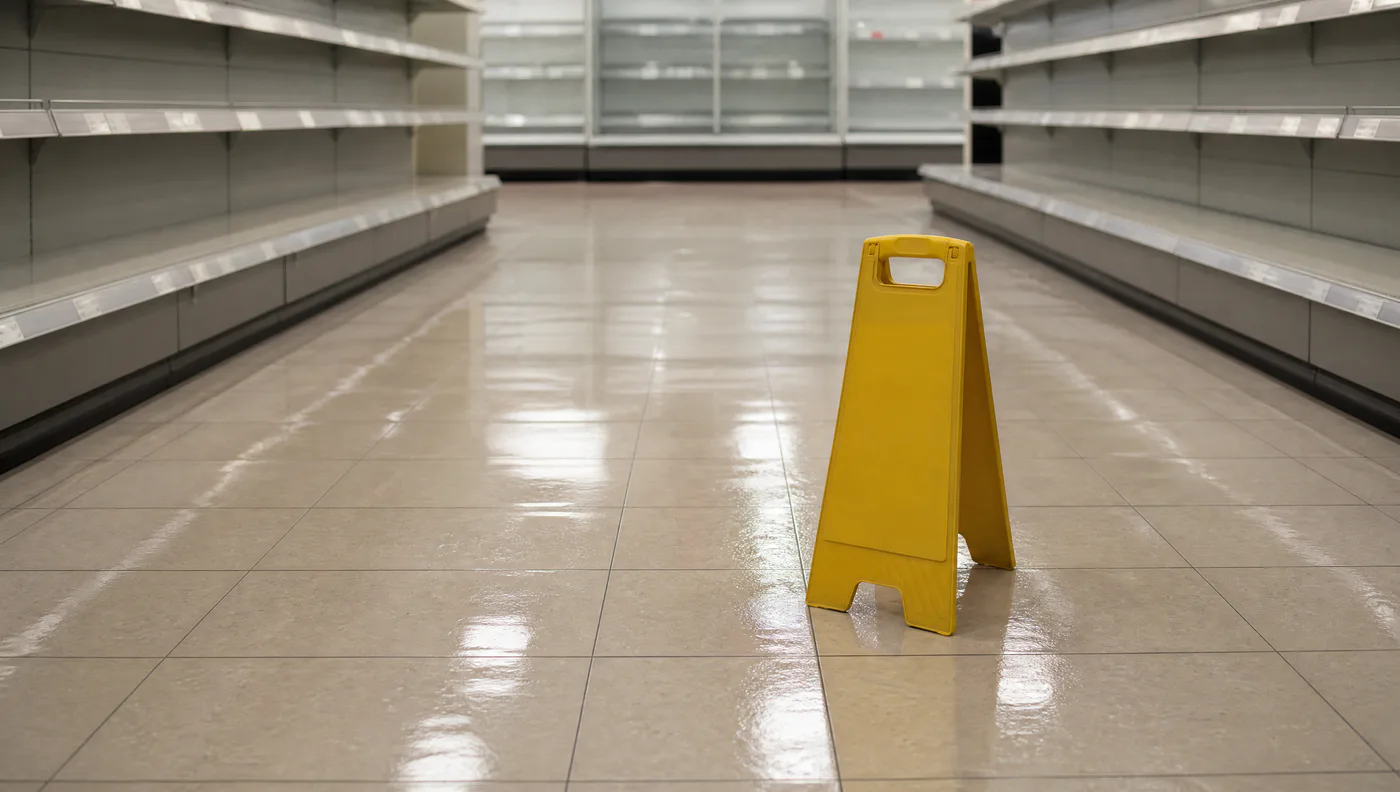
- Recently mopped floors with no sign, or a sign put out after the fall
- Produce, deli and freezer aisles, where the spill is routine and so is the schedule that should catch it
- Broken, uneven or missing floor tile, and transitions between two surfaces
- Stairs with no handrail, a loose handrail, or treads worn smooth
The injuries we see, and what each one turns on
Head and brain
A fall backward onto a hard floor produces the concussions and traumatic brain injuries we see most, and the imaging taken on the day is frequently normal. What follows is memory, concentration, sleep and mood, reported by the people around the injured person before the injured person notices it. Those cases are proved with neuropsychological testing and with treating records, not with the first scan.
Spine and back
Herniated and bulging discs, fractures of the vertebral bodies, and nerve root compression that presents as pain down an arm or a leg rather than in the back itself. Age is the standard defense here: nearly every adult spine shows degeneration on imaging, and the argument is that the fall found it rather than caused it. What answers that is the difference between how someone functioned before and after.
Orthopedic
Hips, wrists, shoulders and ankles, because those are what a person lands on or catches themselves with. These are the injuries most likely to need surgery later rather than sooner, which matters: an early offer is priced on physical therapy bills, and the operation that follows is not covered by a settlement already signed.
What Florida law requires you to prove
Florida makes you prove something most states do not
Under Fla. Stat. § 768.0755, a person who slips on a transitory foreign substance in a business has to prove the business knew about it or should have known. It is not enough that the floor was wet and you fell.
Should have known is proved with circumstantial evidence: that the condition had been there long enough that ordinary care would have caught it, or that it happened with enough regularity to be foreseeable. That second route is the one people overlook, and it is why an inspection log with a gap in it is often worth more than a photograph.
Two years, and it now runs from the fall
For falls on or after March 24, 2023, the deadline to sue is two years under Fla. Stat. § 95.11. Earlier falls generally keep the older four-year deadline. A claim against a city or county carries its own written notice requirement on top, and those deadlines are different again.
Being partly at fault, and the line at 50 percent
Under Fla. Stat. § 768.81, a person found more than 50 percent responsible recovers nothing. At or under half, the recovery is reduced by that share. Expect the argument that you were on your phone, wearing the wrong shoes, or should have seen it, because that argument is worth real money to the other side and past the halfway mark it is worth the entire claim.
The full statutory detail, and the parts that differ by claim type, sit on our statewide slip and fall page rather than being restated in every market.
How we prove it in Broward County
A fall case is documentary. What decides it is rarely what anyone remembers and almost always what was written down before anybody was thinking about a lawsuit.
- The incident report the property wrote on the day, which frequently contradicts the position it takes months later
- Sweep, inspection and floor-care logs, including the gaps in them, which is where constructive knowledge is proved
- Surveillance footage, routinely overwritten on a 14 to 30 day cycle and gone for good once it is
- Prior incidents at the same address, which turn one wet floor into a condition that occurred with regularity
- The lease and the maintenance contract, where a plaza, a mall or an association is involved
- Association board minutes and work orders, which often show the hazard was raised before it hurt anyone
- Employee names and schedules for that shift, before a hospitality workforce has turned over
- The treating records from Broward Health, whose trauma center takes the serious falls in this county
A written preservation demand in the first days is what stops most of that disappearing, and it costs you nothing to have one sent.
Who would handle your case
Being hurt in Fort Lauderdale is hard enough without working out the legal side on your own. The trial lawyers below have handled slip and fall claims across Florida since 1993, and one of them will take yours from the first call to the last check. They will tell you what your case is worth and why, and they will be straight with you about the parts that are hard.
-
 Richard P. Pravato Founding & Managing Attorney Board Certified in Civil Trial Law by The Florida Bar since 2004, and by the National Board of Trial Advocacy. Injury cases exclusively since 1996. Full profile →
 -
 Brian H. Malamud Senior Trial Attorney More than twenty years on the Wolf & Pravato trial team. Brian Malamud has handled your kind of case many times over, and he knows early which parts of it are going to decide it. Full profile →
How insurance companies handle these claims
A fall claim is handled by an adjuster working from a file and a set of instructions, and the instructions are consistent enough that the sequence is predictable. Knowing what is coming is worth more than any argument you could make on the call.
- The call comes early, and it is recorded
- Somebody rings within a day or two, sympathetic and easy to talk to, and asks for a recorded statement while you are still working out how badly you are hurt. You are not required to give one. Anything you say about how you were feeling that week is quoted back months later, when you know a great deal more about the injury than you did then.
- They ask you to sign a medical authorization
- The form handed over is usually a blanket release covering your entire medical history rather than the body part you injured. That is how a shoulder claim turns into a file about a knee you hurt in 2009. Authorizations can be limited to what is actually at issue, and they should be.
- An offer arrives before the treatment finishes
- Early money is priced on the bills that exist today, and the surgery a treating doctor recommends three months from now is not among them. A release signed at that point closes the claim for good. There is no reopening it because the injury turned out to be worse than the first offer assumed.
What a claim can include
Medical care, past and future
Everything already billed, and what the treating doctors say is still coming. Future care is where these claims are won or lost, because it is the part that has to be proved rather than added up.
Lost earnings and lost capacity
Wages missed while treating, and separately the difference between what you could earn before and what you can earn now. Those are two different claims and the second is usually the larger one.
Pain, suffering and loss of enjoyment
Not calculated from a formula, whatever anyone tells you. It is argued from what the injury actually took away, which is why the detail of an ordinary week before the fall matters.
What we have recovered
Verified matters this firm has handled on slip and fall claims. Figures are gross recoveries, before attorney fees, costs and medical liens come out of them.
Our client was leaving a restaurant through the lobby of the Westin Fort Lauderdale Beach Resort when she slipped on a freshly mopped floor and fractured her ankle.
Settlement after suit was filedA restaurant that ignored its own posted safety procedures broke an elderly client’s arm, then argued at trial that she had taken too much medication, then not enough, and finally that she caused the spill herself from fifteen feet away.
Miami-Dade jury verdictEvery verdict and settlement we publish, with the press coverage for the ones that were reported. No result predicts another case: every claim turns on its own facts, its own evidence and the insurance actually available.

Why Wolf & Pravato in Fort Lauderdale
Broward is this firm’s home circuit. A fall here is filed in the Seventeenth Judicial Circuit at the Broward County Courthouse, and the lawyers who tried the firm’s funeral home case to a Broward jury work out of this office.
Richard Pravato has been Board Certified in Civil Trial law by The Florida Bar since 2004. The Bar lists 861 lawyers in the state holding it against a membership over 109,000. What it means in practice is that the other side knows the file can go in front of a jury, and files that can go to trial are priced differently from files that cannot.
The first conversation is free. We are paid out of the recovery or not at all, and if we do not think there is a claim worth bringing we will tell you that rather than take it.
Fort Lauderdale slip and fall questions
A Fort Lauderdale hotel says its cameras did not cover the area. Now what?
That claim is testable rather than final. Hotels keep camera maps, maintenance records and housekeeping schedules, and a written demand covering all of them puts the property on the hook for anything it destroys afterward. Statements taken from staff before the risk department reaches them are frequently more useful than the footage would have been.
I fell in a mall common area, not inside a store. Who is responsible?
Usually the landlord or its management company rather than the retailer, because common areas, food courts and parking decks are typically carved out of a store’s lease. Sometimes a cleaning contractor sits behind that again. The lease and the maintenance contract settle it, and both we can get.
I fell in a parking garage downtown. Is that different?
It usually means more than one defendant. The garage operator, the building owner and the property manager are often separate companies with separate policies and separate records. Lighting levels can be measured after the fact and are frequently below what the building’s own plans called for, which is a documentary answer rather than an argument.
How long do I have to bring a Fort Lauderdale slip and fall claim?
Two years from the fall for most claims arising on or after March 24, 2023, under Fla. Stat. § 95.11, and generally four years for falls before that date. A fall on public property carries a separate written notice requirement with its own timing. The evidence deadlines are far shorter: surveillance is commonly overwritten within 14 to 30 days.
Where would my case be filed?
In the Seventeenth Judicial Circuit at the Broward County Courthouse. Most cases resolve without a trial, though which courthouse a case would be tried in is part of how an insurer values it, and this is the circuit this firm works in every week.
Why are slip and fall cases harder in Florida?
Because of Fla. Stat. § 768.0755. In many states, proving a dangerous condition existed is close to enough. Florida additionally requires proof that the business knew about it or that it had been there long enough that they should have. That extra element is what the case is usually fought over.
The store made me fill out an incident report. Was that a mistake?
No, reporting it was the right thing to do. What matters is what you wrote. People routinely understate their injuries in the first hour because adrenaline masks them, and that report gets read back later. Ask for a copy of anything you signed, and do not give a recorded statement to their insurer afterward.
The questions that come up on every kind of claim, deadlines, fees, recorded statements and fault, are answered on our Florida injury claim FAQ.
More in Fort Lauderdale
Fort Lauderdale Personal Injury Lawyer
Everything we handle in Broward County, and where our office is.
View →Fort Lauderdale Birth Injury Lawyer
Florida birth injury lawyers.
View →Fort Lauderdale Uber and Lyft Accident Lawyer
Florida Uber and Lyft accident lawyers.
View →Fort Lauderdale Traumatic Brain Injury Lawyer
Florida traumatic brain injury lawyers.
View →
Tell us what happened
A lawyer will listen, tell you what Florida law does with those facts, and be straight with you about whether it is worth bringing. We are at 2101 W Commercial Blvd, Suite 1500, Fort Lauderdale, FL 33309.