














Escalator and Elevator Fall Injuries at Miami Malls and Hotels
Escalator and Elevator Fall Injuries at Miami Malls and Hotels
Published by the Law Offices of Wolf & Pravato on July 3, 2026.
Quick answer: A Miami escalator accident lawyer helps people hurt on escalators and elevators at malls, hotels, and public buildings. These machines require constant inspection and maintenance, and when a property owner or maintenance company neglects that duty, a malfunction can cause serious injury.
Every day, countless people step onto escalators and into elevators at Miami’s malls, hotels, and office towers without a moment’s thought. That trust is usually rewarded, but when these machines are poorly maintained, the results can be catastrophic. The Miami premises liability lawyers help people seriously hurt by an escalator or elevator failure hold the responsible parties accountable.
Machines that the public trusts without a second thought
Escalators and elevators are complex machines with moving parts, safety sensors, and control systems that must work flawlessly to be safe. The public uses them constantly and relies entirely on the property owner and its contractors to keep them functioning. That reliance is exactly why the law imposes a real duty of care; a person stepping onto an escalator has no way to inspect it and must trust that it is safe.
How escalator injuries happen
Escalator injuries take several forms: sudden stops or speed changes that throw riders, missing or broken steps, gaps that trap shoes, clothing, or fingers, worn or malfunctioning handrails, and abrupt reversals of direction. Children and the elderly are especially at risk of falls and entrapment. Many of these failures trace back to skipped maintenance, worn parts that should have been replaced, or safety devices that were disabled or defective.
How elevator injuries happen
Elevators cause injury when they mislevel, leaving a dangerous step up or down at a floor, when doors close on a passenger or fail to detect an obstruction, when the car drops or stops abruptly, or when it becomes stuck and a passenger is hurt while escaping. Like escalators, elevators depend on regular inspection and prompt repair, and a malfunction usually reflects a lapse in that upkeep rather than pure chance.
The owner’s and the maintenance company’s duty
A property owner must keep its premises, including its escalators and elevators, reasonably safe for the public, which means arranging regular inspection and maintenance and promptly addressing known problems. The company hired to service the equipment owes its own duty to perform that work competently. When either fails, and a rider is hurt, that failure is the basis of a claim.
Who can be held liable?
Liability in these cases can extend to several parties: the property owner or operator of the mall or hotel, the maintenance or elevator-service company responsible for upkeep, and, where a defect in the machine itself caused the failure, the manufacturer. Because comparative negligence (§768.81) apportions responsibility, identifying each party whose failure contributed is important to reaching all available coverage.
Why do maintenance and inspection records decide these cases
An escalator or elevator case is proven largely through documents: inspection certificates, maintenance and repair logs, prior complaint and service records, and the manufacturer’s specifications. These records reveal whether the equipment was serviced on schedule, whether known problems were ignored, and whether the failure was foreseeable. A gap in the maintenance history, or a record of repeated unaddressed complaints, can establish the neglect at the heart of the claim, and where that neglect is egregious, punitive damages (§768.72) may even come into play.
The special danger to children and older visitors
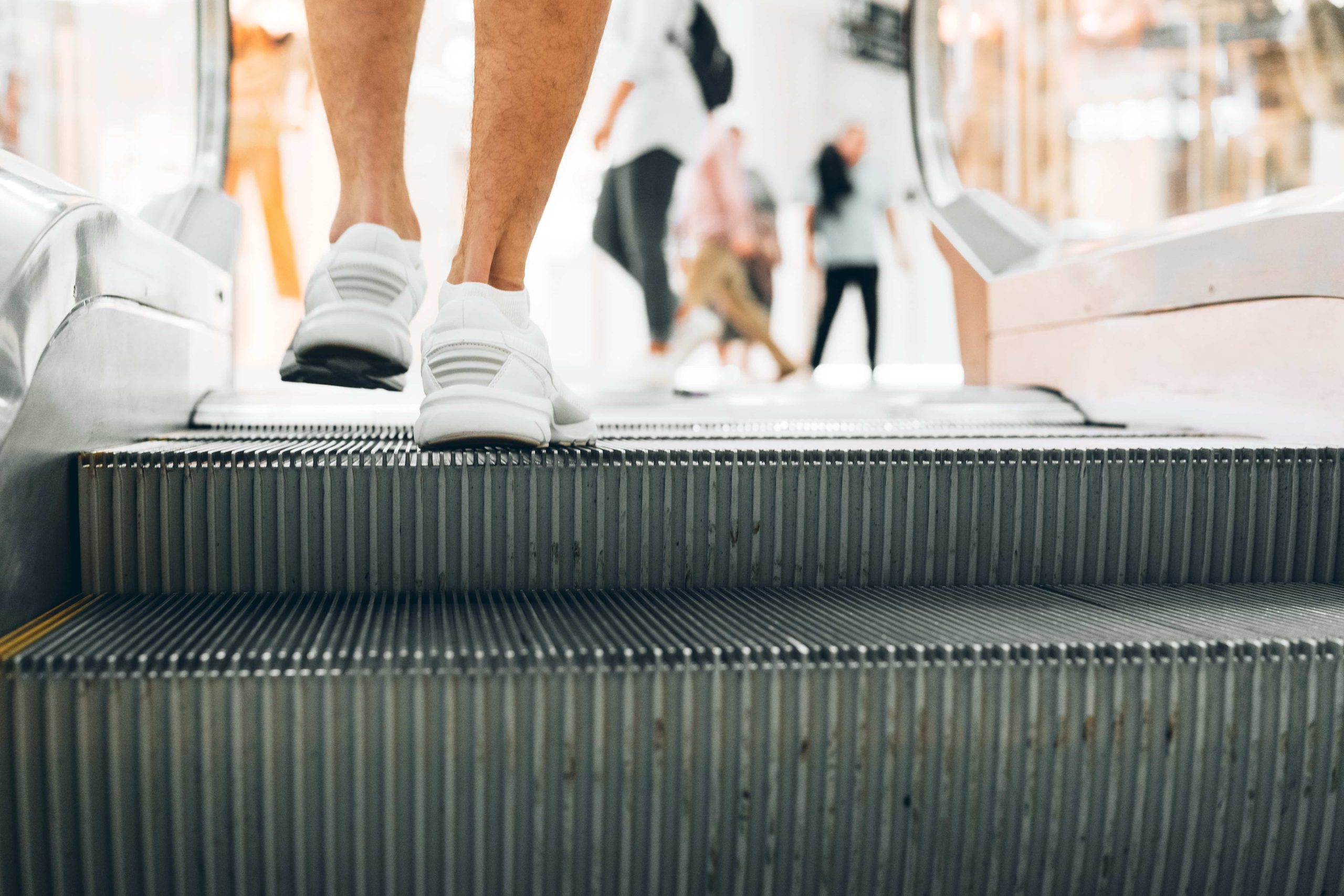
Escalators and elevators pose heightened risks to the most vulnerable. Small children can catch fingers or clothing in escalator gaps or be knocked down by a sudden stop, and older visitors are more likely to fall and to suffer serious fractures. A malfunction that might jostle a healthy adult can gravely injure a child or an elderly person, which is part of why the duty to maintain these machines is taken so seriously.
What an escalator or elevator victim can recover
An injured person may recover medical bills and future care, lost wages, and pain and suffering. Escalator and elevator injuries, crush injuries, amputations, fractures, and head trauma can be severe and permanent, so valuing the full, long-term cost is essential. The Florida premises liability lawyers and the Miami injury team pursue these claims throughout Miami-Dade County.
Why prompt action preserves the proof
The equipment can be repaired or modified after a malfunction, and surveillance footage is overwritten quickly, so early action is essential. A prompt investigation, backed by a demand to preserve the machine’s condition, the maintenance records, and the footage, protects the evidence. And under the statute of limitations (§95.11), the claim must be filed within the period it allows, so acting early safeguards both the evidence and the right to sue.
What to do after an escalator or elevator injury
After a malfunction, quick action protects both safety and a claim. The injured person should seek medical care and report the incident to the property’s management, asking that a report be created and that the equipment be taken out of service and preserved. Photographing the escalator or elevator, the specific defect if visible, and the surrounding area captures evidence before repairs erase it. Getting the names of witnesses and noting the equipment’s identifying information helps later. Because the property owner and its service company control the machine and its records, prompt documentation and a demand to preserve the equipment is often decisive.
Why is expert analysis of the machine essential
Escalator and elevator cases are technical and usually require an engineering expert to determine what went wrong and why. By examining the machine, its maintenance history, and the manufacturer’s specifications, an expert can determine whether a part failed, a safety device was disabled, or required service was skipped, and whether the failure was foreseeable and preventable. This analysis distinguishes a genuine defect or maintenance lapse from an unavoidable event, and it is often what proves that the owner or service company breached its duty rather than that the injury was simply bad luck.
Why are these injuries so often permanent
Escalator and elevator failures tend to cause injuries that do not fully heal. Entrapment can lead to crush injuries and amputations; a fall down a moving escalator or a mislevel elevator can cause traumatic brain and spinal injuries; and the forces involved can shatter bones. These are the kinds of injuries that require surgery, long rehabilitation, and sometimes lifelong care, and their true cost extends far beyond the emergency room. Valuing such a claim means accounting for that permanence, the future surgeries, the lost earning capacity, and the lasting change to the injured person’s life, not just the initial treatment.
Related: short-term rental and Airbnb injuries.
Hurt on an Escalator or Elevator in Miami?
These machines are safe only when properly maintained, and a malfunction can cause devastating injuries. The team behind our Miami premises liability lawyers page can investigate. Contact the firm at 954-522-5800 or 844-643-7200 for a free case review.
Sources: Florida Statutes §768.81 (comparative fault); Florida Statutes §768.72 (punitive damages); Florida Statutes §95.11 (statute of limitations)
About the Firm
Published by the Law Offices of Wolf & Pravato
For nearly three decades, the Law Offices of Wolf & Pravato have represented injured Floridians and their families across South and Southwest Florida, exclusively on the plaintiff’s side. The firm is led by managing partner Richard P. Pravato, a Board-Certified Civil Trial Attorney (Florida Bar No. 86150). To reach the lawyer who handles cases in your area, visit our attorneys page, explore our practice areas, or learn more about our firm.
Law Offices of Wolf & Pravato · Miami, FL (serving Miami-Dade County) · 954-522-5800 · Free case evaluation: 844-643-7200
FAQs
Q1. How do escalator injuries usually happen?
Through sudden stops or speed changes that throw riders, missing or broken steps, gaps that trap shoes, clothing, or fingers, faulty handrails, and abrupt reversals. Children and the elderly are especially at risk. Many failures trace to skipped maintenance, worn parts that should have been replaced, or disabled or defective safety devices.
Q2. What causes elevator injuries?
Elevators cause injury when they mislevel and leave a dangerous step at a floor, when doors close on a passenger or fail to detect an obstruction, when the car drops or stops abruptly, or when a passenger is hurt escaping a stuck car. A malfunction usually reflects a lapse in inspection and repair rather than chance.
Q3. Who is liable for an escalator or elevator accident?
Liability can extend to the property owner or operator of the mall or hotel, the maintenance or elevator-service company responsible for upkeep, and, where a defect caused the failure, the manufacturer. Because responsibility can be apportioned, identifying each party whose failure contributed is important to reaching all coverage.
Q4. How are these cases proven?
Largely through documents: inspection certificates, maintenance and repair logs, prior complaint records, and the manufacturer’s specifications. These reveal whether the equipment was serviced on schedule and whether known problems were ignored. A gap in the maintenance history or repeated unaddressed complaints can establish the neglect.
Q5. Why are children and older visitors at greater risk?
Because a malfunction that might jostle a healthy adult can gravely injure them. Small children can catch fingers or clothing in escalator gaps or be knocked down by a sudden stop, and older visitors are more likely to fall and suffer serious fractures. That heightened risk is part of why the duty to maintain these machines is taken seriously.
Q6. What can an injured person recover?
Medical bills and future care, lost wages, and pain and suffering. Because escalator and elevator injuries, crush injuries, amputations, fractures, and head trauma, can be severe and permanent, valuing the full, long-term cost is essential to a fair recovery.
Disclaimer: This blog post is provided for general informational purposes only and does not constitute legal advice. Reading this content does not create an attorney-client relationship between you and the Law Offices of Wolf & Pravato. Laws change and every case is different, so you should not act or rely on any information here without consulting a licensed Florida attorney about your specific situation. For advice regarding your circumstances, please contact our office for a free consultation.
Recent Posts
- Wrong Burial Plot and Grave-Site Errors in Fort Lauderdale

- Rainwater Falls at Fort Lauderdale Store Entrances

- Parking-Lot Backing Crashes in Fort Lauderdale: Who Has the Right of Way?
- Elevator and Escalator Injuries at Fort Lauderdale Shopping Centers
- Delivery Driver Car Accidents in Lakeland: Who Pays?

- Injured as a Passenger in Fort Lauderdale: Whose Insurance Pays?





FLORIDA’S PERSONAL INJURY ATTORNEYS FOR + 20 YEARS