















Stairway and Handrail Defect Falls in Miami Apartment Buildings
By the Law Offices of Wolf & Pravato · Published July 7, 2026
Quick answer: A fall on a defective stairway or a broken handrail in a Miami apartment building can make the landlord or property owner liable when the defect breached a duty to maintain the premises and the owner knew or should have known about it.
Miami’s many apartment and condominium buildings rely on stairwells that residents and visitors use every day, and when a stairway or handrail is defective, a fall can cause serious injury. These cases are not simply about a slippery step; they often involve a landlord’s failure to maintain the building to a safe standard. A Miami slip and fall lawyer evaluates both the defect and the duty behind it.
Why stairway falls are different from a simple slip
A fall on stairs tends to be more dangerous than a fall on a flat floor, because a person can tumble down multiple steps and strike hard edges along the way. The injuries are frequently severe, and the causes are often structural rather than the result of a one-time spill. A worn tread, a broken handrail, or a code-violating step is a lasting condition that the property owner had time to discover and fix, shifting the focus from a transient hazard to the building’s ongoing upkeep.
A landlord’s duty to maintain the building
The foundation of a stairway-fall case is the property owner’s responsibility to keep the premises reasonably safe.
The obligation to keep common areas safe
Under a landlord’s duty to maintain the premises, the owner of an apartment building must keep the common areas, including shared stairwells, in reasonably safe condition and in compliance with applicable building and housing codes. Stairways used by residents and guests fall squarely within that duty. A landlord who lets a stairwell deteriorate or ignores a known defect has failed to meet an obligation imposed by law.
Building codes and the standard of a safe stairway
Building codes set concrete standards for stairways and handrails, including requirements for step dimensions, handrail height and graspability, and lighting. When a stairway or handrail violates those codes, the violation helps establish that the condition was unsafe by an objective measure. Tying a fall to a code-deficient stair or rail gives the claim a clear standard the property fell short of, rather than a matter of opinion.
Common stairway and handrail defects
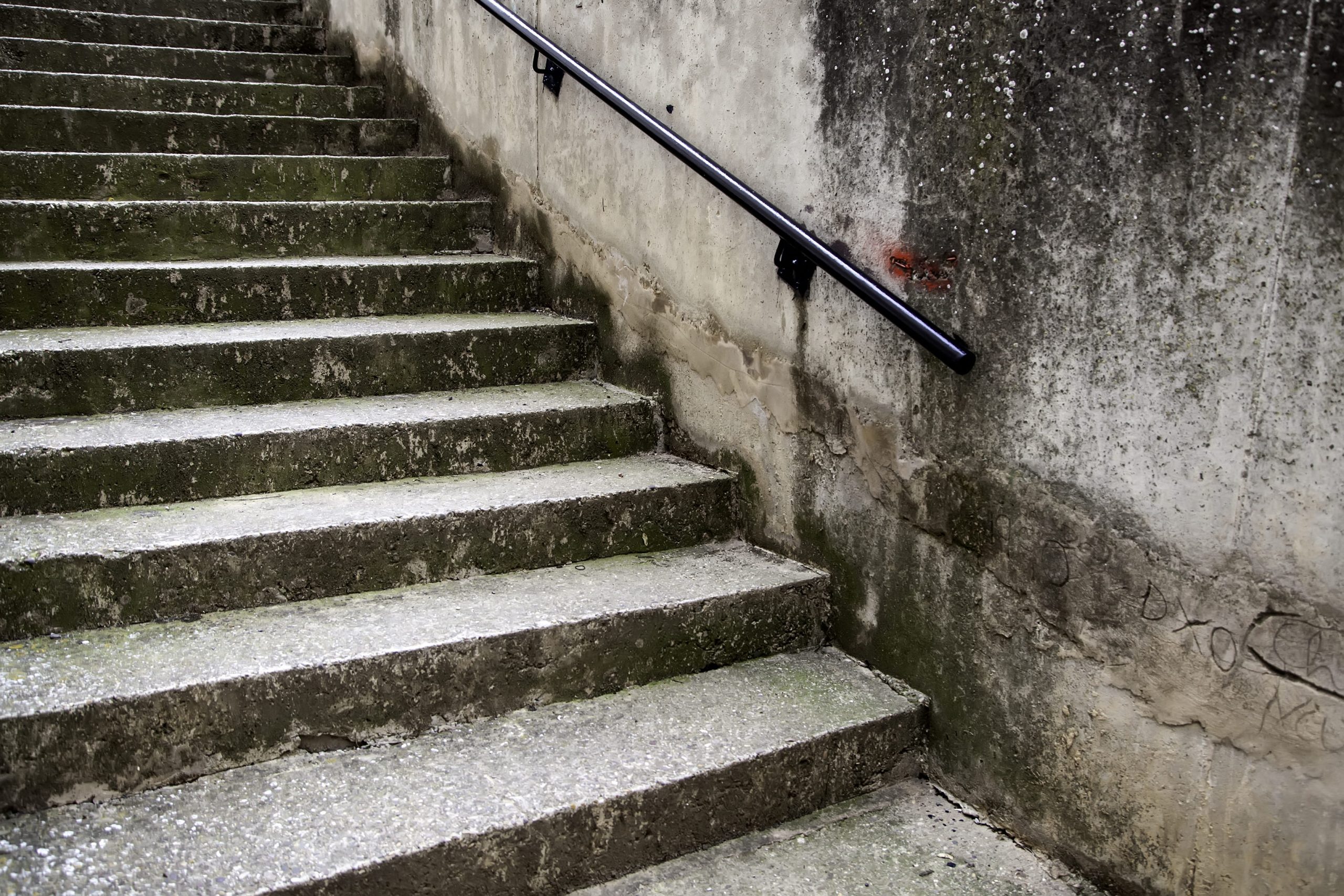
Certain defects recur in these buildings, and each can turn a routine trip up or down the stairs into a serious fall.
Structural and surface hazards on the stairs
Uneven or broken steps, worn or slippery treads, crumbling concrete, inadequate lighting, and debris or water tracked into a stairwell can all cause a fall. Some of these are structural problems the owner should have repaired; others are recurring conditions the owner should have managed. In either case, a stairwell that was allowed to become dangerous reflects a failure of maintenance.
Missing, loose, or non-compliant handrails
The handrail is a stairway’s primary safety feature, and a missing, loose, wobbly, or improperly placed rail can be the direct cause of a fall or the reason a stumble becomes a serious injury. A resident who reached for a handrail that gave way, or that was never there, lost the very protection the building was required to provide. A defective handrail is among the most common and provable failures in a stairway case.
Providing notice and the defect’s role
To hold the owner responsible, the injured person generally must show the owner knew or should have known about the defect. Under the premises notice standard, that knowledge can be actual or constructive, and a long-standing structural defect is often something the owner should have discovered through reasonable inspection. Prior complaints, maintenance records, code-inspection history, and photographs of the defect all help establish notice and connect the condition to the fall. Documenting the exact defect before it is repaired is especially important because a quick fix after the fact can erase the evidence.
Damages in a stairway-fall case
Because stairway falls tend to cause serious harm, from fractures and head injuries to spinal trauma, a claim should account for the full course of treatment, including surgery, rehabilitation, and any lasting limitation, along with lost income and the pain and reduced quality of life the injury caused. Where an older resident is involved, the injuries can be especially grave, and the law does not permit an owner to discount them because of the victim’s age. Victims can review statewide guidance from Florida slip and fall lawyers or reach our Miami injury team.
What to do after a stairway fall
The steps taken soon after a stairway fall can preserve both a person’s health and the evidence on which a claim depends.
Documenting the defect and the scene
Photographs of the specific defect, whether a broken step, a loose or missing handrail, poor lighting, or a worn tread, capture the condition before a landlord repairs it. Images of the whole stairwell, measurements where possible, and the identities of any witnesses round out the record. Because a quick fix after a fall can erase the proof, documenting the hazard promptly is one of the most valuable things that can be done.
Reporting the fall and getting care
Reporting the fall to the landlord or property manager creates a record that it happened, and keeping any written acknowledgment helps. Prompt medical evaluation protects health and ties the injuries to the fall, closing the door on an argument that the harm came from something unrelated. Stairway falls can cause injuries that are not obvious at first, so a careful check-up matters even when the initial pain seems manageable.
It also helps to keep every record connected to the fall, from the emergency visit through any follow-up care and therapy. Stairway injuries such as a fractured wrist or a concussion can require treatment that unfolds over weeks or months, and a continuous medical record ties that care to the fall while showing its full extent. Gaps in treatment give an insurer room to argue the injury was minor or unrelated, so consistent follow-through protects both health and the claim.
Fell on a defective stairway in a Miami building?
A broken step or failed handrail that a landlord should have fixed can support a serious claim. The Law Offices of Wolf & Pravato investigate the defect, the codes, and the notice. Call 954-522-5800 for a free case review.
Sources: Fla. Stat. §83.51; Fla. Stat. §768.0755
FAQs
Q1. Can a landlord be liable for a fall on an apartment stairway?
Yes. A landlord must keep common areas, including shared stairwells, in reasonably safe condition and in compliance with building and housing codes. A fall caused by a defect the owner knew or should have known about can support a claim.
Q2. How do building codes affect a stairway-fall case?
Codes set standards for step dimensions, handrail height and graspability, and lighting. A stairway or handrail that violates those codes is unsafe by an objective measure, which helps establish that the condition was dangerous and connect it to the fall.
Q3. What are common stairway and handrail defects?
Uneven or broken steps, worn or slippery treads, crumbling concrete, poor lighting, and tracked-in water are frequent hazards, as are missing, loose, or improperly placed handrails. A failed handrail is one of the most common and provable causes of a serious fall.
Q4. How do I prove the landlord knew about the defect?
Knowledge can be actual or constructive. Prior complaints, maintenance records, code-inspection history, and photographs help show the owner knew or should have discovered the defect through reasonable inspection. A long-standing structural problem is often something the owner should have found.
Q5. Why is it important to document the defect quickly?
Because a landlord may repair the stairway or handrail after a fall, which can erase the evidence. Photographs and measurements of the defect taken before any repair preserve proof of the condition that caused the injury.
Q6. Are stairway falls usually serious?
Often, yes. A fall down stairs can cause fractures, head injuries, and spinal trauma as a person tumbles down multiple steps. These injuries frequently require surgery and rehabilitation and can leave lasting effects, especially for older residents.
Q7. What if I was a guest, not a tenant?
A landlord’s duty to keep common areas reasonably safe generally extends to residents and their lawful guests. A visitor injured by a defective stairway can pursue a claim on the same basis as a tenant, depending on the facts.
Q8. How long do I have to file a stairway-fall claim in Florida?
Florida sets a limited time period to bring an injury claim. Because a landlord may repair the defect and the evidence can fade, it is wise to act well before the deadline so the condition that caused the fall can be documented.
About the Firm
Published by the Law Offices of Wolf & Pravato
For nearly three decades, the Law Offices of Wolf & Pravato have represented injured Floridians and their families across South and Southwest Florida, exclusively on the plaintiff’s side. The firm is led by managing partner Richard P. Pravato, a Board-Certified Civil Trial Attorney (Florida Bar No. 86150). To reach the lawyer who handles cases in your area, visit our attorneys page, explore our practice areas, or learn more about our firm.
Disclaimer: This blog post is provided for general informational purposes only and does not constitute legal advice. Reading this content does not create an attorney-client relationship between you and the Law Offices of Wolf & Pravato. Laws change and every case is different, so you should not act or rely on any information here without consulting a licensed Florida attorney about your specific situation. For advice regarding your circumstances, please contact our office for a free consultation.
Recent Posts
- Wrong Burial Plot and Grave-Site Errors in Fort Lauderdale

- Rainwater Falls at Fort Lauderdale Store Entrances

- Parking-Lot Backing Crashes in Fort Lauderdale: Who Has the Right of Way?
- Elevator and Escalator Injuries at Fort Lauderdale Shopping Centers
- Delivery Driver Car Accidents in Lakeland: Who Pays?

- Injured as a Passenger in Fort Lauderdale: Whose Insurance Pays?





FLORIDA’S PERSONAL INJURY ATTORNEYS FOR + 20 YEARS