















Why a Cemetery Mistake Is a Different Lawsuit Than a Funeral Home Mistake in Lakeland
A family does not buy a cemetery plot expecting to spend years fighting to find their loved one’s grave. They do not expect the marker to disappear, the burial to be in the wrong location, or the gravesite to be desecrated by vandalism the cemetery failed to prevent. When those things happen, the harm is profound — and the cemetery operator is a legally distinct defendant from any funeral home involved. At the Law Offices of Wolf & Pravato, our Lakeland cemetery negligence attorneys represent Polk County families when a cemetery in Lakeland, Winter Haven, Bartow, or the surrounding communities has failed to meet its duty of care. This article explains how cemetery cases differ from funeral home cases, the specific failures that support claims in Florida, the evidence that proves these cases, and the immediate steps your family should take.
Cemetery negligence is not always a high-profile case. Most cases involve quiet, persistent failures: poor recordkeeping, neglected maintenance, inattentive security, or a one-time burial error that the cemetery has not corrected. The harm is real even when the case is not dramatic. Florida law recognizes the family’s right to a proper, locatable, dignified burial location, and a cemetery operator that fails to provide it is liable for the harm.
The Florida Cemetery Regulation Framework
Cemetery operators in Florida are licensed and regulated under Florida Statutes Chapter 497, the Funeral, Cemetery, and Consumer Services Act. The Florida Board of Funeral, Cemetery, and Consumer Services oversees licensing, complaints, and disciplinary actions against cemetery operators. The framework imposes duties on cemetery operators including accurate plot records, maintenance of grave markers and the cemetery grounds, security against foreseeable vandalism, and accurate recordkeeping for the location of every burial.
When a cemetery operator fails any of these duties and the family suffers harm as a result, Florida law allows the family to pursue a civil claim. The claim is independent of any complaint filed with the FCCS Board, and the documentation generated by a Board complaint is often useful evidence in the civil case.
Cemetery Operators vs. Funeral Homes — Different Defendants, Different Claims
One of the most important early questions in a burial case is whether the responsible party is the funeral home, the cemetery, or both. Funeral homes are responsible for the body up to burial — including identification, transportation, embalming if applicable, and delivery to the cemetery. Cemetery operators are responsible for the burial location, the plot records, the marker, and the gravesite maintenance afterward.
Many burial errors involve both. A funeral home that handed off the wrong remains to the cemetery has caused a body release error, but the cemetery that did not verify the identity at intake may share liability. A wrong-plot burial may be the cemetery’s record-keeping failure, but the funeral director’s failure to verify the assigned plot before lowering the casket may be a contributing cause. Our role is to identify every responsible party and pursue every available insurance source. When cemetery negligence overlaps with a funeral home failure, we coordinate with our Lakeland funeral home negligence team to address both.
Common Cemetery Negligence Scenarios in Lakeland
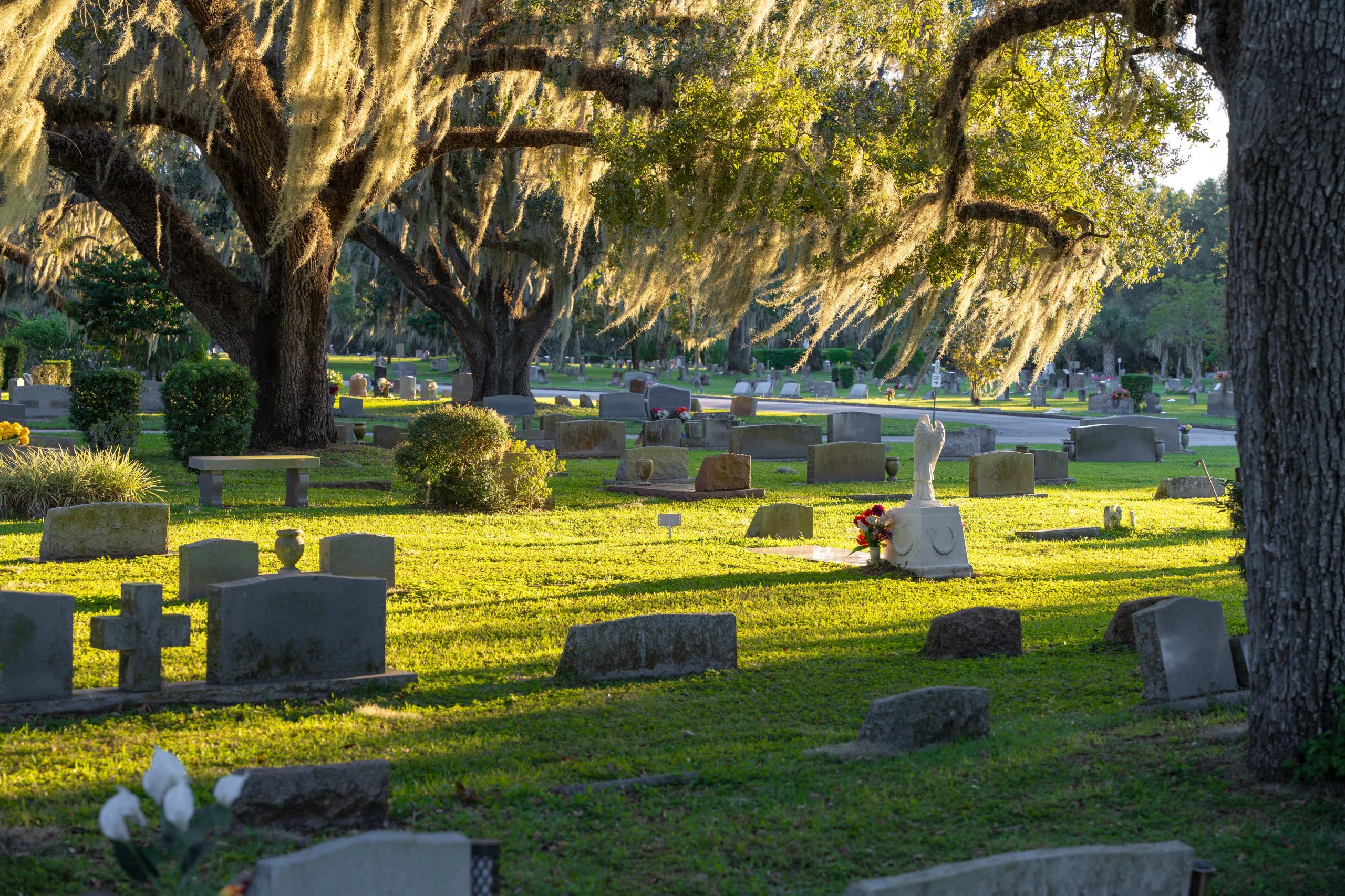
Cemetery negligence cases in Polk County typically fall into one of the following categories:
- Wrong-plot burial. The remains are buried in a plot other than the one the family purchased.
- Stacked burial. A new burial is performed on top of an existing burial, often due to record-keeping failures.
- Lost grave marker. The marker is removed during maintenance, damaged by equipment, or simply lost over time and not replaced.
- Inaccurate plot records. The cemetery cannot locate the burial when the family arrives because the records do not match the burial.
- Gravesite desecration. Vandalism the cemetery failed to prevent or address, or damage caused by cemetery equipment or contractors.
- Failure to honor contract terms. The cemetery failed to provide maintenance, memorial services, or other services the family contracted for.
Lost or Damaged Grave Markers
Grave markers — headstones, footstones, ground-level markers — are often damaged by maintenance equipment, weather, ground settling, or neglect. A cemetery operator has a duty to maintain markers within reasonable industry standards. When a marker is destroyed, lost, or allowed to deteriorate beyond use, the family loses the ability to locate and visit the gravesite as expected. Replacement may be possible — but the harm of being unable to find the gravesite for months or years is itself recoverable damage.
Wrong-Plot and Stacked Burials
Wrong-plot burials are among the most serious cemetery negligence cases. Correction often requires exhumation, re-burial, and significant additional expense — all of which the family did not anticipate when they purchased the plot. Stacked burials, where new remains are interred on top of existing remains, are particularly difficult to correct and often require coordination with our Florida premises liability representation because the cemetery’s failure often involves ground management and maintenance issues.
Gravesite Desecration and Vandalism
Cemeteries owe a duty of reasonable security against foreseeable vandalism. When a cemetery has a known pattern of vandalism — repeated incidents in the same area, prior complaints, public reports — the failure to address that pattern can be the basis of a negligence claim. The harm is not just to the marker or the gravesite; it is to the family’s right to expect that the cemetery will protect their loved one’s resting place. Florida courts have recognized that gravesite desecration can support emotional distress claims even when the physical damage is repairable, because the harm to the family’s right to the burial space goes beyond the value of the marker itself.
Cemetery operators sometimes argue that they cannot prevent all vandalism. That is true — but the legal question is whether the cemetery exercised reasonable care, not whether vandalism is theoretically possible. A cemetery with a history of incidents in a particular section that fails to add lighting, fencing, security patrols, or visibility into the area has failed to act on a foreseeable risk. The same is true when cemetery equipment or maintenance contractors damage markers and the cemetery does not document, report, or repair the damage promptly. These are the cases where the cemetery’s own records — incident logs, complaint history, maintenance reports — make or break the claim.
Evidence That Proves Cemetery Negligence
Cemetery negligence cases are built on the cemetery’s own records and the documents the family received at the time of purchase. We obtain:
- The plot purchase contract and any related documents, including the diagram or plat identifying the purchased location
- The cemetery’s burial log, identifying which remains are in which plot
- Maintenance records, including any record of marker damage, replacement, or removal
- Security incident reports and complaint logs
- Prior FCCS Board complaints and disciplinary history of the cemetery operator
- Photographs and family records documenting the original marker location, the contracted plot, and any present damage
- Aerial photography and GIS records where available, which can help reconstruct the historical location of the plot
Damages a Family May Recover
Cemetery negligence cases can recover refunds for the original plot purchase if correction is not possible, the costs of exhumation and re-burial where correction is possible, the cost of replacement markers, and emotional distress damages where the evidence supports them. Punitive damages may be available under Florida Statute §768.72 where the cemetery’s conduct meets the gross negligence threshold — particularly in cases involving systemic recordkeeping failures or known vandalism patterns the cemetery ignored.
When Cemetery Negligence Becomes a Wrongful Death Claim
Cemetery negligence does not cause death. But it can intersect with a wrongful death claim when, for example, the cemetery’s failures eliminate evidence the family needed for a related claim or when the family was prevented from properly grieving in a way that delayed the underlying claim. In these situations, our Lakeland wrongful death attorneys coordinate the cemetery claim with any underlying wrongful death matter under Florida Statute §768.21.
What to Do If You Suspect Cemetery Negligence
- Photograph the current state of the gravesite, including any missing or damaged markers, the surrounding area, and any visible signs of disturbance.
- Gather the plot purchase contract, the diagram or map showing the plot location, and any maintenance contracts with the cemetery.
- Request the cemetery’s burial log and any maintenance records for the affected area.
- Document every conversation with cemetery staff, including names, titles, and what was said.
- Call a Lakeland cemetery negligence attorney before accepting any ‘goodwill gesture’ from the cemetery operator.
How a Cemetery Negligence Attorney Builds the Case
Our Florida funeral home negligence team approaches cemetery cases as multi-defendant matters when funeral home conduct is also involved. We send preservation letters to the cemetery operator and any contracted grounds maintenance company, pull licensing and complaint records from the FCCS Board, coordinate with cemetery-management standards-of-care experts, and identify every available insurance policy. Cemetery cases often involve corporate parent companies, ground maintenance contractors, and security contractors that each carry separate insurance.
Common Defenses Cemetery Operators Use
- ‘The family must have moved the marker.’ This defense is rebutted with maintenance records, photographs, and the cemetery’s own documentation.
- ‘The damage was caused by vandals beyond our control.’ Cemeteries have a duty of reasonable security against foreseeable vandalism. A pattern of prior incidents undermines this defense.
- ‘The contract limits our liability.’ Liability waivers in cemetery contracts cannot exclude gross negligence or intentional misconduct under Florida law.
Why Families Should Act Quickly
Florida’s statute of limitations for funeral home negligence claims varies by the underlying legal theory. Wrongful death claims generally must be filed within two years of the date of death under Florida Statutes §95.11. General negligence and intentional infliction of emotional distress claims have a four-year deadline. Evidence — paperwork, identification tags, refrigeration logs, witness memory, and the remains themselves — disappears quickly. Calling a Lakeland funeral home negligence lawyer does not commit you to litigation. It commits us to preserving what is left of the evidence.
Why Choose the Law Offices of Wolf & Pravato
Families across Lakeland and the surrounding Polk County communities trust the Law Offices of Wolf & Pravato because of our experience handling funeral-industry negligence cases, our willingness to take cases to trial when the evidence warrants it, and the personal attention we give to every family. Our firm obtained a $3.5 million Palm Beach County jury verdict against a funeral home and a separate seven-figure punitive damages verdict in another funeral-industry case — a record that signals to insurers that our cases are prepared for trial from day one.
- Experience — decades of representing seriously injured Floridians and grieving families across the state, including complex funeral home and wrongful death litigation.
- Expertise — we work with forensic pathology, mortuary science, and funeral-industry standards-of-care experts to build evidence-based cases that hold up at trial.
- Authority — we are one of the few Florida law firms with substantial trial experience against funeral homes, crematories, and cemetery operators.
- Trustworthiness — contingency-fee representation. You pay nothing unless we recover compensation for your family.
- Personal attention — you work directly with attorneys who know your case, not a call center.
Richard Paul Pravato is a founding attorney at the Law Offices of Wolf & Pravato. He is licensed by The Florida Bar (Florida Bar #86150) and has dedicated his career to representing injury victims and grieving families throughout Florida.
Speak With a Lakeland Cemetery Negligence Lawyer Today
If you believe a funeral home, crematory, or cemetery in Lakeland or the surrounding Polk County communities buried your loved one in the wrong plot, lost or damaged the grave marker, failed to maintain the gravesite, or allowed desecration the cemetery should have prevented, do not wait to get answers. Florida’s deadlines are strict, and key evidence can be lost over time.
The Law Offices of Wolf & Pravato offers a free, confidential case evaluation. There is no cost to talk with us, and no fee unless we recover compensation for you. You can request a free case evaluation online anytime.
Call our team today at (954) 633-8270 to schedule your free consultation. Our Lakeland funeral home negligence attorneys will review your family’s case, explain your rights, and pursue the compensation your family deserves.
Frequently Asked Questions
Is cemetery negligence different from funeral home negligence in Florida?
Yes. Cemeteries and funeral homes are different defendants with different duties under Florida law. A cemetery operator is responsible for maintaining the gravesite, the records, the markers, and the burial location. A funeral home is responsible for the body up to burial. Both may share liability when burial errors involve handoff failures, but they are separate licensed entities with separate responsibilities.
What is a wrong-plot burial?
A wrong-plot burial occurs when remains are buried in a plot that was not purchased for them — sometimes the wrong section, sometimes a plot belonging to another family, sometimes on top of an existing burial. The cemetery operator is generally liable for failing to maintain accurate records and to verify the correct plot before burial.
Can I sue a Lakeland cemetery for losing a grave marker?
If the cemetery operator’s failure to maintain the marker, records, or site management caused the loss, yes. The harm depends on the facts — some lost markers can be replaced; others result in lasting harm to the family’s ability to locate or visit the gravesite.
Who is liable for grave desecration?
Depending on the facts, the cemetery operator, security contractors, and any individuals involved may share liability. The cemetery operator’s failure to maintain reasonable security or address known vandalism patterns is often the central claim.
How long do I have to file a cemetery negligence lawsuit in Florida?
General negligence claims must generally be filed within four years under Florida Statutes Section 95.11. If the cemetery negligence intersects with a wrongful death claim, the deadline shortens to two years.
Can I recover for the emotional harm of a wrong-plot burial?
Florida law recognizes emotional distress damages in cemetery negligence cases where the evidence supports them. The harm to the family’s right to a proper burial location is a recognized legal injury.
What does it cost to hire Wolf & Pravato?
Nothing upfront. Contingency-fee representation. No fee unless we recover compensation for your family.
Recent Posts
- Wrong Burial Plot and Grave-Site Errors in Fort Lauderdale

- Rainwater Falls at Fort Lauderdale Store Entrances

- Parking-Lot Backing Crashes in Fort Lauderdale: Who Has the Right of Way?
- Elevator and Escalator Injuries at Fort Lauderdale Shopping Centers
- Delivery Driver Car Accidents in Lakeland: Who Pays?

- Injured as a Passenger in Fort Lauderdale: Whose Insurance Pays?





FLORIDA’S PERSONAL INJURY ATTORNEYS FOR + 20 YEARS