











Should You File an FCCS Board Complaint Before Suing a Fort Lauderdale Funeral Home?
Families in Fort Lauderdale who discover that a funeral home has mishandled a loved one’s remains often want two things at once: they want the funeral home held accountable so it cannot do this to another family, and they want compensation for what their own family has suffered. Florida law provides two separate tracks for those two goals, and they do not always run on the same timeline. At the Law Offices of Wolf & Pravato, our Fort Lauderdale funeral board complaint attorneys help Broward County families understand the difference between filing a regulatory complaint with the Florida Board of Funeral, Cemetery, and Consumer Services and pursuing a civil lawsuit, and we coordinate the two so that they work together rather than against each other.
This article is for families who are weighing whether to file a Board complaint, who have already filed and want to know what happens next, and for families whose civil attorneys have not addressed the regulatory side. The choices a family makes in the first weeks shape both tracks for months or years afterward.
What the FCCS Board Is and What It Can Do
The Florida Board of Funeral, Cemetery, and Consumer Services is housed within the Department of Business and Professional Regulation. It licenses every funeral establishment, funeral director, crematory, and cemetery operator in Florida under Florida Statutes Chapter 497. The Board accepts complaints from any member of the public, investigates them through its enforcement division, and can impose disciplinary action that ranges from written reprimand to fines, license suspension, and revocation.
Board action protects future families. A funeral home that loses its license cannot continue to harm new families. A funeral director with disciplinary history on file becomes a known risk that families can research. But Board action does not put money in the hands of the family that was harmed. Restitution orders are sometimes available in limited circumstances but are not a substitute for civil damages. If the family wants compensation — refunds, corrective costs, emotional distress damages, or punitive damages — the family must file a civil lawsuit.
What a Civil Lawsuit Achieves That a Board Complaint Cannot
A civil lawsuit can recover refunds, the cost of corrective services, emotional distress and mental anguish damages, and punitive damages under Florida Statute §768.72 where the funeral home’s conduct meets the gross negligence or intentional misconduct standard. Where wrongful death is part of the claim, Florida Statute §768.21 allows recovery for the surviving spouse, children, and other statutory survivors. None of these remedies are available through a regulatory complaint. The Board cannot make the family whole. Only a civil court can.
When to File the Board Complaint Before the Civil Lawsuit
There are situations where filing the regulatory complaint first preserves evidence and improves the civil case. The Board can compel the funeral home to produce records that a private party might struggle to obtain without formal discovery. Board investigators interview staff and create sworn records that become powerful evidence later. When the funeral home knows the Board is watching, it is less likely to destroy records or coach witnesses. In some cases — especially where evidence is at risk of being lost in the ordinary course of business — getting the Board involved early is a smart move.
Filing the complaint first also signals seriousness to the funeral home’s insurer, which can affect settlement posture later. An insurer that knows the conduct is under regulatory review treats the civil claim differently than one that does not.
When Filing the Board Complaint First Can Hurt Your Civil Case
There are equally important situations where filing the regulatory complaint first damages the civil case. A complaint filed in the first weeks after a death — when the family does not yet know all the facts — locks the family into a narrative they may not want to defend in litigation. A complaint that overstates what happened can be used to impeach the family’s later civil testimony. A complaint that understates what happened limits the damages the family can later argue.
Families who file regulatory complaints without coordinating with a civil attorney sometimes find that the funeral home’s defense lawyers use the complaint against them — pointing to inconsistencies between what the family told the Board and what the family alleges in the civil case. These inconsistencies are often the result of incomplete early knowledge rather than dishonesty, but the defense will exploit them regardless.
Common Scenarios Where Both Tracks Run in Parallel
Most serious funeral home negligence cases in Fort Lauderdale involve both a Board complaint and a civil lawsuit, filed in coordination. Examples include:
- Wrongful cremation cases where the funeral home cremated the wrong remains or cremated without authorization in violation of §497.607
- Cases where the funeral director’s licensing history shows prior similar misconduct — strengthening both the disciplinary case and the civil punitive damages claim
- Cases involving multiple families harmed by the same funeral home, where Board enforcement may identify additional plaintiffs for a coordinated civil action
- Cases where the funeral home is part of a corporate chain, and the Board investigation may reach beyond the local establishment to corporate policies
- Cases involving falsified records, where the Board has tools to compel preservation that private discovery would have to fight for
The Discoverability of Your Regulatory Statements
Statements made in a Board complaint are generally discoverable in civil litigation. The funeral home’s defense lawyer can subpoena the Board file, obtain the complaint, and use any inconsistencies between the family’s complaint statement and the civil pleading. This is one of the most important reasons to draft the complaint with civil counsel involved. The complaint does not have to be exhaustive. It has to be accurate and consistent with what the family will be prepared to prove in court.
Coordinating the Two Tracks — What an Attorney Does Differently
Our Fort Lauderdale funeral home negligence attorneys approach the regulatory and civil tracks as a single coordinated strategy. We typically draft the complaint with civil litigation in mind, time the filing to maximize evidence preservation, send preservation letters to the funeral home and any third-party crematory or transportation contractor before the Board complaint is filed, and request copies of all Board investigation records throughout the process. When the Board interviews staff, those sworn statements become evidence we use in the civil case. When the Board issues findings, those findings carry substantial weight in front of a jury.
The reverse coordination matters just as much. Discovery in the civil case sometimes uncovers evidence the family can then bring back to the Board to expand the regulatory investigation. A pattern of misconduct that surfaces in deposition testimony can prompt the Board to look at additional families, additional funeral home locations, or additional employees. We have seen civil discovery transform a single-family complaint into a multi-family Board investigation that, in turn, surfaces additional plaintiffs for the civil action. Treating the two tracks as one strategy from the first phone call is what makes this kind of coordinated outcome possible.
How a Fort Lauderdale Funeral Board Complaint Attorney Builds the Case
The civil case-building work runs in parallel to the Board complaint. We obtain the funeral home’s licensing history and prior complaint records, coordinate with mortuary-science and funeral-industry standards-of-care experts, identify every party in the chain of custody, and pursue every available insurance source. The Board’s investigation gives us a head start on these steps, but it does not replace any of them.
Where the civil case involves wrongful death, our Fort Lauderdale wrongful death attorneys work alongside the funeral-industry team so that the regulatory complaint, the civil lawsuit, and any related wrongful death claim are coordinated from the start. Many of the most successful funeral home negligence cases in Florida are won because the family and counsel addressed both tracks together, not because one or the other was perfect alone.
Common Defenses Funeral Homes Use in Board Investigations
- ‘The family misunderstood our procedures.’ The Board investigators are trained to look past this defense by comparing the funeral home’s stated procedures to its actual documentation.
- ‘Our documentation shows we followed the law.’ This defense fails when the documentation is internally inconsistent or when the funeral home cannot produce records it should have maintained.
- ‘This was a one-time mistake by an employee.’ The Board takes this defense more seriously when there is no prior disciplinary history — and less seriously when prior complaints show a pattern.
The defense lawyer’s job in a Board investigation is to limit the scope of disciplinary action as much as possible. The family’s job — and the family’s counsel’s job — is to ensure that the investigation reaches the conduct that actually harmed the family. Coordinating regulatory and civil counsel from the first phone call is what gives families the strongest position in both forums.
Damages a Family May Recover in the Civil Track
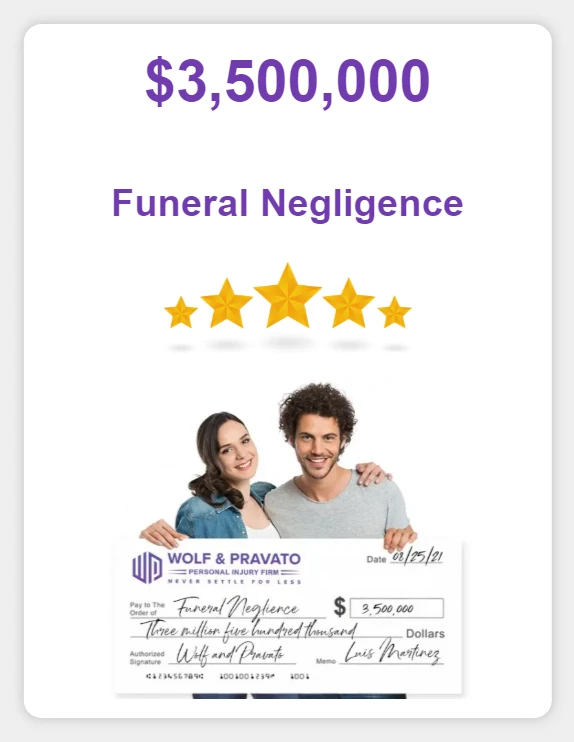
Civil recovery in a coordinated case can include refunds, corrective costs, emotional distress damages, punitive damages under Florida Statute §768.72 where the gross negligence standard is met, and wrongful death damages under Florida Statute §768.21 where applicable. The Board’s regulatory findings often help establish the standard of care violation, which makes the civil case more efficient. Wolf & Pravato’s $3.5 million Palm Beach County jury verdict was achieved in a funeral home mishandling case prepared with the full coordination this article describes.
Why Families Should Act Quickly
Florida’s statute of limitations for funeral home negligence claims varies by the underlying legal theory. Wrongful death claims generally must be filed within two years of the date of death under Florida Statutes §95.11. General negligence and intentional infliction of emotional distress claims have a four-year deadline. Evidence — paperwork, refrigeration logs, surveillance video, witness memory, and the remains themselves — disappears quickly. Calling a Fort Lauderdale funeral home negligence lawyer does not commit you to litigation. It commits us to preserving what is left.
Why Choose the Law Offices of Wolf & Pravato
Families across Fort Lauderdale and the surrounding Broward County communities trust the Law Offices of Wolf & Pravato because of our experience with funeral-industry negligence cases, our willingness to take cases to trial when the evidence warrants it, and the personal attention we give to every family. Our firm obtained a $3.5 million Palm Beach County jury verdict against a funeral home and a separate seven-figure punitive damages verdict in another funeral-industry case — a trial record that signals to defense lawyers and insurers that our cases are prepared for trial from day one.
- Experience — decades of representing seriously injured Floridians and the families of deceased loved ones, including complex funeral home and wrongful death litigation.
- Expertise — we work with forensic pathology, mortuary science, refrigeration engineering, and funeral-industry standards-of-care experts to build evidence-based cases.
- Authority — we are one of the few Florida law firms with substantial trial experience against funeral homes, crematories, and cemetery operators.
- Trustworthiness — contingency-fee representation. You pay nothing unless we recover compensation for your family.
- Personal attention — you work directly with attorneys who know your case, not a call center.
Richard Paul Pravato is a founding attorney at the Law Offices of Wolf & Pravato. He is licensed by The Florida Bar (Florida Bar #86150) and has dedicated his career to representing injury victims and grieving families throughout South Florida.
Speak With a Fort Lauderdale Funeral Board Complaint Lawyer Today
If you believe a funeral home, crematory, or cemetery in Fort Lauderdale or Broward County mishandled your loved one’s remains and you are considering whether to file an FCCS Board complaint, a civil lawsuit, or both, do not wait to get answers. Florida’s deadlines are strict, and key evidence can be lost over time.
The Law Offices of Wolf & Pravato offers a free, confidential case evaluation. There is no cost to talk with us, and no fee unless we recover compensation for you. You can request a free case evaluation online anytime.
Call our team today at (954) 633-8270. Our Fort Lauderdale funeral home negligence attorneys will review your family’s case, explain your rights, and pursue the compensation your family deserves.
Frequently Asked Questions
What is the FCCS Board?
The Florida Board of Funeral, Cemetery, and Consumer Services is the regulatory body within the Florida Department of Business and Professional Regulation that licenses and disciplines funeral establishments, funeral directors, crematories, and cemetery operators across Florida. The Board can suspend or revoke licenses, impose fines, and order corrective action — but it cannot award civil damages to a family.
Should I file an FCCS Board complaint before or after a civil lawsuit?
It depends. In many cases, filing the regulatory complaint first preserves evidence and generates Board investigation records that can be used as evidence in the civil case. In other cases, filing first can lock a family into a regulatory narrative that limits their civil claims. Talk to a Fort Lauderdale funeral home negligence attorney before filing so the two tracks are coordinated.
What does an FCCS Board complaint achieve that a civil lawsuit cannot?
Regulatory action — license suspension, revocation, fines, and disciplinary record. These outcomes protect future families from the same conduct but do not compensate the affected family financially. Civil litigation is the only path to monetary recovery for the family.
What does a civil lawsuit achieve that an FCCS Board complaint cannot?
Compensation for the family — refunds, costs to correct errors, emotional distress damages, and where the gross negligence standard is met under Florida Statute 768.72, punitive damages. Civil cases also allow the family to recover wrongful death damages under Florida Statute 768.21 where applicable.
How long does the FCCS Board take to investigate a complaint?
Investigation timelines vary depending on the complexity of the complaint, the Board’s caseload, and whether the funeral home cooperates. Some matters resolve in months. Others take years. The civil SOL runs in parallel and is not paused by the pendency of a regulatory investigation.
Can the funeral home use my FCCS complaint against me in a civil case?
Statements made in a regulatory complaint can become discoverable in civil litigation. This is one of the most important reasons to coordinate the complaint with civil counsel before filing — the language, the facts presented, and the specific allegations matter.
What does it cost to have Wolf & Pravato file the complaint and represent us?
We do not charge for the regulatory complaint when we are also representing the family in a civil claim. Civil representation is on a contingency-fee basis — no fee unless we recover compensation.
Recent Posts
- Wrong Burial Plot and Grave-Site Errors in Fort Lauderdale

- Rainwater Falls at Fort Lauderdale Store Entrances

- Parking-Lot Backing Crashes in Fort Lauderdale: Who Has the Right of Way?
- Elevator and Escalator Injuries at Fort Lauderdale Shopping Centers
- Delivery Driver Car Accidents in Lakeland: Who Pays?

- Injured as a Passenger in Fort Lauderdale: Whose Insurance Pays?





FLORIDA’S PERSONAL INJURY ATTORNEYS FOR + 20 YEARS