











E-Scooter Injuries in Las Olas and Fort Lauderdale Sidewalks
Fort Lauderdale Las Olas Injuries and Sidewalk: E-Scooter Accident Lawyer
Published by the Law Offices of Wolf & Pravato on July 2, 2026.
Quick answer: A Fort Lauderdale e-scooter accident lawyer helps riders and pedestrians hurt in rental-scooter crashes on sidewalks and around Las Olas. Under Florida law, a motorized-scooter operator has a bicyclist’s rights and duties, so fault turns on negligence, whether by a driver, another rider, or a scooter company.
Rental e-scooters have become a common sight around Las Olas Boulevard and along Fort Lauderdale’s sidewalks and beachfront, offering an easy ride but also a real risk of injury. When a scooter crash happens, riders and pedestrians alike are often unsure of their rights. A Fort Lauderdale bicycle accident lawyers team helps people hurt in these micromobility crashes understand who is responsible and how to recover.
Key takeaways
- Florida law gives e-scooter riders a bicyclist’s rights and duties
- A driver, the scooter company, or a defect may be at fault
- Riders and struck pedestrians alike can have a claim
Why do e-scooters cause injuries in Las Olas, Fort Lauderdale
E-scooters are fast, small, and easy to rent on impulse, and riders often share crowded sidewalks with pedestrians or dart into streets around Las Olas and the beach. Inexperience, uneven pavement, sudden stops, and conflicts with cars and walkers all contribute to crashes. Because a rider is exposed with little protection, even a low-speed rental scooter crash can cause serious injuries.
What Florida law says about e-scooter riders
Florida addresses these devices directly. Under Florida’s micromobility law (§316.2128), the operator of a motorized scooter or micromobility device generally has the same rights and duties as a bicyclist under Florida’s bicycle regulations (§316.2065). That means an e-scooter rider is entitled to use the roadway and is held to the rules of the road, so a driver who injures a rider can be liable just as in a bicycle crash.
Who can be at fault in an e-scooter crash?
Fault depends on whose negligence caused the crash, and more than one party may be responsible.
A negligent motorist
Many e-scooter injuries are caused by drivers who fail to yield, turn across a rider’s path, open a door into one, or simply do not watch for small, fast devices. When a motorist’s carelessness causes the crash, that driver and their insurance can be held responsible for the rider’s injuries.
The scooter company has a defect
Sometimes the fault lies with the scooter itself, a brake, throttle, or steering failure, or with a rental company that failed to maintain its fleet. Where a defect or poor maintenance caused the crash, the company or manufacturer may share liability, adding a source of recovery beyond any at-fault driver.
When a scooter injures a pedestrian
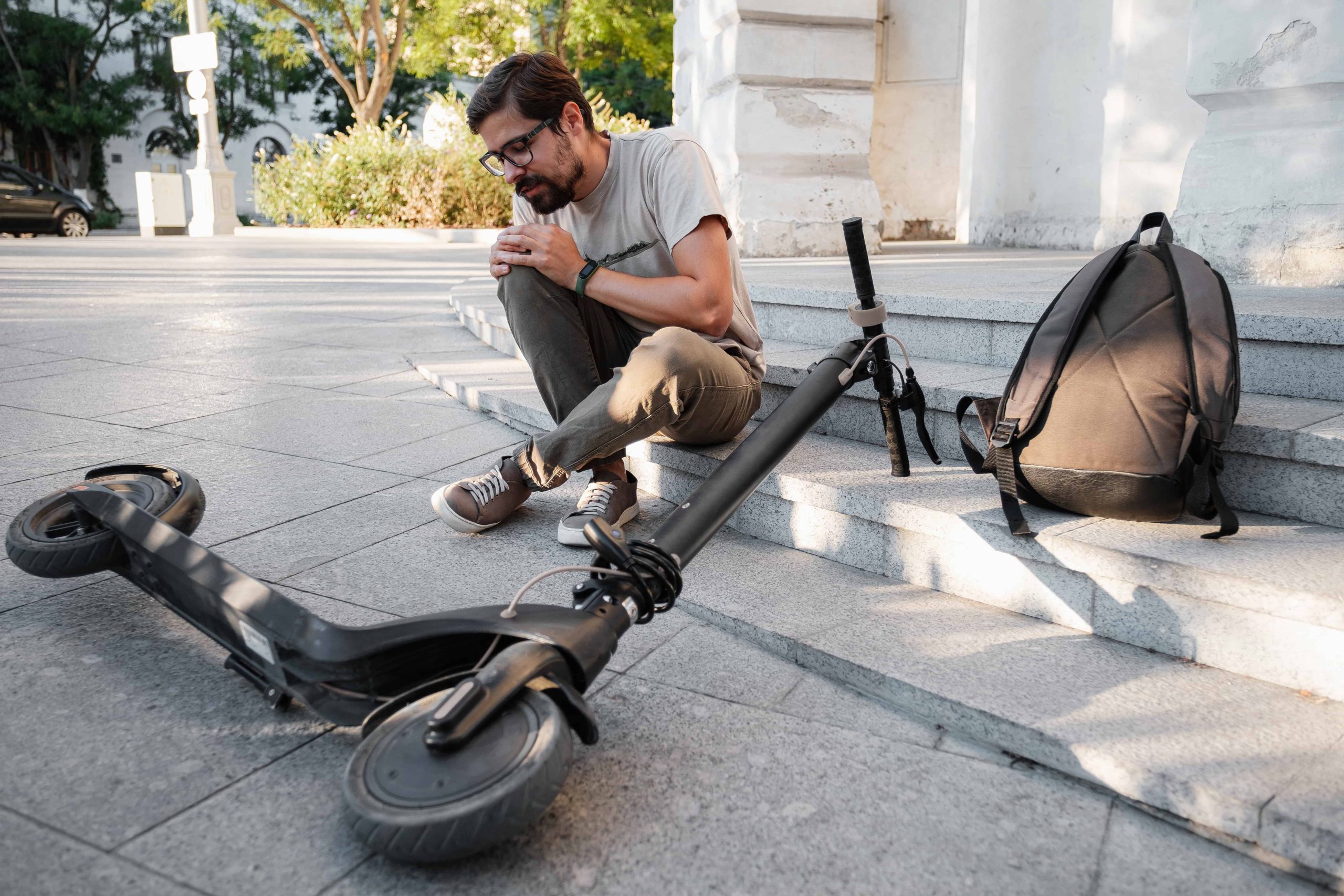
E-scooters not only injure riders; a scooter ridden carelessly on a crowded sidewalk can strike and hurt a pedestrian. In that situation, the injured pedestrian may have a claim against the rider whose negligence caused the crash, and potentially against a scooter company whose practices encouraged unsafe sidewalk riding. The same negligence principles govern who is responsible.
Common e-scooter injuries
Because riders are unprotected and often thrown from the device, e-scooter crashes frequently cause fractures of the wrist, arm, and ankle, head injuries and concussions, facial injuries, and severe road rash. Pedestrians struck by a scooter can suffer similar harm. These injuries can require surgery and lengthy recovery, making careful documentation of their full extent important.
What an injured rider or pedestrian can recover
A recovery may include medical bills, future treatment, lost wages, and pain and suffering, drawn from the coverage of the at-fault party, a negligent driver, a scooter company, or a manufacturer. Because scooter injuries can be serious and the responsible party is not always clear, identifying all potential sources of coverage is important for a full recovery.
Why local sidewalk and scooter rules matter
Florida’s micromobility law lets local governments regulate where scooters may be ridden, including on sidewalks, and Fort Lauderdale has its own rules for shared scooters. Whether a rider was permitted to be where the crash occurred can affect a claim. Understanding the applicable local ordinance, alongside the state statute, is part of establishing fault after a scooter crash.
Why evidence must be gathered quickly
Scooter-crash evidence disappears fast. The rental company’s ride and maintenance data, nearby businesses and traffic cameras along Las Olas, the scooter itself, and witness accounts can all establish what happened. Because this proof is quickly lost and comparative negligence (§768.81) lets an insurer argue the rider shared fault, preserving the evidence early is often decisive.
How long does a Florida claim have to be filed?
A deadline applies here too. Under the two-year deadline (§95.11), most injury claims must be filed within two years. Because the rental company’s data and any camera footage vanish quickly, and the scooter can be returned to service, acting early is what preserves the evidence that proves an e-scooter claim.
What should a rider do after an e-scooter crash?
After a scooter crash, prompt steps protect both health and a claim. The injured rider should seek medical care, report the crash through the rental app or to the company, and, if able, photograph the scene, the scooter, and any hazard or vehicle involved. Capturing the scooter’s identification or a screenshot of the ride preserves proof of which device was used, and gathering witness names records what happened. Because the rental company controls much of the evidence, documenting the scene independently, before the scooter is retrieved or the data is lost, is an important early step.
Why rental agreements complicate these claims
Scooter-rental apps require users to accept lengthy agreements that may include liability waivers and arbitration clauses, and companies often point to them to avoid responsibility. These provisions do not automatically defeat a valid claim: their enforceability varies, and they generally cannot excuse a company’s own negligence or a dangerous defect. Understanding how a particular agreement applies, and where it does not, is part of holding a scooter company accountable when its conduct or equipment contributed to a rider’s injuries.
Hurt in a Fort Lauderdale E-Scooter Crash?
Whether a rider or a pedestrian, a person hurt in a scooter crash has rights, and more than one party may be responsible. The team behind our Fort Lauderdale bicycle accident lawyers page can help. Call 954-522-5800 or 844-643-7200 for a free consultation, any time.
Sources: Florida Statutes §316.2128 (micromobility devices and scooters); Florida Statutes §316.2065 (bicycle regulations); Florida Statutes §95.11 (statute of limitations)
FAQs
Q1. How does Florida law treat e-scooter riders?
Under Florida Statute §316.2128, the operator of a motorized scooter or micromobility device generally has the same rights and duties as a bicyclist under §316.2065. That means an e-scooter rider may use the roadway and must follow the rules of the road, so a driver who injures a rider can be held liable much as in a bicycle crash.
Q2. Who can be held responsible for an e-scooter crash?
More than one party may be responsible. A negligent motorist who failed to yield or turned into a rider is a common cause, but a brake or throttle defect, or a rental company that failed to maintain its scooters, can also share liability. Identifying every at-fault party is important to a full recovery.
Q3. What if an e-scooter rider hits a pedestrian?
A pedestrian struck by a carelessly ridden scooter may have a claim against the rider whose negligence caused the crash, and potentially against a scooter company whose practices encouraged unsafe sidewalk riding. The same negligence principles that govern other crashes decide who is responsible for the pedestrian’s injuries.
Q4. What injuries are common in scooter crashes?
Because riders are unprotected and often thrown from the device, common injuries include wrist, arm, and ankle fractures, head injuries and concussions, facial injuries, and severe road rash. Pedestrians struck by a scooter can suffer similar harm, and these injuries can require surgery and a long recovery.
Q5. Do local Fort Lauderdale rules affect a claim?
They can. Florida’s micromobility law lets local governments regulate where scooters may be ridden, including on sidewalks, and Fort Lauderdale has its own rules for shared scooters. Whether a rider was permitted to be where the crash occurred can affect the claim, so the local ordinance matters alongside the state statute.
Q6. What can an injured rider or pedestrian recover?
A recovery may include medical bills, future treatment, lost wages, and pain and suffering, drawn from the at-fault party’s coverage, whether a negligent driver, a scooter company, or a manufacturer. Because the responsible party is not always obvious, identifying every source of coverage is important.
Q7. What does an e-scooter accident lawyer cost?
A rider or pedestrian pays nothing to start. These claims run on contingency, meaning the firm’s compensation comes solely from a recovery, never out of pocket, and the consultation itself is free. That lets an injured rider or pedestrian pursue a scooter claim, and identify every responsible party, without financial risk.
About the Firm
Published by the Law Offices of Wolf & Pravato
For nearly three decades, the Law Offices of Wolf & Pravato have represented injured Floridians and their families across South and Southwest Florida, exclusively on the plaintiff’s side. The firm is led by managing partner Richard P. Pravato, a Board-Certified Civil Trial Attorney (Florida Bar No. 86150). To reach the lawyer who handles cases in your area, visit our attorneys page, explore our practice areas, or learn more about our firm.
Law Offices of Wolf & Pravato · Fort Lauderdale, FL (serving Broward County) · 954-522-5800 · Free case evaluation: 844-643-7200
Disclaimer: This blog post is provided for general informational purposes only and does not constitute legal advice. Reading this content does not create an attorney-client relationship between you and the Law Offices of Wolf & Pravato. Laws change and every case is different, so you should not act or rely on any information here without consulting a licensed Florida attorney about your specific situation. For advice regarding your circumstances, please contact our office for a free consultation.
Recent Posts
- Wrong Burial Plot and Grave-Site Errors in Fort Lauderdale

- Rainwater Falls at Fort Lauderdale Store Entrances

- Parking-Lot Backing Crashes in Fort Lauderdale: Who Has the Right of Way?
- Elevator and Escalator Injuries at Fort Lauderdale Shopping Centers
- Delivery Driver Car Accidents in Lakeland: Who Pays?

- Injured as a Passenger in Fort Lauderdale: Whose Insurance Pays?





FLORIDA’S PERSONAL INJURY ATTORNEYS FOR + 20 YEARS