














Bicycle-vs-Truck Crashes in Florida: Blind Spots and Wide Turns
Bicycle-vs-Truck Crashes in Florida
By the Law Offices of Wolf & Pravato · Published July 9, 2026
Quick answer: A truck’s large blind spots and wide turns make a collision with a cyclist likely to be catastrophic. Because drivers are trained and required to account for these limitations, fault in a bicycle-vs-truck crash usually rests with the truck driver.
When a bicycle and a large truck collide, the outcome is rarely a fair fight. A truck’s size, weight, blind spots, and turning behavior make these among the most catastrophic crashes a cyclist can face. Yet because commercial drivers are trained and required to account for those very limitations, fault usually rests with the truck. A review of the Florida bike accident claim process starts with understanding why.
Why a truck is so dangerous to a cyclist
The hazards a truck poses to a cyclist come directly from the vehicle’s design and mass.
The size and weight mismatch
A loaded truck can weigh many times more than a car and vastly more than a bicycle and rider. In a collision, the cyclist absorbs nearly all of the force, and even a low-speed contact can be fatal. There is no crumple zone, airbag, or frame to protect the rider. This mismatch means that a truck driver’s mistake around a cyclist carries consequences far beyond what the same mistake would cause between two cars.
Blind spots that hide a rider
A large truck has deep blind spots in front, behind, and along both sides, and a cyclist can disappear entirely into one of them. The right side, where cyclists often ride, is the largest blind spot of all. A driver who does not diligently check mirrors and account for these no-zones can move or turn directly into a rider the driver never saw, which is precisely why the law places the burden of managing blind spots on the driver.
The crashes these hazards cause
Two collision patterns dominate bicycle-vs-truck crashes, and both flow from the truck’s limitations.
The right-hook and wide-turn strike
In a right-hook, a truck turning right swings wide and cuts across a cyclist traveling straight on the right, trapping or crushing the rider as the trailer comes around. Because a truck must swing wide to turn, a driver who fails to confirm the right side is clear can catch a cyclist who was lawfully proceeding beside the truck. These turning crashes are among the deadliest for riders.
Blind-spot and passing collisions
A truck changing lanes or merging without confirming the adjacent space is clear can move directly into a cyclist hidden in a side no-zone. Unsafe passes, where a truck gives a rider too little room and clips or forces them off the road, are another recurring pattern. In each, the driver’s failure to see or accommodate a cyclist who had every right to be there causes the crash.
Why fault usually rests with the driver
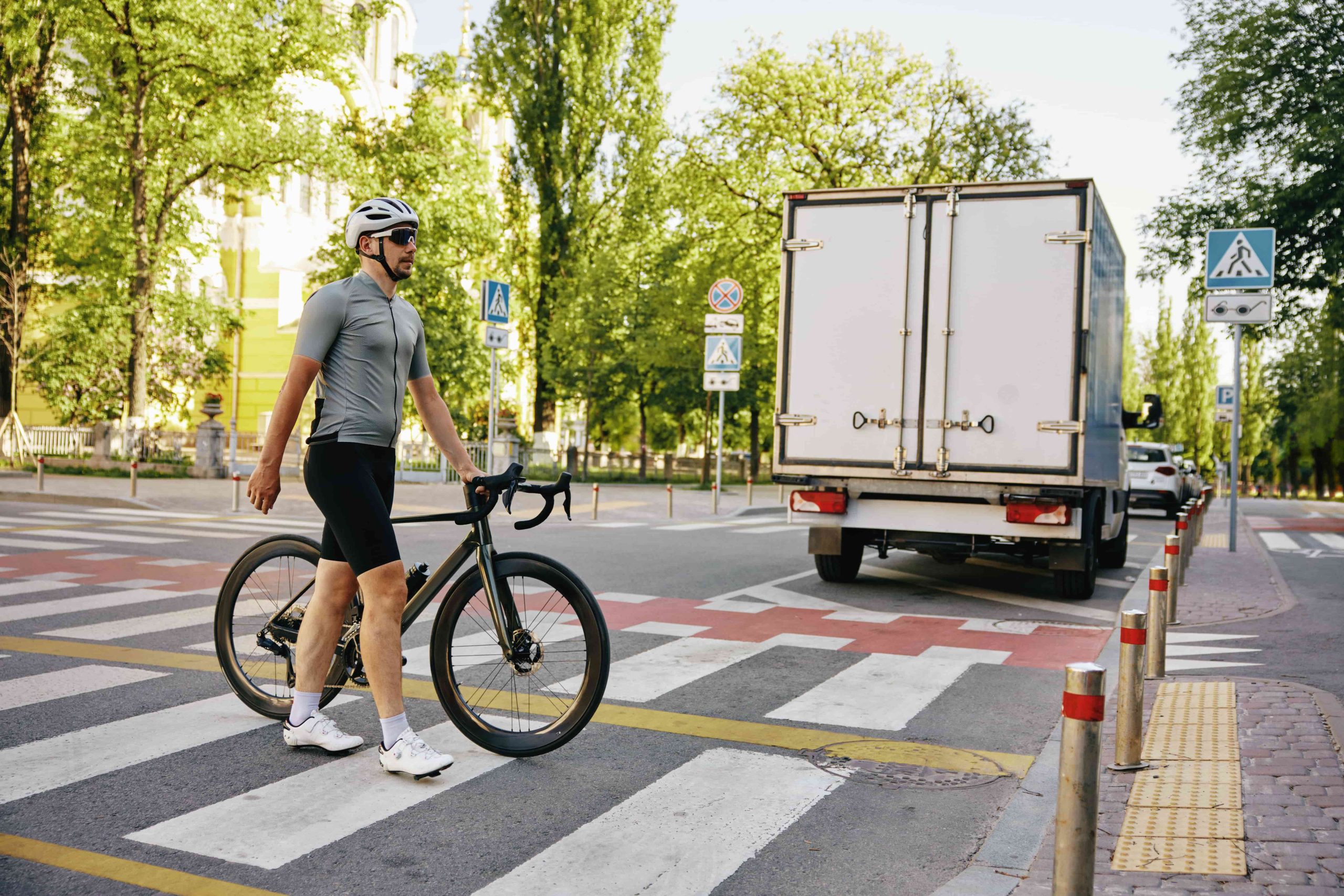
A truck’s blind spots and wide turns are known, permanent features of the vehicle, and the law does not excuse a crash because of them. Under Florida’s bicycle regulations, a cyclist has the rights and duties of any vehicle operator and is a lawful road user. A commercial driver is trained and required to check mirrors, signal, and confirm clearance before turning or changing lanes precisely because of the no-zones. When a driver fails those duties and strikes a rider who was lawfully present, fault generally rests with the truck driver rather than the cyclist.
When the trucking company shares blame
The motor carrier behind the driver can share responsibility for failing to train drivers on cyclist safety, equipping trucks without adequate mirrors or blind-spot aids, or setting schedules that push drivers to rush turns and lane changes. Federal motor carrier safety rules govern how commercial vehicles and drivers must operate, and a carrier’s failure to meet them can support a claim beyond the driver. Because the carrier usually holds much larger insurance, identifying its role is often essential to a full recovery for a catastrophically injured rider.
Proving a bicycle-vs-truck crash
These cases turn on reconstructing where the rider was relative to the truck and what the driver should have seen. The point of impact, the positions of the truck and bicycle, and the damage pattern show whether the rider was in a blind spot or beside a turning trailer. Truck event-data recorders, dashcams, and nearby traffic and business cameras can capture the maneuver, and a rider’s helmet camera, where it exists, can be decisive. Because this evidence can be lost quickly, a prompt investigation and preservation demand to the carrier are important. Riders can also reach Miami bicycle accident lawyers or Fort Lauderdale bicycle accident lawyers.
Catastrophic injuries and full value
Because a cyclist has no protection against a truck’s mass, these crashes are among the most catastrophic on the road, and the claim must reflect that reality.
Why these crashes maim and kill
A rider struck or run over by a truck can suffer amputations, crush injuries, spinal cord damage, and severe traumatic brain injury, and many bicycle-vs-truck crashes are fatal. The survivors often face permanent disability. These outcomes flow directly from the size and weight mismatch that leaves the rider absorbing the full force of the collision.
Valuing a lifetime of care
A claim for a catastrophically injured cyclist must account for a lifetime of consequences: future surgeries, rehabilitation, assistive devices, home modifications, and long-term or lifelong care, along with lost earning capacity and the profound non-economic harm. Where a crash is fatal, the family may pursue a wrongful-death claim. Valuing these cases requires medical and life-care expertise, not a quick estimate.
Because so much is at stake for a catastrophically injured rider or a grieving family, the investigation cannot wait. The truck’s data, the carrier’s records, and camera footage can all disappear within weeks, and the difference between a preserved case and a lost one often turns on how quickly a preservation demand reaches the carrier. Early action protects the evidence that establishes both how the crash happened and the full, lifelong scope of the harm the rider suffered.
Hurt in a crash with a truck while cycling?
A truck’s blind spots and wide turns are the driver’s responsibility to manage, not an excuse for a crash. The Law Offices of Wolf & Pravato reconstruct the crash and hold the driver and carrier accountable. Call 954-522-5800 for a free consultation.
Sources: Fla. Stat. §316.2065; FMCSA Regulations
About the Firm
Published by the Law Offices of Wolf & Pravato
For nearly three decades, the Law Offices of Wolf & Pravato have represented injured Floridians and their families across South and Southwest Florida, exclusively on the plaintiff’s side. The firm is led by managing partner Richard P. Pravato, a Board-Certified Civil Trial Attorney (Florida Bar No. 86150). To reach the lawyer who handles cases in your area, visit our attorneys page, explore our practice areas, or learn more about our firm.
Law Offices of Wolf & Pravato · 2101 W. Commercial Blvd., Suite 1500, Fort Lauderdale, FL 33309 · 954-522-5800 · Free case evaluation: 844-643-7200
FAQs
Q1. Why are bicycle-vs-truck crashes so severe?
A loaded truck weighs many times more than a bicycle and rider, so the cyclist absorbs nearly all of the force with no crumple zone or airbag for protection. Even a low-speed contact can be fatal, which is why a truck driver’s mistake around a cyclist is so dangerous.
Q2. What is a right-hook truck crash?
It happens when a truck turning right swings wide and cuts across a cyclist traveling straight on the right, trapping or crushing the rider as the trailer comes around. Because trucks must swing wide to turn, a driver who fails to confirm the right side is clear causes these deadly crashes.
Q3. Who is usually at fault in a bicycle-vs-truck crash?
Usually the truck driver. A truck’s blind spots and wide turns are known features the driver is trained and required to manage by checking mirrors, signaling, and confirming clearance. Striking a lawfully present cyclist by failing those duties generally places fault on the driver.
Q4. Can the trucking company be held responsible?
Yes. A carrier can be liable for failing to train drivers on cyclist safety, equipping trucks without adequate mirrors or blind-spot aids, or setting schedules that push drivers to rush. Because carriers hold larger insurance, identifying their role is often essential to a full recovery.
Q5. Does a cyclist have the right to ride near a truck?
Yes. Florida law gives a cyclist the rights and duties of any vehicle operator and treats them as a lawful road user. A rider proceeding beside or ahead of a truck is where they are permitted to be, and the driver must account for them.
Q6. What evidence helps prove one of these crashes?
The point of impact, the positions of the truck and bicycle, the damage pattern, truck event-data recorders, dashcams, nearby camera footage, and a rider’s helmet-camera video all help reconstruct the crash. Prompt preservation of the truck’s data is important.
Q7. What if the truck driver says they never saw me?
That is usually not a defense. A truck’s blind spots are a known limitation the driver is trained and required to manage by checking mirrors and confirming clearance. Failing to see a lawfully present cyclist and striking them supports negligence rather than excusing it.
Disclaimer: This blog post is provided for general informational purposes only and does not constitute legal advice. Reading this content does not create an attorney-client relationship between you and the Law Offices of Wolf & Pravato. Laws change and every case is different, so you should not act or rely on any information here without consulting a licensed Florida attorney about your specific situation. For advice regarding your circumstances, please contact our office for a free consultation.
Recent Posts
- Wrong Burial Plot and Grave-Site Errors in Fort Lauderdale

- Rainwater Falls at Fort Lauderdale Store Entrances

- Parking-Lot Backing Crashes in Fort Lauderdale: Who Has the Right of Way?
- Elevator and Escalator Injuries at Fort Lauderdale Shopping Centers
- Delivery Driver Car Accidents in Lakeland: Who Pays?

- Injured as a Passenger in Fort Lauderdale: Whose Insurance Pays?




FLORIDA’S PERSONAL INJURY ATTORNEYS FOR + 20 YEARS