












Bicycle Crashes at Florida Roundabouts: Yielding and Fault
By the Law Offices of Wolf & Pravato · Published July 20, 2026
Quick answer: Roundabouts reduce the crashes that kill drivers by removing high-speed angle impacts. For cyclists, the calculation is different: entering and exiting traffic crosses the bike’s path repeatedly, and the single rule that governs it all, yield to circulating traffic, is the one drivers most often break.
Florida keeps building roundabouts, and for good reason: they eliminate the high-speed right-angle collisions that kill people in conventional intersections. But a design optimized around what happens to cars in a T-bone does not automatically serve someone on a bicycle, and the crashes cyclists have there follow their own logic. Sorting out fault is where Florida bicycle accident lawyers begin.
The one rule that decides most of these cases
A roundabout runs on a single principle: traffic already circulating has the right of way, and traffic entering must yield to it. Under Florida’s right-of-way rules, that yield obligation belongs entirely to the entering driver. And under Florida’s bicycle regulations, a cyclist riding lawfully in the circle is treated as traffic, with the same right to that space as a car. Put those together, and most roundabout bike crashes resolve quickly: a cyclist circulating had the right of way, and a driver entering failed to yield to them. The dispute is rarely about the rule; it is about whether the driver saw the bike, which is not the same question.
Roundabout conflict points for a cyclist
| Point | What the cyclist is doing | What the driver does wrong | Who normally has the right of way |
| Entry | Waiting to enter the circle | Nothing — cyclist must yield here | Circulating traffic |
| Circulating | Riding through the circle | Enters without yielding | The cyclist |
| Exit | Continuing past an exit | Cuts across to exit | The cyclist |
| Multi-lane | Holding a lane through | Changes lanes into the bike | The cyclist |
| Crosswalk | Dismounted, walking across | Fails to yield at the exit leg | The pedestrian |
Four of the five conflict points put the right of way with the cyclist. That is the shape of these cases.
Where the crashes actually happen
Two scenarios account for most of them, and they fail differently.
The entering driver
A driver approaches the yield line, looks left for circulating traffic, and sees an acceptable gap. The failure is one of recognition rather than sight: a bicycle is narrow, arrives faster than drivers estimate, and does not register as traffic to someone scanning for cars. The driver pulls into the circle and hits a cyclist who was already lawfully in it. The driver frequently and sincerely reports that the cyclist came out of nowhere, which is a statement about their attention rather than about the cyclist’s position.
The exiting driver
A driver circulating alongside a cyclist reaches their exit and turns across the bike’s path to take it. This is a right hook wearing a different hat, and it happens because the driver is watching for the exit sign rather than for the vehicle beside them, and because a cyclist riding near the outside edge sits exactly where an exiting car must sweep through. The cyclist, continuing around the circle, has the right of way over a driver leaving it.
Why ‘take the lane’ is the safest and most-blamed choice
Cycling guidance for roundabouts is nearly unanimous and counterintuitive: a cyclist should move to the center of the travel lane before entering and hold it all the way through. Riding the outer edge invites the exiting driver to cut across, and hugging the curb makes the cyclist invisible to entering drivers. Taking the lane makes the bike unmistakably part of traffic and removes the space a driver would use to squeeze past. It is the safest option available. It also generates the argument that the cyclist was obstructing traffic, which has no legal basis, because a cyclist may lawfully use the full lane where the lane is too narrow to share safely, and a roundabout lane is exactly that. Reviewing Florida’s roundabout accident laws gives the broader framework.
The multi-lane roundabout problem
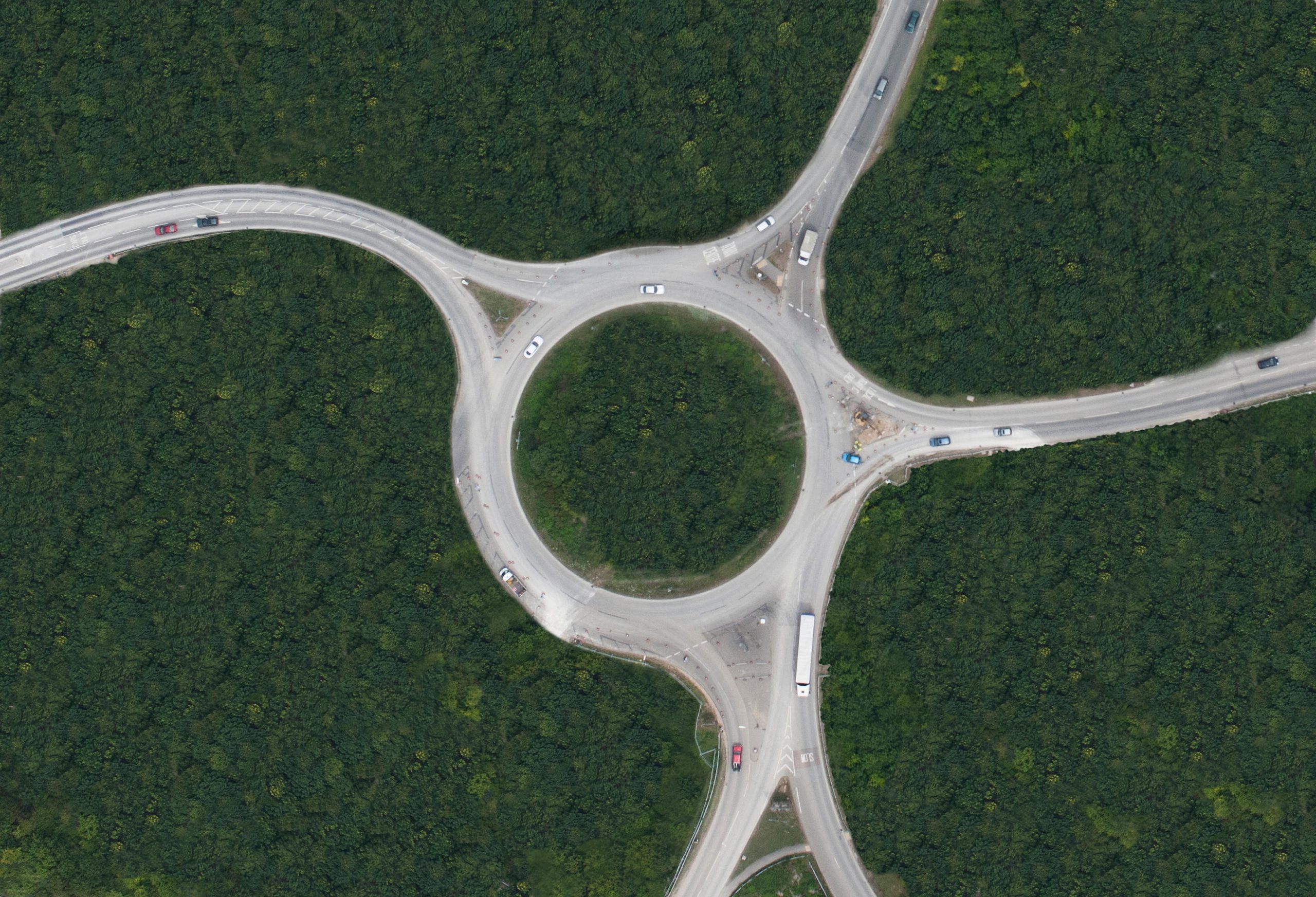
Single-lane roundabouts are manageable for a cyclist. Multi-lane ones are a different proposition, and Florida keeps building them on exactly the wide suburban arterials where cycling is already hardest. In a two-lane circle, a cyclist must choose a lane on entry based on where they intend to exit, hold it against drivers changing lanes around them, and resist the pull toward the outside where every exiting vehicle will cross their path. Drivers, meanwhile, routinely enter the wrong lane for their exit and then correct mid-circle, cutting laterally across whatever is beside them.
That produces a conflict a single-lane circle does not have: the lane-change collision inside the roundabout. The cyclist is holding a lane lawfully, and a driver in the adjacent lane simply moves into the space the bike occupies, either to reach an exit they lined up wrong for or to get around what they perceive as a slow obstacle. The duty here is the ordinary one: a driver changing lanes must ensure the movement can be made safely, and it does not relax because the lane is curved. But the practical result is that a cyclist in a multi-lane roundabout is exposed on both sides at once, and the guidance many riders follow is simply to dismount and use the crosswalks rather than negotiate it, which is a fair admission that the design did not account for them.
Proving a roundabout bicycle crash
Position at impact answers almost everything, because it establishes whether the cyclist was already circulating when the driver entered, and that single fact usually decides the case. The vehicle’s damage location distinguishes an entering-driver crash, front-end contact, from an exiting-driver right hook, which lands on the right side. Reconstruction of the closing speeds addresses the gap that the driver believed existed. Roundabouts are civic infrastructure and often camera-covered, and many riders now record their own routes. Injured cyclists can also reach Fort Lauderdale bicycle accident lawyers.
There is a final point about how these cases are received, and it is worth naming because it shapes the valuation. Roundabouts have a strong public reputation as a safety improvement, and that reputation quietly works against an injured cyclist. An adjuster, and eventually a jury, carries an assumption that a roundabout is the safe design, so a crash inside one must mean somebody did something unusual, and the unusual party is presumed to be the one on the bicycle. The answer is to be specific rather than general: the safety gains roundabouts deliver are real, and they are gains for vehicle occupants in angle collisions, which is a different question from what the design does for a cyclist sharing the circle with entering and exiting traffic. Establishing that distinction early keeps the case from being argued against a reputation instead of against the facts.
Hit by a driver at a Florida roundabout?
A cyclist circulating in a roundabout has the right of way, and entering traffic must yield. The Law Offices of Wolf & Pravato prove their position at impact and press the claim. Call 954-522-5800 for a free case review.
Sources: Fla. Stat. §316.2065; Fla. Stat. §316.123
Frequently Asked Questions:
Q1. Who has the right of way in a Florida roundabout?
Traffic already circulating. Entering traffic must yield to it, and that obligation belongs entirely to the entering driver. A cyclist riding lawfully in the circle is traffic with the same right to that space as a car.
Q2. Are roundabouts safer for cyclists?
Not automatically. They eliminate the high-speed angle collisions that kill drivers, which is a real gain, but for a cyclist the entering and exiting traffic crosses the bike’s path repeatedly. The design was optimized around what happens to cars.
Q3. Should a cyclist ride in the middle of the lane?
Guidance is nearly unanimous that they should, before entering and all the way through. Riding the outer edge invites exiting drivers to cut across, and hugging the curb makes the cyclist invisible to entering drivers. Taking the lane makes the bike unmistakably part of traffic.
Q4. Can I be blamed for obstructing traffic by taking the lane?
Drivers argue it, but it has no legal basis. A cyclist may lawfully use the full lane where the lane is too narrow to share safely, and a roundabout lane is exactly that. Taking the lane is the safest available choice, not an obstruction.
Q5. What is an exiting-driver crash?
A driver circulating alongside a cyclist reaches their exit and turns across the bike’s path. It is a right hook in a different setting, caused by the driver watching for the exit sign rather than the vehicle beside them. The circulating cyclist has the right of way.
Q6. The driver says I came out of nowhere. Does that help them?
No. It is a statement about the driver’s attention, not the cyclist’s position. Bicycles are narrow and arrive faster than drivers estimate, and a driver scanning only for cars may not register one, but the duty to yield to circulating traffic does not depend on noticing it.
Q7. How is fault proven?
Position at impact usually decides it, since it establishes whether the cyclist was already circulating when the driver entered. Damage location distinguishes an entering-driver crash from an exiting right hook, and roundabouts are often camera-covered, with many riders recording their own routes.
About the Firm
Published by the Law Offices of Wolf & Pravato
For nearly three decades, the Law Offices of Wolf & Pravato have represented injured Floridians and their families across South and Southwest Florida, exclusively on the plaintiff’s side. The firm is led by managing partner Richard P. Pravato, a Board-Certified Civil Trial Attorney (Florida Bar No. 86150). To reach the lawyer who handles cases in your area, visit our attorneys page, explore our practice areas, or learn more about our firm.
Law Offices of Wolf & Pravato · 2101 W. Commercial Blvd., Suite 1500, Fort Lauderdale, FL 33309 · 954-522-5800 · Free case evaluation: 844-643-7200
Disclaimer: This blog post is provided for general informational purposes only and does not constitute legal advice. Reading this content does not create an attorney-client relationship between you and the Law Offices of Wolf & Pravato. Laws change and every case is different, so you should not act or rely on any information here without consulting a licensed Florida attorney about your specific situation. For advice regarding your circumstances, please contact our office for a free consultation.
Recent Posts
- Wrong Burial Plot and Grave-Site Errors in Fort Lauderdale

- Rainwater Falls at Fort Lauderdale Store Entrances

- Parking-Lot Backing Crashes in Fort Lauderdale: Who Has the Right of Way?
- Elevator and Escalator Injuries at Fort Lauderdale Shopping Centers
- Delivery Driver Car Accidents in Lakeland: Who Pays?

- Injured as a Passenger in Fort Lauderdale: Whose Insurance Pays?





FLORIDA’S PERSONAL INJURY ATTORNEYS FOR + 20 YEARS