Can You Sue Airbnb? Who Actually Pays When You Get Hurt in a Rental
 By Richard P. Pravato, Board Certified in Civil Trial Law Published November 10, 2026
You got hurt at a house you rented for a few nights, and now you want to know whether you can sue Airbnb. Usually you cannot. A claim like yours is brought against the host and whoever else controlled that property, and Airbnb's terms keep a claim against Airbnb out of a Florida courtroom.
Maybe you are still standing in the rental with a phone in your hand. Maybe you are home with a hospital bill and a host who has stopped answering. Maybe a refund has been offered to you that pays nothing toward the injury. All three need the same four answers.
You have two years in Florida to sue over an injury like this. A host takes the listing down far sooner. If you wait six months, those photographs and reviews are gone. You lose the only proof of what the stairs looked like on the day you booked.
An insurance company pays this, not the host, and the adjuster who reads your file handles these claims for a living. That adjuster has resources you do not.
I am Richard P. Pravato, and our Florida short-term rental injury lawyers run these claims against hosts, managers and condominium associations. The questions are the same on Airbnb, on Vrbo and at a hotel.
I will walk you through it step by step, in the order it happens to you, so by the end you will know who to call first, who to contact next, which insurance pays, and how long you have to file in Florida.
Key takeaways
- A claim over an Airbnb injury is brought against the host, not against Airbnb.
- Airbnb's policy for hosts tops out at $1,000,000 for an entire stay, and the host opens that claim.
- You have two years from the date you were hurt to file a lawsuit in Florida.
Can you sue Airbnb itself?
You can almost never sue Airbnb over an injury at a rental, and you rarely need to. Airbnb says in its own terms of service that it does not own, control or manage any listing. The same page says Airbnb is not a party to the contract between you and your host, and not an insurer either. So you can sue an Airbnb host for the condition of the house, and a manager, the owner on the deed or a condominium association can answer alongside them.
Suing Airbnb the company takes a harder route. Section 23 of those terms sends it to arbitration, one person at a time. An arbitrator is a private judge both sides pay for, and no jury hears the case.
Airbnb also makes you write a letter first. As of November 2026 the terms want a signed notice of the dispute, mailed to Airbnb's agent in Sacramento, then a 30-day wait. Reporting the injury in the app does not count as that notice today.
The arbitration rule blocks nothing you actually need. Three policies can pay the claim you do have.
Which of them pays depends on what you do now. The next question is who you tell, and in what order.
Step one) Who to call in the first hour
Call 911 or get to an emergency room first, then tell the host what happened in writing through the app. Airbnb answers the phone here on +1-415-800-5959, and its help page offers a chat window.
Get seen by a doctor in Florida before you fly home. An emergency room visit ties the injury to that address and that date. People wait and see their own doctor at home, and a defense lawyer then says it happened elsewhere.
Then write to the host rather than call, because a message in the booking thread carries a date nobody can move. Name the stair, the gate or the deck, and say you were hurt.
Photograph the thing that hurt you, and put a shoe in the frame for scale. Screenshot the listing, the house rules and the reviews.
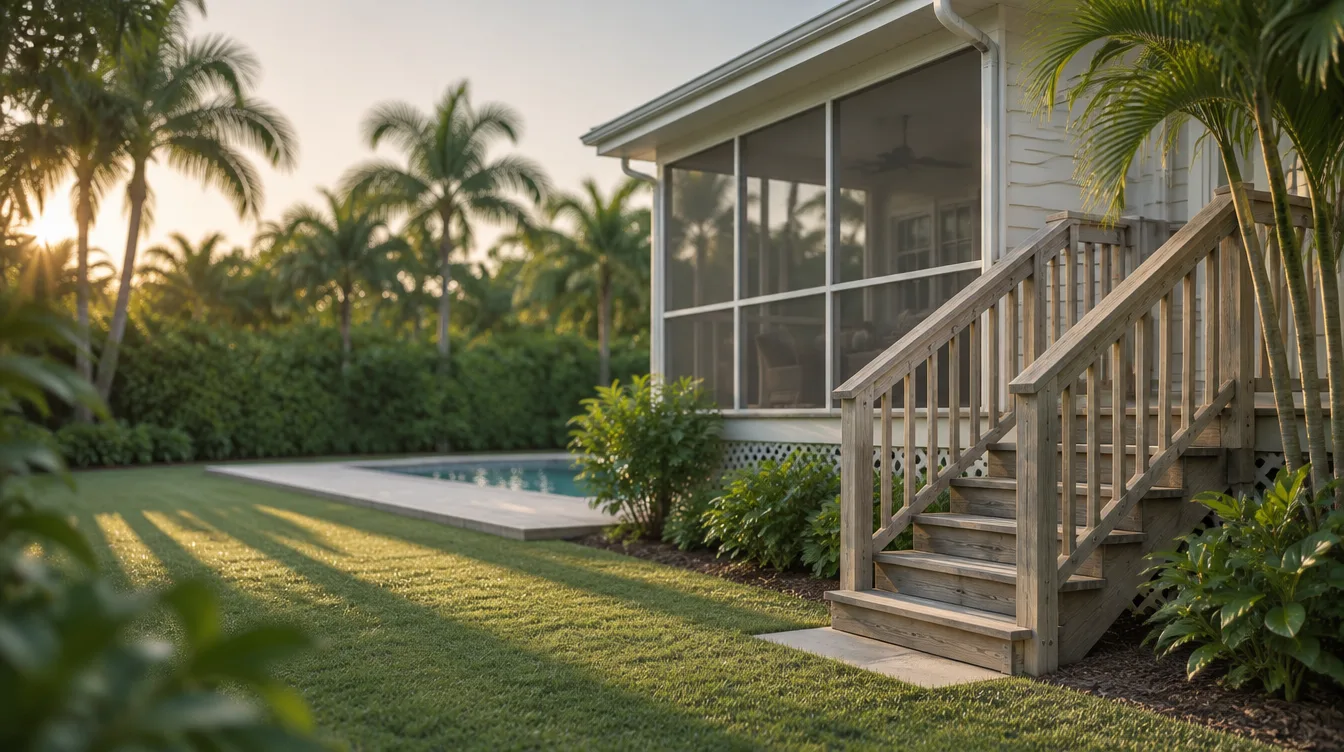
The stairs, the dock and the pool fence are where it usually happens:

The first hour is for getting any medical attention you need, then putting the injury on the record with a date. A lawyer who runs these claims will tell you what to put in that message. So what do you do next?
Step two) Who to contact in the first week
Ask the host to open the insurance claim, then find out who really owns the house. Airbnb takes that claim through a form the host fills in. Its own program summary says an adjuster appointed by the insurer then calls to handle it.
So the host holds the door to the money. Ask in the booking thread, in writing, and tell Airbnb the same week. A host who refuses leaves you a record of it, and your claim does not need them.
Next, look up who owns the property. The county property appraiser names the owner from the address, free, in a minute. That name is often a company or a trust rather than the person who messaged you, and it decides which insurer is involved.
Then check the state register. A Florida house rented to guests more than three times a year, for stays under 30 days, is a lodging business, and the state licensing portal lists it.
A license is not the same thing as an inspection. State law puts hotels on two inspections a year and leaves vacation rentals off that schedule. Nobody inspected that stair, so after an Airbnb slip and fall your photographs matter.
A complaint to the state is not your claim. It says on its complaint page that it cannot recover anything for your injuries.
If you wait a few months, the stair is rebuilt and the reviews are edited. Call a lawyer the day a host stops answering, because the next question is which policies exist at all.
Step three) Find out which insurance is in play
Three policies can pay a claim like this, and the case depends on which of them covered that night. Airbnb puts one behind the stay. The host may hold a second, and whoever else controlled the space may hold a third.
Start with Airbnb's, because it costs the host nothing. Airbnb calls it host liability insurance, the policy that pays when a host is found legally responsible for a guest getting hurt. The limit is $1,000,000 for the whole stay. It pays nothing merely because you were hurt in the house, because somebody has to establish that the host was responsible first.
It only reaches a stay booked and paid for on the platform, and a host can opt out of it. So ask whether it covered your stay.
The host's own policy is the second place to look. An ordinary homeowners policy is written for a family living in their own home and leaves out business use. Letting the house to guests is business use, so it often answers with a refusal.
The third policy belongs to whoever controlled the part of the property you were hurt on. A condominium association owns the lobby, the lift and the pool deck, and Airbnb's policy covers it there too.
Most people hand that question to a lawyer, because the host rarely answers it. The next question is whether a million dollars reaches an injury like yours.
Step four) Check whether that million dollars reaches your injury
That million dollars reaches fewer injuries than you would think, because the policy carries 23 exclusions. The limit covers the whole stay. The bill for fighting the claim comes out of it too, because Airbnb's program summary puts the cost of investigating and defending inside the same million.
Four of them decide Florida cases. Anything to do with watercraft is out, unless the boat was the listing and was tied up at the dock. So a trip on the host's boat is not covered, and a fall on the dock is.
Mold is out as well, because the policy drops any injury from fungi or bacteria inside a building. An assault by the host is out, and so is sexual assault. Carbon monoxide goes the other way: the pollution clause carves out smoke, fumes, soot and carbon monoxide inside the house.
One more line deserves attention. Airbnb says the policy is sometimes written by an insurer your state does not regulate, and the state fund that pays when an insurer fails does not stand behind it.
Here is a checklist of what Airbnb's million does cover, and two injuries it does not:

So the policy reaches some injuries and drops others. What happens if it drops yours?
What Florida law gives you as a guest
Florida treats you as a paying customer of a lodging business, the strongest position the law gives a visitor. The host owes you a property kept reasonably safe, and a warning about a danger they knew of and you could not see.
A Vrbo stay runs the same way, and you can sue the host rather than the platform. Florida looks at how the house is used rather than at which app took your money, so the booking site changes nothing. The insurance is the half that does. Airbnb's cover only reaches a stay booked on Airbnb, so a Vrbo guest should ask Vrbo in writing which cover applied and who the insurer is.
Florida gives you two years from the date you were hurt to sue. The state cut that from four years in 2023, so older articles are wrong.
Your own share of the blame cuts your money. Florida law cuts what you collect by the percentage of fault put on you, so a jury that puts you 20 percent at fault takes a fifth off.
That rule has a cliff in it. What happens if a jury puts most of the blame on you? Anyone found more than 50 percent at fault collects nothing at all, which is why a casual admission in a message thread does real damage.
What it looks like once it is handled
Once this is handled, the paperwork belongs to somebody else. Your lawyer holds the listing, the photographs and the license record, and the adjuster stops calling you.
You have the Florida hospital bill paid instead of a collection letter. The treatment at home, the changed flights and the lost wages all count in the same claim.
Ask your lawyer for the date your 2 years runs out and put it in your phone. You end up with one person to call and a settled bill, instead of a year of letters.
How we work a short-term rental injury claim
After an Airbnb accident we start the week you call, because these properties change. Our first letter goes to the host through the platform, so it sits in the booking record with a date on it. It asks for the insurance claim to be opened.
Moving fast decides these cases. A guest dived off the dock of a Fort Myers rental on the Caloosahatchee River and broke his neck. No sign warned him, and we were retained 5 days later.
We had people on the dock and in the riverbed within days. Hurricane Ian destroyed that property weeks later, and the case resolved for a significant confidential settlement on evidence that no longer existed.
Does Airbnb pay my hospital bill, and other questions we get
Does Airbnb pay my hospital bill while all this is going on?
No, Airbnb does not pay your medical bills while the claim runs. It states in its terms that it is not an insurer, and the review takes months. Get the care now, on your own health insurance.
The host offered me a refund. Should I take it?
A refund pays back the nights you did not use, and does nothing about a broken wrist. Take it, and sign nothing that says release or waiver.
Talk to us before you sign anything
If you were injured at an Airbnb or a Vrbo anywhere in Florida, we will find out who owned that property. We will find whether it was licensed and which policies were in force. The first call is free.
This article is general information about Florida law, not legal advice, and the outcome depends on the facts of each case. Statutes, platform terms and insurance programs change, so the rules in your case may differ. Prior results do not guarantee a similar outcome.
Related reading
 Claims and Settlements

Injured at Home Depot or Lowe's? Who Is Responsible in Florida
Richard P. Pravato  Claims and Settlements
Florida Dangerous Dog Law: What It Means if That Dog Already Bit Someone
 Brett J. Yonon
 Claims and Settlements
The Other Driver Lied to Police? How Car Accident Fault Is Determined
Richard P. Pravato