Florida Comparative Negligence: What Happens If You Are Partly at Fault
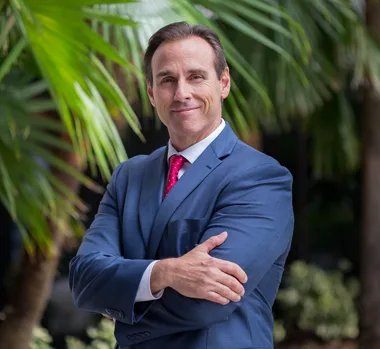 By Richard P. Pravato, Board Certified in Civil Trial Law Published October 9, 2026
You were hurt in a crash in Florida, and some of it was your own doing. Maybe you were a few miles over the speed limit. Maybe you looked down for a second, or stepped off the curb where there was no crosswalk. What you want to know is whether that ends your claim.
It does not, up to a point. Florida comparative negligence is the rule that splits the blame for a crash among everybody involved, as percentages, and it does two things to a car accident claim. It cuts your damages by your share of the blame. And since a law Florida passed in 2023, it pays you nothing at all once your share passes half.
So where exactly does that cutoff sit, and who decides which side of it you are on? By the end you will know what the rule does to a claim, what House Bill 837 changed in 2023, the one kind of case it misses, how a fault percentage gets set, and what moves it. I am Richard P. Pravato, Board Certified in Civil Trial Law, and negligence claims are the only work I have taken since 1996.
Key takeaways
- Florida comparative negligence reduces what you recover by your own percentage of fault, so sharing the blame lowers a claim instead of ending it.
- The cutoff is more than 50 percent. A claimant found greater than 50 percent at fault for their own harm recovers nothing, which is what people mean by the 51 percent bar.
- Medical malpractice is the one carve-out written into the statute. A chapter 766 claim still runs on the old pure comparative negligence rule.
- The 51 percent bar is keyed to when the case was filed, not when the crash happened. The enacting law says causes of action filed after March 24, 2023.
What Florida comparative negligence means if you are partially at fault
Florida reduces what you recover by your own percentage of fault, and a claimant found more than 50 percent at fault for their own harm recovers nothing.
Both halves sit in one statute. Florida Statute 768.81(2) says contributory fault “diminishes proportionately” what you are awarded but “does not bar recovery, subject to subsection (6).” Subsection (6) is the part that bars it: in a negligence action, “any party found to be greater than 50 percent at fault for his or her own harm may not recover any damages.”
Two terms in there do real work. Comparative negligence is the name for dividing responsibility among everybody who helped cause an injury, written as percentages that add up to 100. Contributory fault is your own slice of that total.
The reduction runs up the scale until it stops being a reduction at all, which is why this is called the 51 percent bar.
Where that comes from: Florida Statute 768.81, the comparative fault statute.
Pure versus modified comparative negligence: what House Bill 837 changed in 2023
For about fifty years Florida ran the version lawyers call pure comparative negligence. Your own share reduced the award and never ended it. The standard comparative negligence example: someone found 90 percent to blame for a $100,000 loss still collected $10,000. At 99 percent to blame they still collected $1,000.
Florida’s 2023 tort reform rewrote comparative negligence. House Bill 837 became Chapter 2023-15, Laws of Florida, approved by the Governor on March 24, 2023, and section 9 of it added subsection (6) to 768.81. Florida is now a modified comparative negligence state: the reduction stays and a ceiling goes on top of it.
A third system gets mixed up with this one. Contributory negligence is the harsh rule in which any fault at all, even one percent, ends a claim. Florida has never used it.
A real shared fault case: just under $400,000 then, nothing now
A client of ours, Mr. T, was riding a scooter at night in dark clothing and ran a stop sign. A car hit the scooter and tore up Mr. T’s left leg. Several attorneys had turned the case down, and on those facts it is easy to see why.
We brought in an accident reconstruction expert instead of accepting the obvious story. The car had been doing roughly 10 miles an hour over the limit at impact, and the expert showed that at the posted speed the collision does not happen at all, because Mr. T clears the intersection first. The stop sign was still ours to answer for. But the driver’s speed turned a near miss into a crash, and once that was on paper rather than in an argument, a jury putting 5 to 10 percent of the fault on the driver stopped being far-fetched. At mediation the carrier paid our client just under $400,000 rather than find out.
Under the law in force then, 10 percent on the other side was enough. Today the same facts, the same expert and the same 10 percent finding produce nothing at all.
Whether the 51 percent bar applies turns on when your case was filed
Most guides to this rule say the bar covers accidents after March 24, 2023. The enacting law does not say that. Section 30 of Chapter 2023-15 reads: “this act shall apply to causes of action filed after the effective date of this act.” Filed, not accrued.
The act uses the other word where it means the other thing. Section 28 says the changes to Florida Statute 95.11 “apply to causes of action accruing after the effective date,” and that is the amendment that cut the deadline for a negligence suit from four years to two, now at 95.11(4)(a). One section is keyed to the date of your crash. The other is keyed to the date your case was filed.
Courts are still working through what that means for claims pending in March 2023, and have not all reached the same answer. Almost any case filed since then is under the bar. If yours has been open for years, check which version of 768.81 it falls under. The source is Chapter 2023-15, Laws of Florida, sections 28 and 30.
Who decides fault in a car accident, and what moves the percentage
Nobody hands you a percentage after an at-fault accident in Florida. Two people set one, at two stages.
The adjuster goes first. An insurer reads the crash report, the photographs and anything you said on a recorded call, decides what share is yours, and discounts its offer by that much. That figure is an opening position and almost always high. Since 2023 it is also a threat, because an adjuster who can push you past 50 percent can call your claim worth zero.
The jury goes last. The verdict form asks for a percentage next to each party, and the judge applies the reduction and the bar after. A Broward County jury put one of our clients, burned when propane tanks exploded behind a Pompano Beach bakery, at 45 percent and the bakery at 55. The verdict came to $1,387,060.58. Five points the other way, on today’s rule, and it pays nothing.
What moves those numbers is physical evidence collected before it disappears. In a Fort Lauderdale case the officers blamed our client for a U-turn, and the event data recorders pulled from both cars showed the other driver doing over 100 mph in a 45 zone, which is what makes judging an oncoming car’s distance impossible. The carrier paid its full $100,000 limits. Our walkthrough on how to dispute car accident fault covers the paperwork side.
The defense does not have to stop at you, either. Under 768.81(3)(a) it can ask the jury to put fault on somebody who was never sued, but it has to name that person in its pleading and prove their fault at trial by a preponderance of the evidence. An empty seat is not a free square on the verdict form.
The exceptions: medical malpractice, intentional torts and negligent security
The carve-outs are written into the statute, and medical malpractice is the large one. Subsection (6) says in terms that it “does not apply to an action for damages for personal injury or wrongful death arising out of medical negligence pursuant to chapter 766.” A malpractice claim still runs on pure comparative negligence, so a patient found 70 percent responsible for their own outcome still collects the other 30.
| Kind of claim | Does the 51 percent bar apply? | Where that is written |
|---|---|---|
| Car, truck, motorcycle, bicycle and pedestrian crashes | Yes | 768.81(1)(c) and (6) |
| Slip and fall and other premises claims | Yes | 768.81(1)(c) and (6) |
| Negligent security | Yes, and the jury weighs the attacker’s share too | 768.0701 |
| Product liability | Yes | 768.81(1)(c) |
| Professional malpractice other than medical | Yes | 768.81(1)(c) |
| Medical malpractice under chapter 766 | No. Pure comparative negligence still governs | 768.81(6) |
| An injury caused on purpose | No. The statute does not reach intentional torts | 768.81(4) |
Negligent security needs a warning of its own. HB 837, which is the short name for that same act, also created Florida Statute 768.0701, which says that when a person lawfully on a property is hurt by a third party’s crime, the jury “must consider the fault of all persons who contributed to the injury.” That includes the person who attacked you. Every percentage point the jury writes beside the attacker is a point the property owner does not pay.
What we do when an insurer puts the blame on you
Fault is the whole case now, so the work starts there rather than at the medical bills.
- The evidence gets locked down in the first weeks. Camera systems record over themselves, often inside 30 days, and a car’s event recorder is wiped when it is repaired or scrapped. Photograph the scene the same week, and ask us to send a preservation demand before anything is cleared.
- The crash report gets tested, not accepted. An officer writes an opinion under time pressure, from what is left at the scene. We have had officers issue corrected reports, and reconstruction show the first one had the physics wrong.
- The other side’s share gets proved, not argued. Mr. T’s case turned on showing what would not have happened at the posted speed. That is expert work under Fla. Stat. 768.81(3)(a), which puts the burden of proving anyone else’s fault on the party claiming it.
Questions people ask me about a shared fault car accident in Florida
If I paid the ticket, does that settle my fault percentage?
It does not. Paying a Florida traffic citation counts as admitting the infraction, and the same statute says that admission “shall not be used as evidence in any other proceedings”: Fla. Stat. 318.14(4)(b).
Does it end my claim if I was not wearing a seat belt?
Not by itself, though it is in play. Florida Statute 316.614(10) says a seat belt violation is not negligence in itself and cannot be used to reduce damages, but it “may be considered as evidence of comparative negligence.” So it can push your percentage up, though it cannot decide the claim on its own.
Florida is a no-fault state. So why does my share of the blame matter?
Two separate layers. Your own Personal Injury Protection pays first, whatever caused the crash. Comparative negligence governs the claim against the driver who hit you, and that is the one your percentage shrinks or ends. Our guide to Florida’s no-fault rules covers that first layer.
Can the other driver still sue me if I was mostly at fault?
Yes, and this catches people out. The 51 percent bar stops a mostly at-fault party from collecting their own damages. It does nothing to shield them from a claim. Our piece on suing after a crash you caused works through it from that side.
Find out what your real fault percentage is before an adjuster picks one
Wolf & Pravato represents injured people across Florida, from offices in Fort Lauderdale, Miami, West Palm Beach, Boynton Beach and Fort Myers. If an insurer says you were partially at fault for a car accident, bring us the report and the photographs before you answer. We work out what the evidence supports.
Request a free case review. There is no fee unless we win money for you.
This article is general information about Florida law, not legal advice, and every claim turns on its own facts and evidence. Prior results do not guarantee a similar outcome.
Related reading
 Claims and Settlements
Jackknife Accident Florida: Causes, Liability, Claims
Richard P. Pravato  Claims and Settlements
 Left-Turn Accidents in Miami: Who Is Usually at Fault?
Richard P. Pravato  Claims and Settlements
 Multi-Vehicle Crashes on I-95 and US-1 in Fort Lauderdale: How to Protect Your Claim When Five Cars Collide
Richard P. Pravato