Injured at Home Depot or Lowe's? Who Is Responsible in Florida
 By Richard P. Pravato, Board Certified in Civil Trial Law Published November 13, 2026
If something fell on you at Home Depot or Lowe's, you do not have to prove the store knew it was there. Almost every page about being injured at Home Depot tells you otherwise, and that mistake is the difference between a claim worth running and one that quietly gets dropped.
Florida wrote its statute for wet floors. It makes you prove the store knew about the spill or should have known, and most of these claims die right there.
A box that falls on you from a shelf is not covered by that statute at all. The question is whether the load was stacked safely, and the store's own records answer that.
Getting those records is the hard part. That aisle is already back in order, and the store video is next. The longer you wait, the less of it is left for anyone to ask for. Florida gives you 2 years to sue, and nothing like 2 years to prove it.
By the time most of our clients call us, the other side has already opened a file, and the people on it handle these claims for a living. They have resources you do not.
My name is Richard P. Pravato. Our Florida store injury lawyers bring these claims against the national retailer, the shopping center owner and the outside vendor who stocked the shelf.
So let me walk you through it step by step, in the order it comes at you, so by the end you will know who is responsible, what to do in the first hour, which evidence disappears first, and what Florida law makes you prove.
Key takeaways
- A box that falls on you is not a spill, so Florida's spill statute does not cover it.
- Ask the store in writing to keep the video, because Florida gives you no separate claim once it is gone.
- You have 2 years from the date you were hurt to sue in Florida.
Injured at Home Depot: who is responsible?
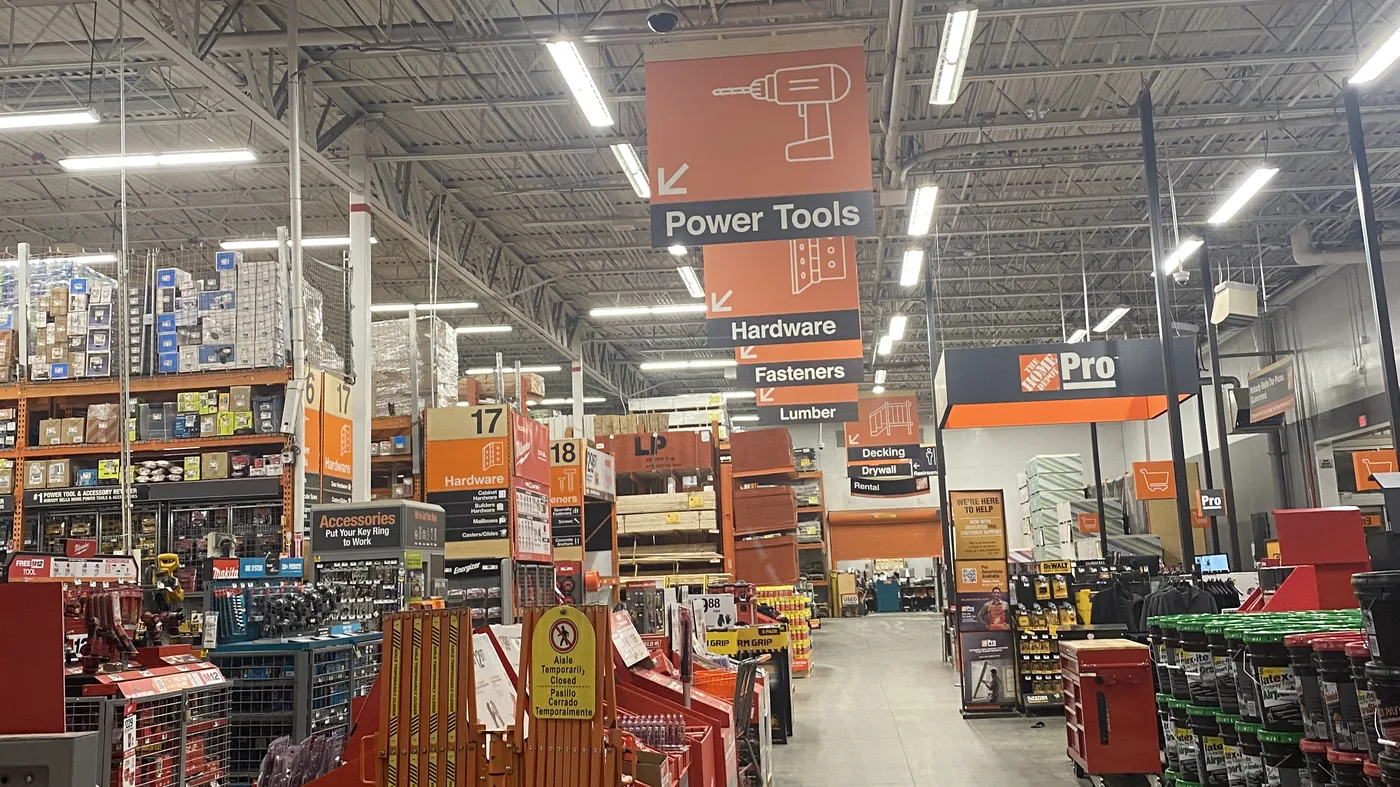
Home Depot is responsible when one of three things happened: its own staff built the stack, nobody took a damaged shelf out of use, or a forklift carried stock over your head. These stores keep the spare stock high up in the same aisle you shop in.
A heavy item does far more damage when it falls from high up. Quikrete sells concrete mix in bags up to 80 pounds, and those bags sit above head height beside tile and lumber.
Stacking them is not a matter of opinion. The federal storage rule, 29 C.F.R. 1910.176(b), says bags and bundles stored in tiers must be "stacked, blocked, interlocked and limited in height so that they are stable and secure against sliding or collapse". It is written for staff safety rather than for shoppers, and it is still the plain standard for what a safe stack looks like.
Six things hurt people in these stores:
- Stock stored above your head falls on you, usually after somebody overloaded the shelf or knocked it.
- A forklift hits the shelving, bends it, and nobody takes it out of use.
- A forklift moves stock while you are shopping in the same aisle.
- A display is stacked too high, or an item is leaned at the end of an aisle and slides off.
- Spilled paint, rain walked in from outside or water from the garden department leaves the floor wet.
- A pallet, a cord or a hose is left where people walk, and somebody trips on it.
Every one of those six comes down to one question: who put that thing where it was? The boxes above your head, the panels on edge and the long boards are where it starts:

Step one) What to do in the first hour
Do two things in the first hour: get medical care, and photograph the aisle before staff tidy it. By the time we are called, the aisle is usually back in order. Nobody tidies it to spite you. It simply stops looking the way it did when it hurt you.
Go to an emergency room the same day and tell the doctor exactly what happened. Those notes tie your injury to that store on that date.
Then take the photographs, and put your shoe in one frame for scale. Six shots cover it:
- The item itself, where it landed on the floor.
- The shelf it fell from, taken from directly underneath.
- The whole aisle from both ends, so the photo shows how high the shelf is.
- Any warning sign, or the bare floor where one should have been.
- Your injuries, and the floor if it was wet.
- The aisle number and the store number on the sign above you.
Keep what you were wearing and do not wash it. Ask the people around you for a name and a mobile number, staff included, because shoppers leave and staff change.
Call a lawyer the same day, because our office sends the letter that stops the video being wiped. That letter has to arrive while the recording still exists. So what do you do next?
Step two) Who to tell, and what to put in writing
Tell a manager before you leave the building, and ask for two things in writing: the report number and a copy of the report. That form is the store’s own record that you were hurt there on that date, and in our files it is the first document the other side reaches for.
Say only what you saw. Do not guess how long the water had been there, and never say you are fine. Shoppers say that in front of a manager, then cannot walk the next morning, and the report keeps it forever.
Some stores will not hand a customer a copy. Ask anyway, write the number down, and get the manager's full name. Then email the store's customer service that evening, because an email carries a date nobody can move.
A claims company often takes over from there rather than the store. In the files we run, that adjuster calls early and the call is friendly. They are also paid by the people you may end up suing.
Two things matter on that call. Do not give a recorded statement, and do not sign anything with the word release or waiver in it. Tell the adjuster your lawyer will call back, which ends the call politely.
If you leave with no report number, you can spend months arguing you were ever in that store. The paperwork is only half of it.
Step three) Save the evidence that disappears first
Save four things, roughly in the order they disappear: the witnesses, the fallen stack, the store video, and finally your 2 year deadline. All four are reachable on the day it happens, and every week after that fewer of them are.
The video decides most of these claims. A store camera records what the shelf looked like and whether staff walked past the puddle. Those systems record over old footage, and nobody is under a duty to keep yours until your lawyer puts the store on notice.
Shoppers get the next part wrong: you cannot sue a Florida store for wiping the video. The Florida Supreme Court ended that in 2005 in Martino v. Wal-Mart Stores, Inc., 908 So. 2d 342. The Florida Bar Journal sets out what the court put in its place, which is a penalty inside the case you already have.
A judge can tell the jury to assume the missing footage helped you, and a store that destroys proof after a warning can lose the right to argue the point. That warning matters, because the court asks whether the store knew to keep the video.
So our letter goes out in days, not months. It names the store, the date, the hour and the camera, and it asks for the report, the inspection sheets and any earlier complaint about that shelf.
If you leave it a year, the staff who stocked that aisle may have moved on. You lose the only people who can say who built the stack.
One of our clients fell in a Fort Lauderdale hotel lobby that staff had mopped with no sign out, and the video we got of the mopping ended the argument about fault. So the store is one name on the claim. Who else belongs on it?
Step four) Find out who else may be responsible
Five others can be responsible for a Home Depot accident besides the store, and each carries its own insurance. Finding them early matters, because a store that is only part to blame pays only its share.
Start with whoever owns the building. A home improvement store may rent its site, and a shopping center owner can control the parking lot, the walkways and the loading area. A fall out there can belong to that owner rather than the store.
Then look at who put the stock on the shelf. Some stock is put out by an outside vendor's crew rather than by store staff, and that crew works for a separate firm with its own insurance. So does a cleaning contractor brought in to mop.
The shelf itself can put a fifth name on the list. Specialist firms build and install heavy steel shelving, and a frame that folds under a normal load is a product fault. A tool or a ladder that broke in your hands opens the same door.
You cannot find any of this from the aisle. The report, the stocking schedule and the service records carry it, and the letter in step three asks for all three. The next question is which rule Florida puts you under.
What Florida law makes you prove
Florida law makes you prove one of two different things, and which one depends on whether you slipped on something or something hit you.
Florida wrote a statute for spills alone. Section 768.0755 opens with the words "if a person slips and falls on a transitory foreign substance", the legal name for anything wet or loose lying where it does not belong. Water, paint and potting soil all count.
Slip on one of those and you have to prove the store knew. The statute gives two ways: show the mess sat long enough that staff on their rounds should have found it, or show it happens often enough there to be expected. Our post on proving what a store should have known works through both.
A falling item is not something you slipped on, so that statute does not apply. Subsection (2) of it says the section "does not affect any common-law duty of care owed by a person or entity in possession or control of a business premises".
So the ordinary rule applies instead. The store has to keep the place reasonably safe, inspect it, and fix or warn about what it finds. You are asking whether the load was stacked safely and whether anyone checked the shelf. Nobody is making you prove how many minutes a hazard sat there.
Here is the spill rule beside the falling item rule:

One deadline covers both. Florida law 95.11(5)(a) gives you 2 years from the date you were hurt to sue. Older articles still say four years, and they are wrong.
Will the store blame you?
Yes, expect the store to blame you, and expect it early. Three arguments come back in the claims we run. You pulled the item down yourself. You were not looking, and anyone could have seen it.
Your share of the blame costs you money. Florida splits fault by percentage, so a jury that puts 20 percent on you takes a fifth off what you collect. There is a cliff in that rule.
Florida law 768.81(6) says a person found more than 50 percent at fault for their own harm recovers nothing at all. That is why a casual "I wasn't really watching" on a recorded call does more damage than anything else you can say.
Being blamed is not the same as being at fault. An older client of ours broke an arm in a restaurant that ignored its own written safety steps.
The defense told a Miami-Dade jury our client had taken too much medication. Then it said too little. Then it said our client had caused the spill, from fifteen feet away.
After four days the jury put the restaurant at 95 percent fault and returned $300,000, which made TopVerdict's list of the top 50 Florida premises verdicts of 2018. Three contradictory stories hurt the defense more than our client. So what happens once this is over?
What it looks like once this is handled
Once this is handled, your phone stops showing the adjuster's number. The letters go to your lawyer's office, and the claim number stops being the thing you think about at night.
You end up with the hospital bill closed instead of a collection letter on the counter. The missed shifts, the drives to therapy and the care you still need all sit in one claim.
Ask your lawyer for the date your 2 years runs out and put it in your phone. After that you have one person to call.
How we work a falling merchandise claim
We start a Home Depot injury claim in the first week, because the shelf has already been rebuilt. Our opening letter goes to the store and to the claims company. It demands four things: the video, the report, the inspection sheets and the stocking schedule.
Then we find out who stacked it. The stocking schedule names the crew, the service record names the firm that maintains the shelving, and the lease names who controls the lot.
Heavy goods cases are worth that effort. A landscaping supply company ran heavy machinery over a client's foot, which cost that client several surgeries and a lifetime of care. We walked out of a court-ordered mediation, and the insurer paid $2,000,000 as trial got closer.
Our five offices sit in Fort Lauderdale, Miami, West Palm Beach, Boynton Beach and Fort Myers.
Home Depot injury claim questions we get asked
Can I sue for a slip and fall at Home Depot in Florida?
Yes, but the spill statute makes you prove the store knew or should have known about the water. Staff who mopped and left no sign out created the danger themselves, which is the simplest version of that proof.
What if another customer knocked the item down?
The store can still answer for it. If another shopper could tip it over with one hand, it was not stacked safely.
What are Home Depot injury settlements worth?
No honest number fits every case. Our guide to what a slip and fall claim is worth sets out what counts.
Does it matter that I was at Lowe's and not Home Depot?
No. Florida applies the same duty to every business that invites the public in, so the store name changes who you sue, not what you have to prove.
Talk to us before you give a recorded statement
Something fell on you, or a wet floor put you down, in a Florida store. We will send the letter that keeps the video, find out who controlled that aisle, and tell you honestly whether the store is responsible. The first call is free.
Cover photo by Plantsmushrooms, CC0, via Wikimedia Commons. This article is general information about Florida law, not legal advice, and the outcome depends on the facts of each claim. Statutes and store policies change, so the rules in your case may differ. Prior results do not guarantee a similar outcome.
Related reading
 Claims and Settlements

Negligent Security in Florida: When a Property Owner Is Responsible for a Crime
 Brett J. Yonon
 Medical
The Personal Injury Claim Process in Broward, Miami-Dade and Palm Beach County
Richard P. Pravato  Claims and Settlements
Worst Car Insurance Companies for Paying Claims: How to Check Any Insurer Yourself
Richard P. Pravato