




Was Your Loved One Embalmed Without Permission in Lakeland? What Florida §497.385 Means for Your Family
Many families in Lakeland assume that embalming is automatic — that any funeral home receiving a body will embalm it as part of the standard process. That assumption is wrong. Under Florida law, a funeral home cannot embalm without authorization from the legally authorized representative. When a funeral home embalms first and asks questions later, it has violated Florida statute and broken the family’s right to control how their loved one’s body is treated. At the Law Offices of Wolf & Pravato, our Lakeland unauthorized embalming attorneys handle these cases for families in Polk County, including families whose religious, cultural, or personal beliefs do not permit embalming.
Embalming is invasive. It involves the injection of preservative fluids into the circulatory system and the removal of bodily fluids. For some families, embalming violates religious obligations — Jewish law generally prohibits embalming, and many Islamic and orthodox traditions also restrict it. For others, embalming violates the deceased’s clearly expressed wishes. Florida law protects the family’s right to make this decision and assigns liability to the funeral home that ignores it.
What Florida Statute §497.385 Requires
Florida’s embalming consent rule is in Florida Statute §497.385, as part of the broader Florida Statutes Chapter 497 framework. The statute requires that a licensed funeral establishment obtain authorization before embalming human remains. The authorization must come from the legally authorized representative of the deceased — the surviving spouse first, then adult children, then parents, then siblings, in priority order. The authorization must be informed: the funeral home must communicate what embalming involves and obtain a clear consent before proceeding.
The statute does not allow funeral homes to embalm ‘just in case’ the family decides on viewing later. It does not allow funeral homes to embalm because the body was delivered without instructions. It does not allow funeral homes to treat embalming as a default operation. A funeral home that embalmed without the required authorization has violated the statute, regardless of whether the family later decided viewing or any other service that would have involved embalming.
When Embalming Becomes Unauthorized in Florida
- Embalming performed before the funeral home obtained authorization from the legally authorized representative
- Embalming authorized by someone lower in the priority order when a higher-priority representative was reasonably available
- Embalming performed despite the family’s explicit instruction that embalming was not permitted
- Embalming performed without informed consent — the family signed something but was not told what embalming actually involves
- Embalming performed by an unlicensed individual under the funeral home’s supervision
Common Scenarios in Lakeland Funeral Homes
Unauthorized embalming cases in Polk County often fall into recognizable patterns:
- Family arrives to make arrangements and discovers the body has already been embalmed. The funeral home embalmed at intake without contacting the family for authorization.
- Religious family is told ‘we did not know.’ The family communicated their religious objection during the initial call, but the staff member who took the call did not document it. The next shift embalmed.
- Embalming for viewing the family had declined. The family selected a closed-casket service or direct burial. The funeral home embalmed anyway, then sought retroactive payment for the service.
- Lower-priority signer used. An adult child signed the embalming authorization when the surviving spouse was reasonably available. Under Florida law, the spouse has priority.
Religious and Personal Reasons Families Refuse Embalming
Many Lakeland families have legitimate religious or personal reasons to refuse embalming. Jewish law generally prohibits embalming because it views any invasive treatment of the body as a violation of the duty to bury the dead intact and promptly. The Jewish tradition of tahara — ritual washing performed by the chevra kadisha — is incompatible with embalming. Many Islamic traditions require ghusl (ritual washing) and prompt burial within 24 hours, leaving no room for embalming. Some Christian traditions, particularly Greek and Russian Orthodox and certain Protestant communities, oppose embalming on religious grounds. Hindu and Sikh traditions, where burial is permitted in lieu of cremation, also typically reject embalming. Personal reasons — including the deceased’s expressed wishes, environmental concerns about embalming fluids, or simply a family decision based on cost or values — are equally valid under Florida law.
When the family has communicated any of these reasons to the funeral home and the funeral home embalmed anyway, the violation is severe. The harm extends beyond the unauthorized procedure itself — the family’s religious obligations may now require additional ritual responses, and the deceased’s expressed wishes have been violated permanently. In Jewish tradition, embalming may require additional rituals before burial can proceed. In Islamic tradition, the violation may require the family to consult a religious authority about how to proceed with janazah prayers. These are not abstract concerns. They are real, documented harms that Florida courts recognize.
Wolf & Pravato has represented families across South Florida whose religious and personal funeral instructions were ignored. The funeral home’s own intake notes, the family’s contemporaneous text messages, voicemails, and emails, and the cultural and religious context together establish what was communicated and when. Cases where the family’s instructions were documented at intake and then ignored by a later shift are particularly strong because the funeral home’s own records prove both the instruction and the violation.
Evidence That Proves Unauthorized Embalming

The strongest unauthorized embalming cases rest on the funeral home’s own documentation, contradictions in the funeral home’s records, and the family’s own communications. We pull:
- The signed embalming authorization, including the time, date, and signer’s relationship to the deceased
- The funeral home intake log showing when the body arrived and when embalming was performed
- The funeral director’s licensing history and any prior complaints on file with the FCCS Board
- All communications between the family and the funeral home, especially anything documenting religious or personal instructions
- The contract documents and any ‘package’ the family was offered, to determine whether embalming was actually selected
- Witness statements from any staff member who was present during intake or embalming
Damages a Family May Recover
Unauthorized embalming cases can recover refunds, the cost of any corrective religious or personal ceremonies, emotional distress and mental anguish damages where the evidence supports them, and in serious cases punitive damages where the funeral home’s conduct meets the gross negligence standard. Where the unauthorized embalming intersected with the underlying death — for example, by eliminating evidence needed for a related malpractice or wrongful death claim — additional damages may be available through coordination with our Lakeland wrongful death team.
When Punitive Damages Are Available
Punitive damages under Florida Statute §768.72 require gross negligence or intentional misconduct. A funeral home that ignored explicit family instructions, that embalmed despite a documented religious objection, or that systemically embalmed at intake without seeking authorization may meet the threshold. Our firm has obtained a seven-figure punitive damages verdict in a funeral-industry case where the conduct was sufficiently egregious.
What to Do If You Suspect Unauthorized Embalming
- Do not sign any release, refund agreement, or waiver.
- Request copies of all authorizations the funeral home claims you signed and the time-stamped intake documentation.
- Document your family’s instructions in writing — any text, email, or voicemail referencing religious or personal restrictions on embalming.
- Take photographs of the body if viewing has been permitted and any visible signs of embalming are present.
- Call a Lakeland embalming negligence attorney immediately. Embalming records are sometimes adjusted after the fact, so prompt preservation matters.
How an Unauthorized Embalming Attorney Builds the Case
Our Lakeland funeral home negligence counsel approaches unauthorized embalming cases by establishing two key facts: the family did not consent (or the consent was not informed or was obtained from the wrong person), and the funeral home embalmed anyway. We then identify every responsible party — the funeral establishment, the licensed funeral director who supervised, and any contracted embalmer — and pursue every available insurance source. We coordinate with mortuary-science experts to evaluate whether the funeral home’s intake procedures violated industry standards independent of the statutory consent rule.
Time-stamping is often decisive in these cases. Modern funeral home software systems and intake software automatically record when documents are created, when authorizations are signed, and when embalming begins. When the funeral home claims the family signed at a particular time but the intake log shows embalming had already started, the contradiction proves the case. We obtain these timestamps through formal discovery and, where necessary, through forensic review of the funeral home’s software logs. The same is true for paper records — original ink color, signature pressure, and document aging can sometimes be analyzed to confirm or rebut a funeral home’s claim that paperwork was completed in real time. These investigative tools are most effective when deployed early, before records can be edited, lost, or destroyed in the ordinary course of business.
Common Defenses Funeral Homes Use
- ‘The family signed the authorization.’ We test whether the authorization was informed, when it was signed, and whether the signer had legal priority under Florida law.
- ‘Embalming is standard for any body received.’ Florida law does not allow ‘standard’ embalming without authorization. There is no industry-standard exception to §497.385.
- ‘We embalmed to preserve the body until the family decided.’ Refrigeration — not embalming — is the lawful method of preservation pending family decisions.
Why Families Should Act Quickly
Florida’s statute of limitations for funeral home negligence claims varies by the underlying legal theory. Wrongful death claims generally must be filed within two years of the date of death under Florida Statutes §95.11. General negligence and intentional infliction of emotional distress claims have a four-year deadline. Evidence — paperwork, identification tags, refrigeration logs, witness memory, and the remains themselves — disappears quickly. Calling a Lakeland funeral home negligence lawyer does not commit you to litigation. It commits us to preserving what is left of the evidence.
Why Choose the Law Offices of Wolf & Pravato
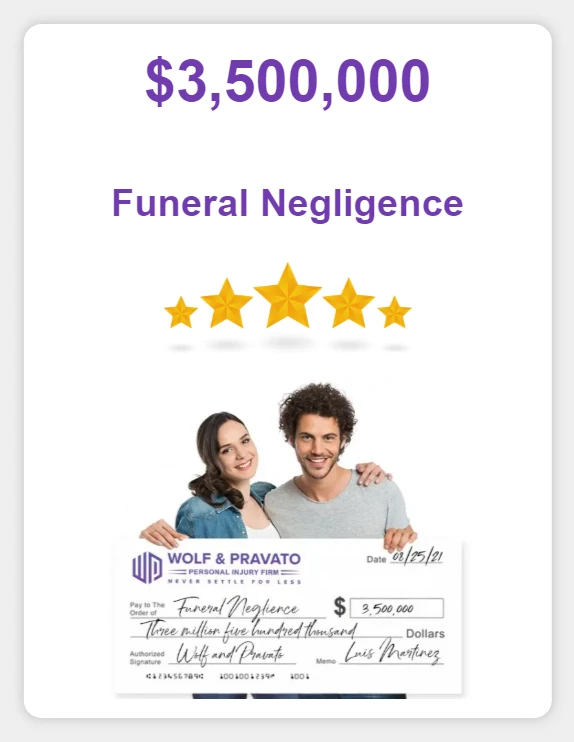
Families across Lakeland and the surrounding Polk County communities trust the Law Offices of Wolf & Pravato because of our experience handling funeral-industry negligence cases, our willingness to take cases to trial when the evidence warrants it, and the personal attention we give to every family. Our firm obtained a $3.5 million Palm Beach County jury verdict against a funeral home and a separate seven-figure punitive damages verdict in another funeral-industry case — a record that signals to insurers that our cases are prepared for trial from day one.
- Experience — decades of representing seriously injured Floridians and grieving families across the state, including complex funeral home and wrongful death litigation.
- Expertise — we work with forensic pathology, mortuary science, and funeral-industry standards-of-care experts to build evidence-based cases that hold up at trial.
- Authority — we are one of the few Florida law firms with substantial trial experience against funeral homes, crematories, and cemetery operators.
- Trustworthiness — contingency-fee representation. You pay nothing unless we recover compensation for your family.
- Personal attention — you work directly with attorneys who know your case, not a call center.
Richard Paul Pravato is a founding attorney at the Law Offices of Wolf & Pravato. He is licensed by The Florida Bar (Florida Bar #86150) and has dedicated his career to representing injury victims and grieving families throughout Florida.
Speak With a Lakeland Unauthorized Embalming Lawyer Today
If you believe a funeral home, crematory, or cemetery in Lakeland or the surrounding Polk County communities embalmed your loved one without consent, embalmed despite your family’s religious or personal objections, or obtained authorization from the wrong person, do not wait to get answers. Florida’s deadlines are strict, and key evidence can be lost over time.
The Law Offices of Wolf & Pravato offers a free, confidential case evaluation. There is no cost to talk with us, and no fee unless we recover compensation for you. You can request a free case evaluation online anytime.
Call our team today at (954) 633-8270 to schedule your free consultation. Our Lakeland funeral home negligence attorneys will review your family’s case, explain your rights, and pursue the compensation your family deserves.
Frequently Asked Questions
What does Florida §497.385 require for embalming?
Florida Statute 497.385 requires that a licensed funeral establishment obtain authorization before embalming human remains. The authorization must come from the legally authorized representative — typically the surviving spouse, then adult children, then parents, and so on. Embalming without that authorization violates Florida law.
The funeral home says embalming is ‘automatic’ for any body it receives. Is that true?
No. There is no ‘automatic’ embalming under Florida law. The funeral home must obtain authorization before embalming, regardless of whether viewing is planned or whether the family has selected a service package. A funeral home that embalmed without obtaining authorization has violated §497.385.
Our religion does not permit embalming. The funeral home embalmed anyway. Do we have a case?
Yes. When a family has communicated that embalming is not permitted — for religious, personal, or cultural reasons — a funeral home that embalms anyway has violated both the Florida embalming consent statute and any contract terms that incorporated the family’s instructions. These cases can support claims for emotional distress and, in some cases, punitive damages.
How long do I have to sue for unauthorized embalming in Florida?
General negligence and intentional infliction of emotional distress claims must generally be filed within four years under Florida Statutes Section 95.11.
Can I recover punitive damages for unauthorized embalming?
Where the funeral home’s conduct meets the gross negligence or intentional misconduct standard under Florida Statute 768.72, punitive damages may be available. A funeral home that embalmed despite explicit family instructions not to may meet that standard.
The funeral home offered a refund. Should we accept it?
Do not accept a refund or sign any release without consulting an attorney first. A refund typically requires the family to release future claims, and the harm from unauthorized embalming is rarely captured by a partial refund.
What does it cost to hire Wolf & Pravato?
Nothing upfront. Contingency-fee representation. No fee unless we recover compensation for your family.
Recent Posts
- Wrong Burial Plot and Grave-Site Errors in Fort Lauderdale

- Rainwater Falls at Fort Lauderdale Store Entrances

- Parking-Lot Backing Crashes in Fort Lauderdale: Who Has the Right of Way?
- Elevator and Escalator Injuries at Fort Lauderdale Shopping Centers
- Delivery Driver Car Accidents in Lakeland: Who Pays?

- Injured as a Passenger in Fort Lauderdale: Whose Insurance Pays?





FLORIDA’S PERSONAL INJURY ATTORNEYS FOR + 20 YEARS