Do Pedestrians Have the Right of Way in Florida? Not Always
 By Richard P. Pravato, Board Certified in Civil Trial Law Published November 18, 2026
No. Florida gives a person on foot the right of way in some places and takes it away in others, and where you were standing decides which. Almost everybody believes a walker always has it. An adjuster uses that belief against you in the first call.
Two rules run at once, and the adjuster quotes only the first. One decides who had the right of way. The other tells every driver to try not to hit you anyway, even where you were in the wrong.
The clock is the real problem. Florida gives you 2 years to sue, and nothing like 2 years of proof. The longer you wait, the more of the traffic light records and corner footage is already written over.
November makes that worse. The clocks went back on November 1, so the drive home now happens in the dark. Of the people killed walking in 2024, 73 percent died between 6 in the evening and 6 in the morning.
By the time most of our clients call us, the driver's insurance company has opened a file. The people on it handle these claims for a living, and they have resources you do not.
My name is Richard P. Pravato, and our Florida pedestrian accident lawyers bring these claims against the driver, the vehicle's owner and the employer behind both. So let me walk you through it step by step, so by the end you will know where you were standing in the eyes of the law, what your own mistake costs you, which proof goes first, and what the law pays for when somebody does not survive.
Key takeaways
- Inside a crosswalk in Florida, the driver has to stop for you. Outside one, you have to let the traffic through.
- A pedestrian who was partly to blame still collects money, unless a jury puts more than half the blame on them.
- You have 2 years from the date of the crash to sue in Florida.
Do pedestrians always have the right of way in Florida?
No. You have the right of way inside a crosswalk, and you lose it the moment you step outside one. Florida writes its pedestrian right of way laws situation by situation, which is why two people hit on one street get two different answers.
Most people picture a crosswalk as white paint. Florida crosswalk law does not. At any ordinary intersection it treats the space between the sidewalk edges as a crosswalk whether anybody painted it or not. That is an unmarked crosswalk, with the same rights.
Step into the road away from a crossing and the rule flips, because there you let the traffic through.
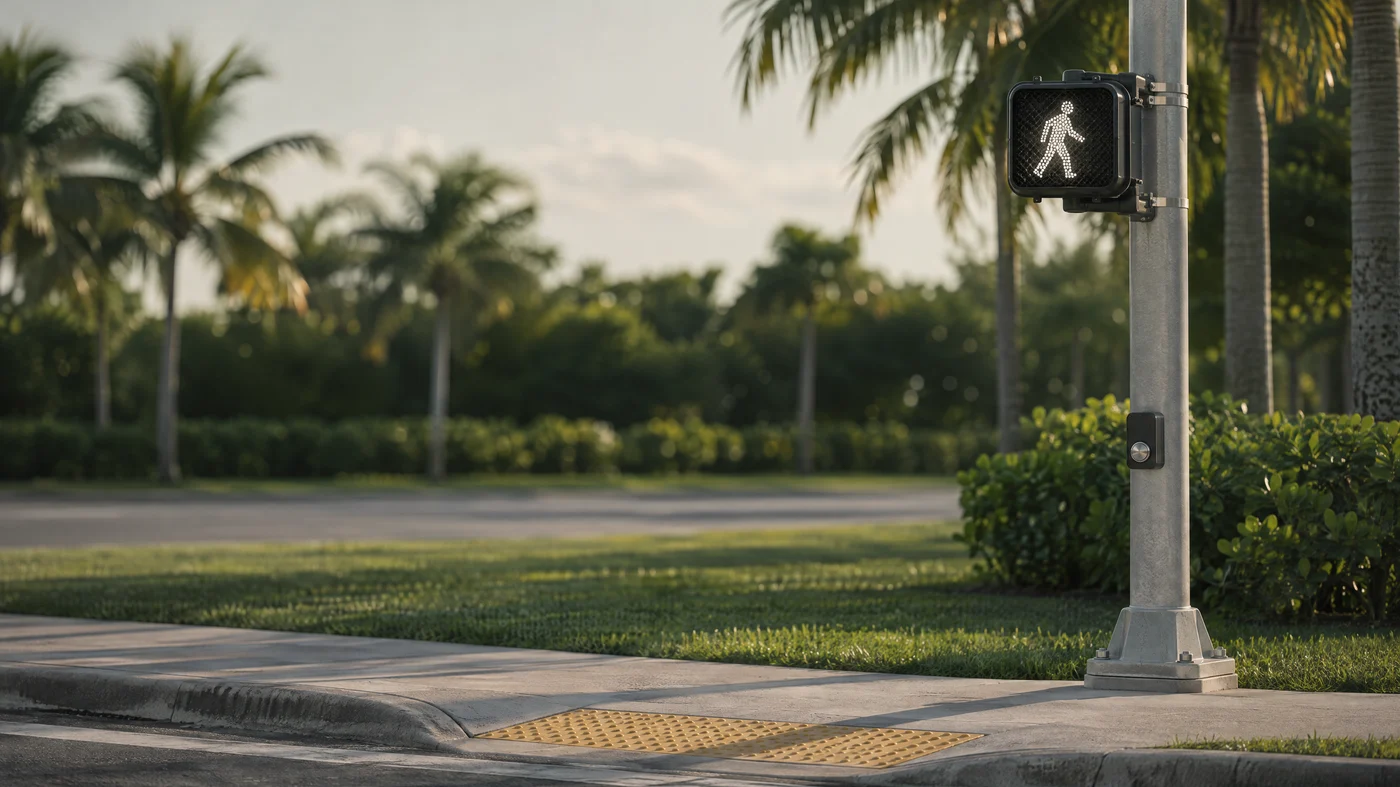
Here are the two places photographed, a painted crossing and a stretch of road away from one:

That second rule catches people out. It holds no matter where you were standing. Florida Statute 316.130(15) tells every driver to "exercise due care to avoid colliding with any pedestrian", whatever the paint says and whatever you did wrong. So a driver who never looked cannot use your mistake as a shield.
Breaking that rule carries a price. The state sets a minimum citation of $164 and three points for a driver who fails to stop for a person crossing. The same agency counted 12,760 pedestrian crashes in Florida in 2025, and 652 people died in them.
Step one) Work out where you were standing when it happened
You were standing in one of five places when it happened, and each place hands the duty to a different person. Florida pedestrian laws split the road that way, so find your row below.
Three of the five protect you. You crossed on a walk light, or at a corner with no working light, or you were already out in the road when the car reached you. The other two put the duty on you, and insurers reach for the last one most.
| Where you were | Who had to wait | Florida law |
|---|---|---|
| In a crossing, with a walk light or a green light | The driver, including a driver turning left or right | 316.130(7)(a) |
| In a crossing, no working light | The driver, once you are on their half of the road or near enough to be in danger | 316.130(7)(c) |
| Crossing anywhere that is not a crossing | You | 316.130(10) |
| Between two intersections that both have working lights | You, and you have to use the painted crossing | 316.130(11) |
| You left the curb in front of a car too close to stop | You | 316.130(8) |
What happens if you guess the row wrong on a recorded call? The difference between row two and row three is the whole claim, so call a lawyer before you tell anybody which one you were in.
Step two) Find out what your own mistake actually costs you
Your own mistake costs you a percentage of the money, right up to the point where it costs you all of it. A jury puts a number on your share of the blame, and that number comes straight off what you collect.
Say a crash is worth $200,000 and the jury puts 20 percent of the blame on you for stepping out early. You take home $160,000 instead, because Florida splits fault by percentage.
One number ends the claim outright. Florida law 768.81(6) says a person more than 50 percent at fault for their own harm "may not recover any damages". At 50 percent you still collect half. At 51 percent you collect nothing.
That rule arrived in March 2023, and it is why older articles about pedestrian claims are now wrong. Before it, a person 80 percent to blame still collected a fifth. So a pedestrian one point over that line can lose everything, and moving a jury from 55 percent to 45 is the whole fight.
People call this jaywalking. Jaywalking is not illegal in Florida as a crime, and the state's traffic code never uses the word anywhere in it. Crossing outside a crossing breaks row three of the table above, and the law calls that a noncriminal traffic infraction, the same family as a parking ticket.
Breaking that rule does not end your claim either. It gives the other side a percentage to argue for, and nothing more. Our article on hitting someone crossing outside a crosswalk runs the same percentages from the driver's side. Here is what your share of the blame does to a $200,000 case:

Step three) Save the evidence before somebody records over it
Save five things, and start with the ones that disappear in weeks rather than years. All five exist on the day of the crash, and fewer of them exist every week after it.
The traffic light decides the argument more often than any witness does. The agency that runs the intersection keeps timing records showing how long the walk light stayed on and when it changed. Nobody holds them for you.
Video is next, and it rarely comes from one camera. A city camera may cover the corner, and a shop may cover the sidewalk outside its door. A bus at the stop and the car behind may both have been recording.
A commercial vehicle carries its own record. Delivery trucks, buses and work vans run cameras and tracking systems logging speed, braking and the moment of a turn. The company owns that data and deletes it on its own schedule.
Phone records and witnesses finish the list. The driver's records show whether a call was live at the moment of impact. Witnesses move, change numbers and stop being sure, so a statement taken in the first week beats the same memory a year later.
A preservation letter stops the deleting, and the first week is when it has to go out. Our office sends one within days, naming the date, the hour, the intersection and the vehicle.
Florida law 95.11(5)(a) still gives you 2 years to sue. If you wait a year to start, the footage is gone and the claim is alive with nothing to run it on. So which crash keeps producing these cases?
Why a right turn is the most dangerous moment for a person on foot
A right turn is dangerous because the driver is looking the wrong way. To turn right into traffic, a driver watches the left for a gap. The crossing they are about to drive through sits on their right.
If the vehicle is a truck or a bus, the problem doubles. A high cab and a long hood hide a stretch of road beside the passenger door. A person can stand right there in the crossing, doing everything correctly, and never be seen. If you wait for eye contact, it never comes.
Florida law does not take that as an excuse. Under Florida law 316.075(1)(a), traffic on a green light, "including vehicles turning right or left", has to wait for people lawfully in the intersection. No driver can wait for somebody they never looked for.
From above, the driver's problem is easy to see. They are looking left for a gap while the crossing sits on their right.

One of our own cases is exactly this. Our client was 19. He rode his bike toward a large intersection on Broward Boulevard, got off at the corner, and waited.
A large commercial vehicle pulled up beside him, indicating right, and its driver watched the left for a gap. The walking figure came on. Our client stepped into the painted crossing with the bike beside him, and the driver turned without ever looking right. Our client died.
Nothing about those facts was unclear. Our client waited his turn, crossed on the light and stayed inside the painted lines. The company still refused to accept responsibility, so we filed suit in Broward County and fought for years, until we won the maximum recovery available for the family. The amount is confidential.
A commercial vehicle also widens who answers for the crash. An employer can be responsible for an employee who causes one on the job, and Florida has a rule that can put a vehicle's owner on the claim too. That is why a commercial vehicle claim is investigated differently. Our client was walking a bike, and families ask us about the bike constantly.
Does walking a bike through a crosswalk make you a pedestrian?
Yes, a person who gets off the bike and walks it keeps every right a person on foot has. Florida sets out what a pedestrian is in three words, and Florida law 316.003 says it means "any person afoot". Nothing in those words cares what you are pushing beside you.
Riding is not the same as walking. A person who stays in the saddle on the road gets the rights and the duties of a driver, so the fight turns into your lane, your lights and the direction you were headed.
A third rule helps riders more than either of those. Florida says a person riding across a road along a crosswalk has the rights and duties of a pedestrian, so you keep the crossing rules in the saddle.
That difference is worth money. An insurance company that can call you a vehicle gets to argue about your lane. One facing a person in a crossing has to explain why its driver did not stop.
So the adjuster asks early whether you were riding or walking. Answer honestly and let our Florida bicycle accident lawyers take the next call. Electric bikes sit in their own group, under rules in our guide to Florida electric bike laws. Some of these crashes leave nobody able to bring a claim at all.
When a pedestrian dies, who files the claim and what does it pay for?
A court-appointed personal representative files it, not the family. Florida splits what the case pays into three parts: the family's grief, the bills they paid and the money the person would have earned.
A personal representative is the person a judge names to stand in for someone who has died, usually a spouse, a parent or a grown child. Until then nobody can file.
Parents of a dead child can recover for their own grief. Florida then sets out what a child is in a way nothing else does. A child here means anybody under 25, and Florida law 768.18(2) says so in those words.
Our client, then 19, was a legal adult in every other part of his life. For this case his parents still counted as the parents of a minor child. Had he been 25, they could claim for their own grief only if no other survivor existed.
Two more groups cover the bills, and Florida law 768.21 lists them. A relative who paid the medical or funeral bills can get that money back. The estate can claim what the person would have earned over a working life.
The deadline runs from the death rather than from the crash. Florida law 95.11(5)(e) gives a family 2 years, so a grieving family has to pick a lawyer sooner than anybody should have to. Our Florida wrongful death lawyers take the court paperwork off them where we can.
What it looks like once this is handled
Once this is handled, the adjuster stops calling you. The letters go to your lawyer's office instead, and the claim number stops being the thing you lie awake thinking about.
The hospital bill sits closed instead of turning into a collection letter. The missed shifts, the drives to therapy and the care you still need in a year all go into one claim.
Ask your lawyer for the date your 2 years runs out and put it in your phone. After that there is one number to call, and it is not the insurer's.
How we work a Florida pedestrian claim
We start in the first week, because the records and the corner footage are already counting down. Our first letters go to three places: the agency that runs the lights, the driver's insurer and the firm that owns the vehicle.
Then we go and look. We measure the crossing and photograph the view from the driver's seat, which shows what they could and could not see. A truck or a bus adds the camera files, the tracking data, the hiring file and the training records.
These cases earn that effort. One pedestrian client of ours, hit by a car on a Florida road, recovered $3,850,000 in compensation.
Our five offices sit in Fort Lauderdale, Miami, West Palm Beach, Boynton Beach and Fort Myers. A review costs nothing, and we only get paid if you do.
Pedestrian right of way questions we get asked
Who pays my hospital bills while the claim runs?
If you were hit by a car while walking, your own car insurance usually pays first. The cover is called personal injury protection, and it follows the person rather than the car. If nobody in your home has it, the insurer for the car that hit you pays. See a doctor within 14 days or you lose it.
Do pedestrians have the right of way in a parking lot?
Florida's traffic code mostly stops at the edge of a private lot, so the crossing rules above do not decide it. The question turns into whether the driver was careless. Our guide to parking lot accidents works through it.
What if the driver drove off and nobody got a plate?
You may still have a claim against your own insurer, under what is called uninsured motorist cover. It is optional in Florida, so read your policy rather than assume. The hunt for the car stays live, and corner footage usually finds it.
Related reading
 Road Accidents

Pedestrian Crashes at Florida Highway On- and Off-Ramps
Richard P. Pravato  Road Accidents
Elderly Pedestrian Injuries in Florida: Higher Stakes, Bigger Damages
Richard P. Pravato 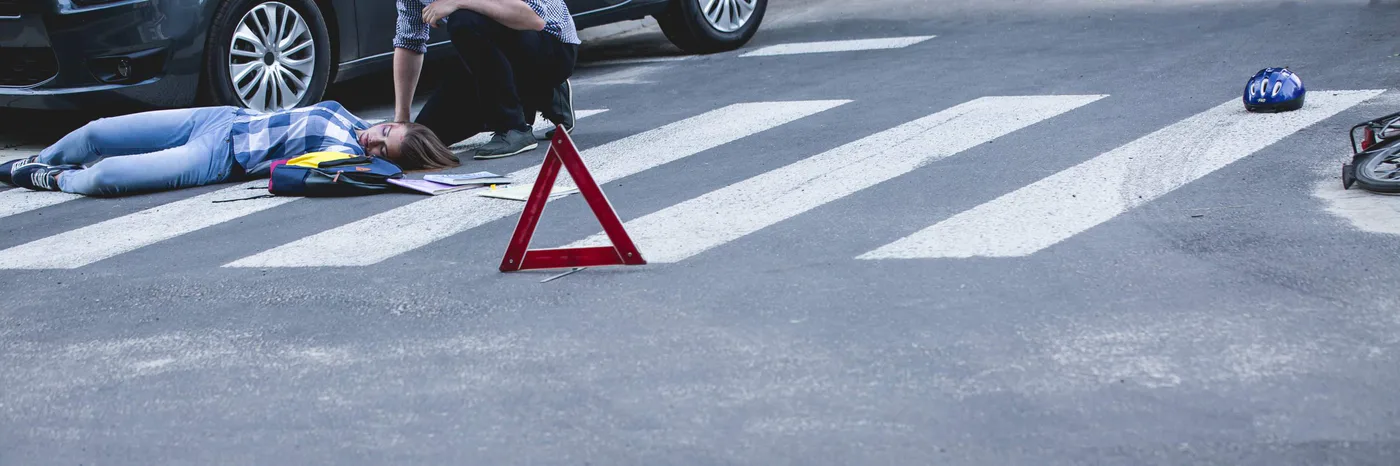 Road Accidents
Pedestrian Hit in a Florida Parking Lot: Backing and Low-Speed Crashes
Richard P. Pravato