
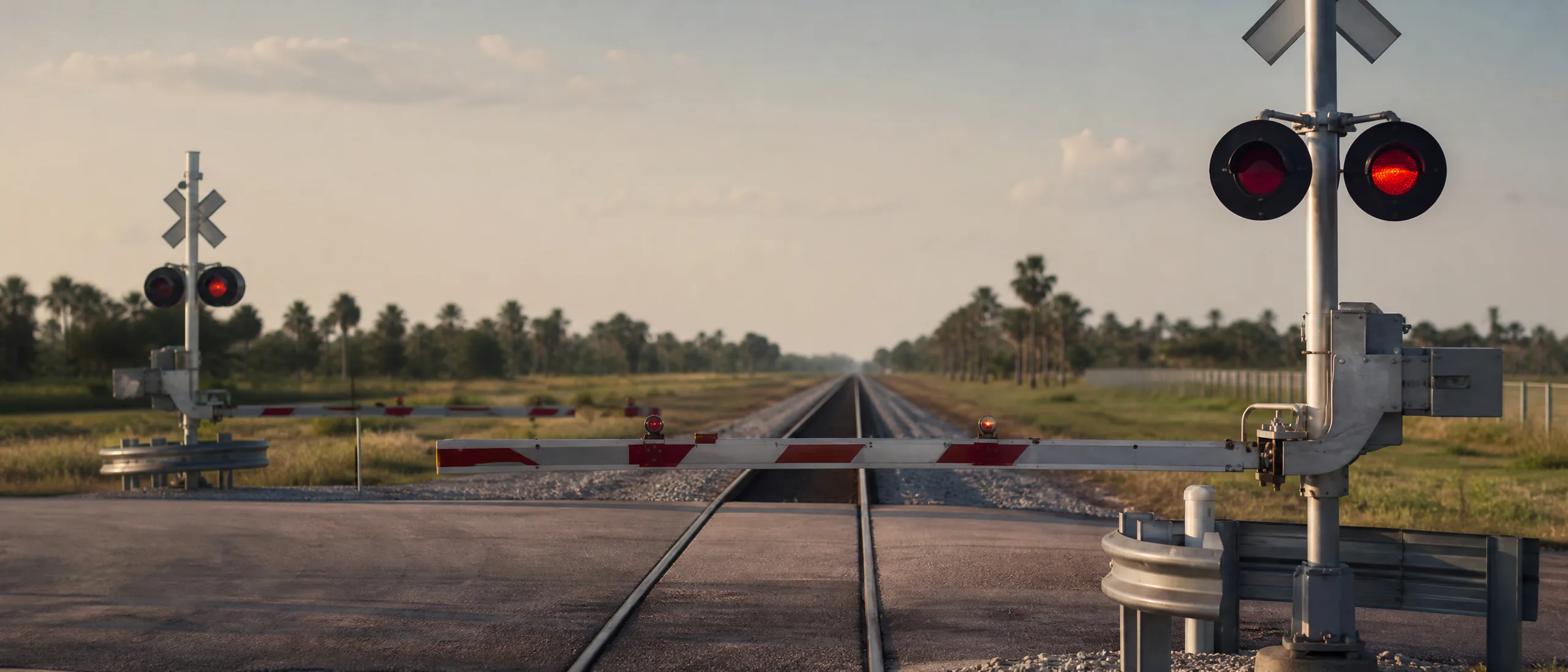
West Palm Beach Train Accident Lawyer
A train accident runs under federal rules as well as Florida’s. We work both, and go after the data the railroad holds. We can take it from here. Call 833-370-8692 for a free consultation. You pay us nothing unless we win. Our West Palm Beach personal injury lawyers have taken these cases across Palm Beach County since 1993.
Train Accident claims in West Palm Beach
A railroad has its own police force, its own investigators and its own event recorders, and all three are at work on a crash long before anybody contacts the people who were hurt. Meanwhile you are dealing with the hospital, the time off, and an account of events built entirely by the company involved. Getting at the signal and recorder data is our job, and we start the day you call.
Between Boca Raton and the north end of the county the FEC alignment runs parallel to the coastal road grid, crossing at grade repeatedly through built-up areas. The addition of frequent high-speed passenger service to a corridor that previously carried mostly freight changed the risk profile of every one of those crossings, and pedestrian claims are a substantial part of the caseload alongside vehicle ones. Where a crossing is in poor condition, or where signals or gates malfunctioned, the responsible party may be the railroad, a contractor, or the local authority responsible for the approach.
The coastal rail corridor runs the length of Palm Beach County with crossings every few blocks, and a second corridor west of it carries commuter and intercity passenger service. Pedestrian claims are a large share of the caseload here. Most claims carry a two-year deadline, and the evidence clock is shorter.
What to do after a train accident in West Palm Beach
- Photograph the crossing before anything is repaired. The gates, the lights, the crossbuck, the road surface over the rails, and the view up the track in both directions from where a driver actually sits. A crossing gets attended to after a collision, and the version of it that caused the collision stops existing. Stand back far enough to show what was growing beside the track and what was parked near it, because an obstructed sight line is measured from a point rather than described.
- Get the demand out for the event recorder and the forward camera. A locomotive records speed, throttle, brake applications and horn, and most carry a forward-facing camera. Under 49 CFR § 229.135 the duty to preserve that data expires one year from the date of the accident unless the agency asks for it. None of it is automatic. Sending the written demand is the most useful thing done in the first month.
- Write down what you heard, and when you heard it. Whether a horn sounded, how long before the train arrived, and whether the lights were flashing when you reached the crossing. Do it the same day and take it from every passenger separately. Horn timing is regulated to the second, so an account written at the time is evidence rather than a memory argued over at a deposition two years later.
- Get medical care the same day. Rail collisions deliver more force than road collisions, and the injuries that decide a case are frequently not the ones treated at the scene. Head injury, spinal injury and internal bleeding all present late. A gap between the collision and the first medical visit is the most common argument made about how badly somebody was hurt.
- If you work for the railroad, get advice before the statement. A claim agent will reach an injured railroad employee quickly, sometimes at the hospital, and will ask for a recorded account and a signature. Railroad employees are not in the state compensation system. They are in a federal negligence claim worth considerably more, and what gets said in the first hours is used in it. Ask for time.
Where these happen in West Palm Beach
Palm Beach County has more at-grade street crossings than any other market this firm serves, and they sit inside a built-up road grid rather than out in open country.
-
The coastal corridor through the downtown grid
The eastern alignment runs parallel to Dixie Highway and crosses the numbered streets and the main east-west roads at grade.
- Crossings a few hundred feet apart in places, each with its own signal equipment and its own history
- High-speed passenger service added to a corridor that used to carry mostly freight
- Quiet zones through much of the built-up length, which changes what the absence of a horn means
- A private corridor owner and a private operator, with no damages cap
-
The western corridor and the station district
The commuter and intercity alignment runs west of the downtown grid and carries three different passenger operations on the same track.
- A publicly operated commuter service, with sovereign immunity limits and a notice condition
- Intercity passenger service run by a separate national operator
- Freight on the same rails outside passenger hours
- Platform, boarding and station claims rather than crossing collisions
-
Pedestrian claims along the corridor
A substantial part of the rail caseload in this county involves somebody on foot, near or on the tracks, in a residential block.
- Where fencing exists along the corridor and where it stops
- Crossings people use routinely that were never built as crossings
- Lighting and sight lines on the approach the person actually took
- Whether the horn sounded, and whether the corridor there is a quiet zone
-
The crossing itself as the defect
Several of these claims are not about the train at all, but about the condition of the crossing it ran through.
- Gates and lights that failed to activate, or activated late or partly
- A history of false activation at the same crossing, which teaches drivers to ignore it
- Humped and rough crossing surfaces that ground a low vehicle out on the rails
- Responsibility split between the corridor owner, a signal contractor and the road authority for the approach

What causes them
- Crossings marked with a crossbuck sign alone, with no lights and no gate
- Vegetation, parked rail equipment and structures blocking the view up the track
- Humped and rough crossing surfaces that ground a low vehicle out on the rails
- Short road approaches where traffic backs up across the tracks with nowhere to go
- Horns sounded late, sounded briefly, or not sounded where a horn was required
The injuries we see, and what each one turns on
Spinal cord injury and paralysis
The injury that changes every part of a life at once, and the one where a settlement has to carry decades of care rather than a course of treatment. A life care plan costed by a professional separates a real figure from a guess, and it is built from the treating physicians rather than an insurer’s estimate.
Amputation and crush injury
Rail equipment does not yield. Limb loss brings prosthetics replaced on a schedule rather than bought once, revision surgery, and a home and a vehicle that have to be changed to work. Each is a separate head of loss and each is regularly left out of a first offer.
Burns
Fuel, and on freight operations the load itself, put burns into this practice that road cases rarely produce. Treatment runs for years through grafting and revision, and the scarring is a distinct claim from the medical cost.
What Florida law requires you to prove
A federal layer sits over the state claim
Railroad safety is regulated federally, and 49 U.S.C. § 20106 requires that regulation be nationally uniform so far as practicable. Carriers read that as ending state claims and it does not. The same statute preserves a state action for injury or death where the railroad failed to meet the federal standard of care, failed to follow its own rule made under a federal regulation, or breached a compatible state requirement. Which of the three a case runs on is decided early, and it shapes what gets asked for.
The warning system, and what happens when it fails
A system that fails to activate is covered by 49 CFR § 234.105, and one that activates when it should not by 49 CFR § 234.107. Both require the railroad to warn its crews and law enforcement and to protect the crossing another way: with a flagger for each direction of traffic a train may run at normal speed, with partial coverage it may not exceed 15 miles per hour, and with none it must stop and be flagged through. Whether that happened is documented.
The horn, and the places it is silent
Under 49 CFR § 222.21 the horn begins at least 15 seconds and no more than 20 seconds before the locomotive enters a crossing, in a pattern of two long, one short and one long. Communities can establish quiet zones where routine sounding stops, and 49 CFR § 222.35 sets what has to be in place first, including gates and flashing lights to the national standard and signs telling drivers no horn will sound. South Florida has a great many. Quiet zone status changes what a missing horn means, so it is established first rather than last.
What the driver owed, and what a claim is worth
Florida drivers must stop between 15 and 50 feet from the nearest rail when a signal warns of an approaching train, when a gate is down, when a flagger signals, or when a train is plainly visible and in hazardous proximity, under Fla. Stat. § 316.1575. That duty sits alongside the railroad’s. Fault is shared under Fla. Stat. § 768.81, where somebody more than 50 percent responsible recovers nothing, and most claims arising on or after March 24, 2023 carry a two-year deadline under Fla. Stat. § 95.11.
Railroad employees are in a different system entirely
A railroad worker hurt on the job is not in workers’ compensation. Under 45 U.S.C. § 51 the carrier answers for injury resulting in whole or in part from the negligence of its people or a defect in its equipment, track or roadbed. Negligence has to be shown, which compensation does not require, and in exchange the claim pays full damages including pain and suffering. Under 45 U.S.C. § 53 the worker’s own carelessness reduces damages but never bars the claim, and counts for nothing where a safety statute violation contributed. The deadline is three years under 45 U.S.C. § 56, in state or federal court.
The full statutory detail, and the parts that differ by claim type, sit on our statewide train accident page rather than being restated in every market.
How we prove it in Palm Beach County
Almost everything that decides one of these cases is held by the railroad, and none of it arrives by asking politely on the phone.
- The locomotive event recorder and the forward-facing camera, demanded in writing in the first weeks
- Signal maintenance, inspection and activation failure records for that specific crossing
- The quiet zone application and approval for that stretch, and the safety measures it required
- Vegetation control records, and photographs of the sight line from where a driver actually sits
- Crossing surface and approach maintenance records
- Dispatch records, radio traffic and the crew’s reports
- Fencing and corridor access records where somebody was on foot
- Camera footage from businesses and traffic systems near the crossing, on a short overwrite cycle
The preservation duty for recorder data expires a year after the accident, and the crossing itself gets repaired far sooner than that. The demand is the first piece of work in the file.
Who would handle your case
Being hurt in West Palm Beach is hard enough without working out the legal side on your own. The trial lawyers below have handled train accident claims across Florida since 1993, and one of them will take yours from the first call to the last check. They will tell you what your case is worth and why, and they will be straight with you about the parts that are hard.
-
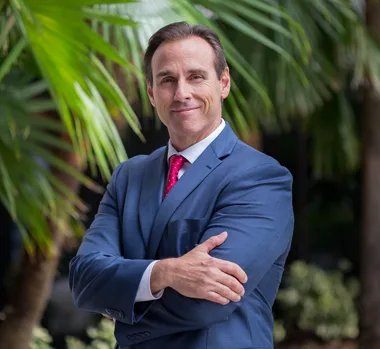 Richard P. Pravato Founding & Managing Attorney Board Certified in Civil Trial Law by The Florida Bar since 2004, and by the National Board of Trial Advocacy. Injury cases exclusively since 1996. Full profile →
 -
 Brett J. Yonon Senior Trial Attorney Selected to Florida Super Lawyers in 2024 and 2025. Brett Yonon is who this firm puts on a catastrophic injury or a death in the family, and he has tried those cases to verdict. Full profile →
How insurance companies handle these claims
A railroad does not behave like a car insurer. It has its own investigators on scene within hours, its own claim agents, and lawyers who defend these cases for a living and have defended them at this exact crossing before.
- The train could not possibly have stopped
- Usually true and usually beside the point. A freight train needs close to a mile, which is why the case is about the warning rather than the braking: whether the gates worked, whether the horn sounded when it should have, whether the sight line was clear, and whether the speed suited the protection there. Stopping distance is the reason the railroad’s duties sit upstream of the moment.
- We have reviewed the recorder data
- They have, within days, and the family has not. The event recorder, the forward camera, the dispatch and radio record and the crew’s statements are the case, and the preservation duty for recorder data runs out a year after the accident. An early written demand is what turns a review they did into a record you can read.
- This is a workers’ compensation claim
- Not for a railroad employee. It is a federal negligence claim with a three-year deadline, full damages including pain and suffering, and a rule that the worker’s own carelessness reduces the recovery rather than ending it. The mistake is usually made in the first week, by somebody filling in the form they were handed.
What a claim can include
Lost income and lost earning capacity
Wages missed, and separately what somebody can no longer earn for the rest of a working life. For a railroad employee the calculation runs against a specific pay scale and a specific pension, which makes it more concrete than in most cases.
Pain, suffering and loss of the ability to enjoy life
The largest head of loss in a serious rail case and the one an early offer prices lowest, because it is the one with no invoice attached.
Scarring and disfigurement
A separate claim after burns or amputation. Photograph the healing as it happens, because a record of what it looked like at three weeks does not exist unless somebody made it.
Why Wolf & Pravato in West Palm Beach
A Palm Beach County rail case is filed in the Fifteenth Judicial Circuit in West Palm Beach, and the firm’s office on Vista Parkway is in the county rather than across the state. These claims routinely involve a corridor owner, an operator, a signal contractor and a road authority at once, and holding all of them in one case is what keeps the file moving.
Board Certification in Civil Trial law is the Bar’s own measure of trial experience, and 861 of Florida’s 109,000-plus lawyers hold it. Richard Pravato has held it since 2004. It is the credential that changes how an adjuster reads a file, because it says the case has somewhere to go if they will not pay it.
Asking costs nothing and there is no fee unless we win. If we look at what happened and think the claim is not worth pursuing, we will say so on the first call instead of signing you up.
West Palm Beach train accident questions
The crossing gates in my neighborhood go down for no reason all the time. Does that matter?
It matters a great deal. Repeated false activation at a crossing is a documented condition with its own federal response requirements, and it is also the mechanism that trains drivers and pedestrians to treat a real warning as another fault. The signal maintenance record for that crossing shows the history, and it is one of the first things requested.
A family member was killed on the tracks and we were told there is no claim.
That answer is given far too quickly in this county. Fencing and where it ends, established informal crossings the railroad knew about, lighting, sight lines and horn use are all part of the analysis, and none of them is settled by the word trespass. These are hard cases and they are worth having looked at properly rather than closed on a phone call.
Which operator was it? We could not tell.
Most people cannot, and it changes the case completely. The publicly run commuter service carries a $200,000 limit and requires written notice before suit. The private corridor operator and the national intercity operator carry no cap and follow ordinary deadlines. The corridor, the time and a photograph of the equipment are usually enough to settle it in the first conversation.
I was hurt as a passenger on a train. Is that different?
Yes. A passenger claim does not involve the crossing questions at all and generally turns on the carrier’s duty to its passengers, covering matters such as sudden stops, platform gaps, door operation and boarding. It is a more conventional claim, though the operator may still be a government entity with notice requirements.
The crossing gates were down. Is the case hopeless?
Not automatically. Whether the gates and lights operated correctly, how much warning time they gave, whether the train sounded its horn as required, and whether sight lines were obstructed are all separate questions with documentary answers. The gates being down is where the inquiry starts, not where it ends.
The questions that come up on every kind of claim, deadlines, fees, recorded statements and fault, are answered on our Florida injury claim FAQ.
More in West Palm Beach
West Palm Beach Personal Injury Lawyer
Everything we handle in Palm Beach County, and where our office is.
View →West Palm Beach Product Liability Lawyer
Florida product liability lawyers.
View →West Palm Beach Scooter Accident Lawyer
Florida scooter and e-scooter accident lawyers.
View →West Palm Beach Drowning Accident Lawyer
Florida drowning and near-drowning lawyers.
View →
Tell us what happened
A lawyer will listen, tell you what Florida law does with those facts, and be straight with you about whether it is worth bringing. We are at 2101 Vista Parkway, Suite 4500, West Palm Beach, FL 33411.