
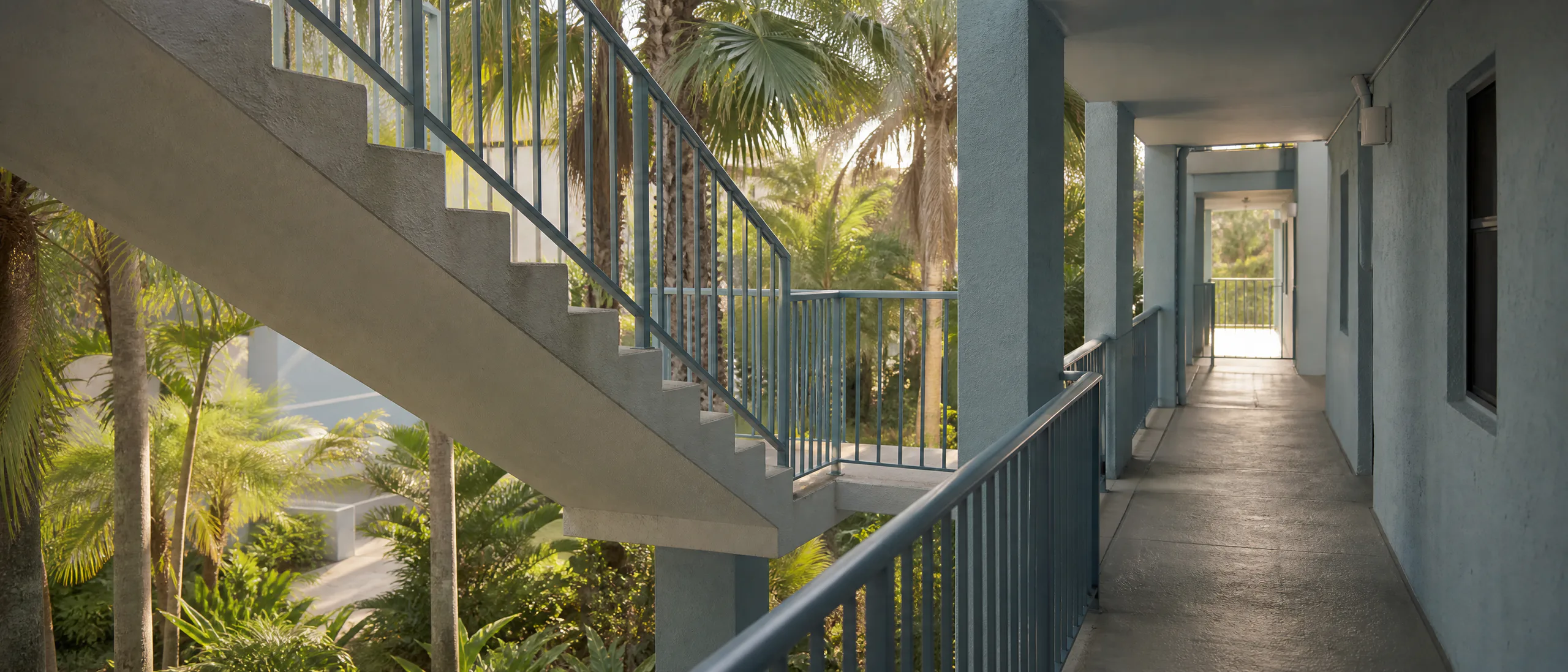
Fort Myers Hotel Accident Lawyer
Resort and vacation rental injuries often involve an operator who is not the owner. We can take it from here. Call 833-370-8692 for a free consultation. You pay us nothing unless we win. Our Fort Myers personal injury lawyers have taken these cases across Lee County since 1993.
Hotel Accident claims in Fort Myers
Lee County's accommodation runs from resorts to condominium rentals and short-let houses, and the party responsible for safety is frequently not the party named on the booking. An owner, a management company, a rental platform's local operator and an association can each hold part of the duty, and each carries separate insurance. Pool areas, docks, stairs and balconies produce most of the serious claims. The listing itself becomes evidence, because what it advertised about the property is relevant to the duty assumed, and listings get edited after an incident.
Who owed you a safe property is rarely one company
Lee County accommodation runs from full resorts to condominium rentals, RV resorts and single houses let by the week, and the duty splits differently in each. An owner, a management company, a rental operator and a condominium association can each hold part of it, and each carries separate insurance. The name on the booking confirmation is frequently none of them.
That is worth untangling early rather than late, because the party that controlled the pool deck may not be the party that controlled the stairs, and a claim aimed at the wrong entity loses time it cannot get back. Screenshot the listing as it stood when you booked. What it advertised about the pool, the fencing, the dock or the beach access is evidence about the duty that was taken on, and listings get edited quietly after somebody is hurt.
The pool is regulated as a public pool, and that is a higher bar
A pool serving a resort, a motel, an apartment building or a cooperative living project is a public swimming pool under Fla. Stat. § 514.011 rather than a backyard pool, which changes what the operator owed. Fla. Stat. § 514.0315 requires every public pool and spa to carry anti-entrapment protection meeting the recognized standard, and older single-drain pools have to carry a further layer on top of it.
So the questions on a Lee County resort pool case are not the fence-and-latch questions that decide a suburban drowning. They are whether the pool held a current operating permit, what the water clarity was, whether the drain covers were the certified ones and when they were last changed, and whether anybody was doing the daily checks the permit assumes. All of that is documented, and the documents either exist or their absence is itself the answer.
Building work on a property that never closed
A great deal of Lee County accommodation has been repaired, rebuilt or expanded while continuing to take guests, and that produces a category of injury the rest of the state sees less of. A guest walking a route that changed yesterday, past an excavation, a lift, a stored pallet or a temporary rail, is being asked to navigate a construction site nobody told them they had entered.
Two parties answer for that, usually. The contractor controls its own work area and what it leaves in it, and the property decides where guests are allowed to walk and what it warns them about. Both carry insurance and both point at the other, which is ordinary. What settles it is the site logbook, the daily reports and the photographs, and those exist because a contractor is required to keep them.
Docks, ramps and the water side of a resort claim
Waterfront accommodation on the Caloosahatchee and along the Gulf beaches carries a set of hazards the hotel category does not usually cover: fixed and floating docks, boat ramps, kayak and paddleboard launches, seawalls and the drop into water whose depth is not what it appears to be. This firm resolved a confidential settlement for a serious neck injury from a dive off the dock of a Fort Myers rental on the Caloosahatchee, on a failure to warn that the water was shallow and murky.
Storms reshape all of it. A riverbed or a beach profile after a hurricane is not the one in last season’s photographs, and a dock rebuilt to a new height changes what a person stepping off it is dealing with. That is an argument for looking at the property quickly, because the version of it that caused the injury may not survive the next season.
Where your case would be handled
Our office is at 1825 Colonial Blvd, Fort Myers, FL 33907, and a claim arising here is filed in the Twentieth Judicial Circuit at the Lee County Justice Center.
The law that decides it
The statutes, deadlines and proof requirements for a premises liability claim are the same anywhere in Florida, so they live once on our florida premises liability lawyer page rather than being restated on every city page. What changes locally is the court, the evidence and who you are dealing with, which is what this page covers.

Our team will not let you go through a hotel accident claim alone
Getting hurt somewhere you had every reason to feel safe is hard enough without the owner acting like it never happened. Nothing undoes the injury, and we will not pretend otherwise. What we can do is make the owner answer for a danger they already knew about, and we will take the case as far as it has to go.
Our trial attorneys have been trying Lee County cases together since 1993, and one of them works your Fort Myers claim from the first call to the last check. A case filed here goes to the Twentieth Judicial Circuit at the Lee County Justice Center.
Meet the attorneys →Fort Myers hotel accident questions
It was a vacation rental, not a hotel. Who is responsible?
Potentially the owner, the management company and the local operator, depending on who controlled the property and who handled safety compliance. Screenshot the listing as it appeared when you booked, because what it said about the pool, the fencing or the stairs is evidence about what was promised, and it is commonly changed afterward.
The resort says the pool met code. Does that end it?
No, and it is checkable rather than arguable. A public pool operates on a permit, and the drain covers, the anti-entrapment protection, the clarity readings and the daily logs are all recorded. Meeting code on the day it opened is also not the same as meeting it now, because certified drain covers have a service life and get replaced on a schedule that somebody has to actually follow.
I was hurt walking past construction work at the resort.
Then there are likely two claims rather than one. The contractor answers for its own work area and what it left in the guest route, and the property answers for where it let guests walk and what it told them. Photographs taken that day are unusually valuable here, because a site changes daily and the layout that hurt you may be gone within a week.
The questions that come up on every kind of claim, deadlines, fees, recorded statements and fault, are answered on our Florida injury claim FAQ.
More in Fort Myers
Fort Myers Personal Injury Lawyer
Everything we handle in Lee County, and where our office is.
View →Fort Myers Wrongful Death Lawyer
Florida wrongful death lawyers.
View →Fort Myers Medical Malpractice Lawyer
Florida medical malpractice lawyers.
View →Fort Myers Workers Compensation Lawyer
Florida workers compensation lawyers.
View →
Tell us what happened
A lawyer will listen, tell you what Florida law does with those facts, and be straight with you about whether it is worth bringing. We are at 1825 Colonial Blvd, Fort Myers, FL 33907.